BIRDING ON THE LUNE ESTUARY AND THE FOREST OF BOWLAND...................................CURLEW SANDPIPER/RUFF/LAPWING CONDER CREEK PETE WOODRFF

Thursday, 18 August 2011

Untitled....


....couldn't think of one!

Small Heath. Marc Heath

On a good day weather-wise, save a few 'whites' I saw just four butterflies today, a Small Heath and 3 Red Admiral, all four seen on Harrisend where I found 3 Whinchat, an annual event here if you chose to be there on the right day/s. Also of note, 2 Whitethroat took me by surprise in the lone Hawthorn by the track where a Willow Warbler came within a couple of mtrs as I stood motionless, c.15 Meadow Pipit, a Dunnock, and a Buzzard. From the track to Lane Head I saw 2 Redstart, and at least 20 Mistle Thrush exploded out of one of the brilliant old Oak trees down this track, a Coal Tit also noted.

At Conder Green void of a circuit today, 5 Common Sandpiper, the two drake site-faithful Wigeon were on Conder Pool with little else, c.35 Goldfinch in flight. At Glasson Dock on the Lune Estuary an adult Mediterranean Gull, Spotted Redshank, Greenshank, and in excess of 1,000 Redshank today. I noted the absence of any Bar-tailed Godwit here.

At Cockersands, a small variety of c.1000 waders on Plover Scar consisted of, 5 Whimbrel, up to 100 Ringed Plover, 750 Oystercatcher, 130 Dunlin, 6 Golden Plover, 9 Knot, and 5 Turnstone. Off here were 33 Eider, and 3 Linnet noted on the headland. As I walked towards Bank End to check out the high tide gull roost - which resulted in a nil of interest - an Osprey went over going south west.

The Glorious Twelfth.  

Having been in Red Grouse country this morning I was reminded of the shock and disbelief I had when reading a comment regarding the then forthcoming 'Glorious Twelfth' - a day celebrated by the so called 'Guardians of the Countryside' - from a high profile professional with a dedication to wildlife, which said quote....'Its not a sport I take part in but accept that the Red Grouse we see on the moors are only there because of it'....unquote.....Perhaps you'd like to read through that once again, just to be sure you got it right. 

Wednesday, 17 August 2011

The Sandwich Tern.


Sandwich Tern. Phil Slade

The first British record of Sandwich Tern (ST) goes back as far as 1784 at Sandwich in Kent, the bird was then collected by a William Boys, the bird was sometimes then called Boys Tern....Thanks for the photograph PS. 

The ST is an annual visitor to Preesall Sands during its migration journey to West Africa in mainly late July-late August, though earlier and later records can be found. I visited Knott End on 29 July specifically to see if the ST had started to gather yet and was a little surprised to count at least 230 birds there, a lovely sight of a bird which makes an equally lovely sound.

Oakes reported ST's nesting with Common Terns on the Ainsdale/Formby coast in 1910, 1912, and 1916, as I understand it there have been no attempts since. The ST is always the first 'tern' to be seen in the spring, the average date being the last few days in March, though the earliest date was recorded at Heysham on 13 March 1990, this same site also has the claim of a late record, that of a bird seen on 7 November 1991, but another record during the winter months was of an individual seen off Blackpool in December 1994.

I've not made many notes on ringing statistics and recoveries, but a notable recovery is that of a nestling S.s.acuflavidus - which breed along Atlantic and Gulf coasts - ringed in North Carolina, and was found dead in its first winter in southwest England, another also ringed in North Carolina was found in the Netherlands.

It's a sad fact that trapping is carried out - mainly by children - in West Africa, they use dead fish as bait in a noose trap and in the 21st century this so called 'tradition' still remains widespread. In years when the Sardine is abundant the trapping becomes even more prevalent. It is painfully obvious that there is the need for a high profile in the education of the people of parts of the world where this kind of attitude towards wildlife - in this case the ST - which brings them to trap and kill with no justification. Such an education would not only benefit the birds and their populations, but would also benefit the local fisherman as the very birds they are killing are those which are used as markers of fish concentrations in their seas.

And finally....

White-throated Hummingbird. Colin Bushell

A bit of exotica from a previous trip to Regua in Brazil, the bird is an Atlantic Forest endemic....Thanks CB.


And whilst I'm certainly not good on insects, I reckon images like this one from amateur photographers deserve a lot of credit....Thanks GG.


I'm afraid you have to ignore the video above, apparently there was an error whilst downloading it and I've no idea how to get rid of the thing, in any case it doesn't work anyway.....A Birds2blog boob!!

Monday, 15 August 2011

The Usual Suspects.


Well a few of them anyway.

I've also accumulated quite a number of brilliant images from some birder/photographers I know, the first of today's is....

Merlin. Colin Bushell

My favourite raptor the smart little Merlin which Colin found at Hesketh Out Marsh recently, the caption read 'Magnificent Merlin'....I'll second that.

White-throated Robin. Gary Jenkins

Gary joined the hordes at Hartlepool, Durham in June to see and photograph this little gem which caused quite a stir during its stay there. As for me....I managed to get some time in today but despite some considerable effort uncovered nothing other than a few of the usual suspects in the Conder/Glasson/Cockersands/Bank End area.

At Conder Green it took me thirty seconds to establish Conder Pool to be deserted save two lonesome drake Wigeon. On the circuit I noted 6 Common Sandpiper, at least 80 Redshank with which - when they took to flight - I saw briefly with them a same size wader definitely not a Redshank. I reckon if you're planning a visit here sometime soon you may find a Ruff which I'm refusing to record having lost the bird to view and didn't find again despite trying to. Also noted, 4 Swift over, maybe my last of 2011, and House Martins are still visiting nest at River Winds.

On the Lune Estuary at Glasson Dock which I mistimed - I'm pretty good at mistiming - 'cos the tide was well up but had driven at least 900 Redshank to closer quarters than usual, c.250 Dunlin, 320 Golden Plover, a Greenshank, and 55 Bar-tailed Godwit are a remnant of what they've been during most of the summer here, up to 90 Canada Geese were noted on Colloway Marsh.

The waders at Cockersands were confined to Plover Scar on the high tide and I noted 2 Whimbrel, c.20 Ringed Plover, 10 Dunlin, and a solitary Turnstone, a passing Peregrine Falcon soon changed the landscape....but shouldn't that be waderscape! Eleven Eider seen included two adults and two young, these birds have been seen here on two recent visits 28 July/3 August and have always been in the same area separated from the rest and were three young then, a Wheatear also seen, and a brief raptor in flight and soon over the hedge was Merlin/Sparrowhawk of which I'll plump for the latter. One of the most notable records of the day in my book was that of 18 Greenfinch here.

On Hillam Lane at least 40 Tree Sparrow seen from a moving car. And at Bank End I noted a Common Sandpiper, 2 Black-tailed Godwit, and c.15 distant Linnet on the marsh.

And finally....

Stonechat. Warren Baker

A nice image of the juvenile Stonechat from my man in Kent, the most dedicated patchworker I know....bar none.

Whinchat/ Wheatear. Warren Baker

And....whats the odds on this happening again....a pretty amazing photograph.

Sunday, 14 August 2011

Along came the spider.


The Ladybird Spider (LS) was for many years thought to be extinct in the UK, but in the 1980's a colony was discovered still clinging on. It is a truly amazing creature not only because of its bright red body and four black spots giving rise to its name of LS, but also because it is a creature which leads a fascinating life, not least because they spend most of the time underground where they create silk canopies decorated with the remains of other spiders, ants, and beetles they have previously eaten.

Today conservationists are giving the LS a helping hand by releasing some into one of the most diverse insect and spider habitats in the country at Arne RSPB Reserve in Dorset. These creatures will be yet another addition to a reserve which already plays host to a number of rare insect and spider species which includes....

Silver-studded Blue. Steven Cheshire

The threatened Silver-studded Blue butterfly, and....

Roesel's Bush cricket
Roesel's Bush Cricket. Nick Gadenne 

The Roesel's Bush Cricket which was only discovered at Arne last year, it is quite rare and formerly found only in coastal areas of the south east.

The most interesting and intriguing aspect of all this is the method being used to transfer the LS's which is in empty plastic mineral water bottles, they are apparently the right shape and size for the spiders to make their nests in, they were captured in the heather and moss filled bottles, and having settled in and made their webs, they will be buried in holes in the ground at their new home at Arne.

Being the heathland specialist it is, the LS - along with birds like the Dartford Warbler and Nightjar - has suffered over the years from the loss of its heathland habitat through destruction. More than 90% of lowland heathland has been lost to such things as commercial forestry, development, and agriculture.

So....lots of fingers crossed at this project and the attempt to save the LS.

Last week will go down in my book as the worst for some time and for one reason or another I've done no birding since the exceptionally good and rewarding day I had last Tuesday in the Marshaw/Tower Lodge area in Bowland. I have a feeling if I continue to have these spells of no birding - five days now - and follow the trend of non-bird related posts, there's going to be the need to change the title of Birds2blog to maybe....Wildlife2blog!!

Friday, 12 August 2011

No Go....


....and the Ross's Gull.

For one reason or another the traditional Friday JB/BT/PW jaunt was called off today. I'm housebound and taking antidepressants by the dozen, whilst KT continues to insist its not the end of the world, well....we're all entitled to our opinions.

Ross's Gull. Pete Woodruff. 

So I've been sifting through my photographs and came across a reminder about a gem of a gull which I went to see at Lytham St Annes in April 2008. My resulting photograph may well look initially good, but the camera didn't handle the bright light and the bird appears to be a pure white individual with its plumage detail bleached, in fact the birds upperparts are essentially a soft grey. This unfortunate individual was found dead in the area in May.

For nearly a hundred years one of the great ornithological mysteries of the Arctic was the location of the breeding grounds of the Ross's Gull (RG). The bird had been seen only amongst the pack-ice of the far north and seemed likely to breed only in the high Arctic. In 1905 the Russian explorer Alexandrovitch Buturlin discovered the main breeding area only just within the Arctic Circle, on the Kolyma River delta of eastern Siberia. Subsequent records showed that the RG bred further south often in association with Arctic Tern, Spotted Redshank, Snipe, and Ruff in well-vegetated marshy areas. Had he been alive, it is unlikely that anyone would have been more surprised than James Clark Ross, the man who collected the first specimen of the gull and who undoubtedly associated the bird only with ice and snow. Today it is well established that the RG breeds in north-eastern Siberia, western Greenland, and in northern Canada, the most famous site being at Churchill, Manitoba.  

Although formerly a great rarity in Britain, the RG has been much more regular since 1974 and the first record for Lancashire was that of an adult found on Birkdale shore in January 1983. There was a RG which created an excellent record in 1995 in that it was seen briefly at Fleetwood in January, relocated six days later at Seaforth, and then became the longest staying RG in the country being seen at Seaforth until the last sighting in March almost two months after first being seen in Fleetwood. I myself remember this bird well, it was reported as being seen on the reserve fairly regularly during the day usually only for short periods before flying off inland to feed. The bird would then reappear at dusk to roost, in itself an unusual behaviour in that Seaforth was at the time - and presumably still so today - rarely used as an overnight gull roost, therefore, in relation to all other gulls, this bird had the entire reserve to itself for its overnight stay. I clearly remember a friendly 'Mersey Birder' telling John Leedal and myself all this interesting detail as we waited in anticipation for this gem of a gull to return for one of its predictable 'short periods' during its long record breaking stay here....it did eventually return to our great pleasure and delight.

Birds....they fascinate me in a thousand ways!    

Wednesday, 10 August 2011

Out of time....again!

With the weather set to be similar again tomorrow things not looking all that exciting birding wise at the moment, but always an opportunity to have another sift through history to find some random records.

Swallow on the wire. Geoff Gradwell 

Twelve months ago today I watched c.300 Swallows lingering a few minutes at Conder Green which included a jaw dropping pure white albino type. I can't help wondering if this was a once in a lifetime observation for the species. 

One or two other records of interest noted during the search....

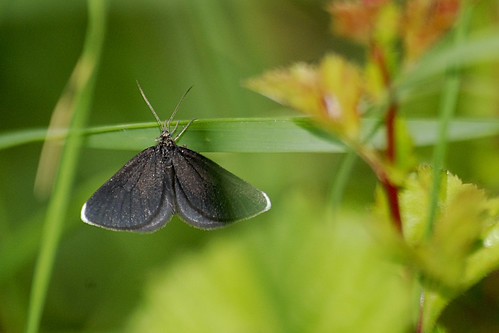
chimney sweep moth
Chimney Sweep. Aileen Urquhart.

The only Chimney Sweep I ever saw was on Hutton Roof on 24 June 2003. A daytime flying moth found in areas of limestone and is completely black save the tips of its forewing, it is local throughout Britain. I noted c.300 Small Tortoiseshell at Cockersands on 10 July in the same year.

On 14 June 2004 I found 9 juvenile Ring Ouzel together at a location in the Forest of Bowland. In the same year, 2 Pectoral Sandpipers were on Conder Pool. On 5 November 2005 I found a Grey Phalarope at Heysham Harbour, and on 11 July at Halforth I saw an amazing 16 Little Ringed Plover, and 12 Clouded Yellow butterflies were seen along the coastal path towards Cockers Dyke from Fluke Hall on 7 August.

Painted Lady. Phillip Tomkinson

An amazing 149 Painted Lady butterflies were found on Clougha/Birk Bank on 30 May 2009. And 2 Wood Sandpiper were on Conder Pool on 4 September 2009.

I'D SOONER BE BIRDING....BUT WHO KNOWS WHEN!

Tuesday, 9 August 2011

Well, that was a good idea!


I only managed half of my plan today as I got quite carried away with my observations in Bowland between Marshaw and Trough Bridge on a visit which turned out to be 'a good idea' and very rewarding. But first one of my - now becoming - regular pics showing the respect some of the natives have for our countryside....

Human Remains in the Forest of Bowland. Pete Woodruff.

It was good to find 10 Spotted Flycatcher still very active between the two aforementioned points, also good to find 8 Redstart including two juveniles, 7 Siskin including good views of a young bird, and 7 Grey Wagtail were along the length of the stream.  

Spotted Flycatcher - East Kent - 18/6/11
Spotted Flycatcher Marc Heath

Also noted, 4 Nuthatch, 10 Coal Tit, 2 Goldcrest, 8 Meadow Pipit, 2 Mistle Thrush, a Song Thrush, Chiffchaff, 2 Red Grouse, a Kestrel, and a Stoat, an excellent 3.5 hours in an equally excellent part of the world....A coffee and buttie and I was off to Hawthornthwaite.

View from Hawthornthwaite Fell. Pete Woodruff.

Well being a pic of mine not the best result in the world, of the view over the inner Morecambe Bay to the distant and hazy Lakeland Mountains. I was at least a little satisfied to find a pair of Stonechat up here today, though my last visit on 30 June produced nine, being a pair with five young and a pair. Also seen today, 2 Wheatear, and at least 12 Sand Martin in the air and around the c.15 nest hole colony - not all of which have been active - but which has had some obvious success with two young seen with heads at the hole this afternoon. Two Kestrel were the only other birds seen up here, and I saw only six butterflies in as many hours, three of which were too distant and escaped ID, the other three being 2 Green-veined White, and a Peacock.

View from Hawthornthwaite Fell. Pete Woodruff.

A slightly better result from Hawthornthwaite Fell. By the way, the other was taken through my binoculars.

Please take a look at Marc Heaths blog, he currently has some stunning images of the rare Willow Emerald Damselfly.

Sunday, 7 August 2011

More on the Adder.


Adder

Although I've actually never been on the hunt for Adders I've been lucky over the years to have found them on occasions. I'm not about to advertise where on Birds2blog as I've decided to adhere to a request made to me some time ago not to do so. That said, I do strongly object - with rare exclusions like this one - to people taking on the role of dictator having any part in birding. There are of course always those who necessitate the need to dictate in order to attempt to control their objectionable attitude in being non-conformists causing unnecessary disturbance - and often much worse - to wildlife.

The Adder is the only venomous snake native to Britain though it has the most highly developed injecting mechanism of all snakes, but it is not an aggressive creature if treated with respect. They are relatively common in areas of rough open countryside and are best seen in early spring when they emerge from hibernation. By mid April - if you're lucky - you might see the males wrestling for supremacy for the females whilst writhing around each other at times covering the ground at great speed in combat....

 ARKive video - Adder males determining dominance

Births take place around this time of the year in August and early September, but unlike most reptiles the Adder doesn't lay eggs but gives birth to young, quite small but perfect miniatures of the adult. Young Adders tend to hibernate in the area where they were born, their survival throughout the winter following their birth is dependant on the severity of the weather.

Adders usually eat small rodents but can go for long periods without feeding, in fact an adult can survive on eating the equivalent of only nine voles in a year. If the opportunity arises they will also take young from the nests of ground nesting birds. They strike swiftly, injecting a lethal dose of venom, then wait until the prey is dead before eating the victim whole as all snakes do. The Adder itself has its own predators including birds of prey like the Buzzard, the young Adder is also at risk with adult snakes. It is protected by law against being killed or injured by human activity, but as we all know these protection laws are pretty flimsy when it comes to protection from those less inclined than you and I to respect the countryside and its wildlife around us.

There's a cautionary tale about the Adder towards the end of a posting which I'd suggest is a good idea to heed....Look for the pic of the Adder and start to read just above it in Butterflies and A+E

Friday, 5 August 2011

Around and about.

The Fridays around and about with JB/BT.

Purple Loosestrife. Pete Woodruff.

You guessed it....we first went to check out the Freeman's Pools where we found 6 Little Grebe saw 2 Jay in flight and 10 Swift over, Moorhens included six young, and a Little Ringed Plover was on the Aldcliffe flood. At Conder Green 6 Greenshank seen were four in the Conder Channel and two on Conder Pool where 2 Little Egret were seen, also on the pool an adult Spotted Redshank, and 6 Common Sandpiper in the creeks.

There's a good little pond as you drive into Glasson Dock by the mini roundabout and the countryside is awash with beautiful colour as the Purple Loosestrife above shows. This pool looks good for Dragonflies as last year proved, but only one Brown Hawker showed today with 2 Red Admiral, a Peacock, and Green-veined White. On the Lune Estuary at Glasson Dock, an adult Mediterranean Gull was distant, and at least 650 Redshank seen, otherwise the place was almost deserted.

The day became pretty bird-less from here on with a feeling of non-commitment about it. At Cockersands a Comma and Common Blue was all that found its way into my little black book, and a detour round Gulf Lane was totally fruitless. At Pilling Lane Ends, I saw 10 Gatekeeper, and a Peacock, the excellent count of at least 55 Common Blue were in the main found by BT who walked in the opposite direction to me.


At Fluke Hall, this creature caught my eye though I know not what, 4 Linnet were the only birds seen on a typical Friday brief visit and we were on our way home....I'm becoming depressed, but....


....some more of that aforementioned 'countryside awash with beautiful colour' was to be seen at Pilling Lane Ends and looks even better than it did when I photographed it last Friday and is enough to lift anyones spirits....including mine!! 

Thursday, 4 August 2011

The Polygamist.


Pied Flycatcher. The Cheat. David Cookson

The Pied Flycatcher (PF) is a bird I've become more familiar with over the past three years, in particular at Barbondale where there has been an upturn in its status and where this year has seen the best breeding season I know of, though the species at this location I'm not fully historically in tune with.

With the successes came the failures at Barbondale and its the latter I'm just as interested in as the former. There are rarely any definitive answers as to why a nest should fail, bad weather, food shortage, nest predation of many kinds including adults taken by predators. But one puzzle to the mystery interests me more than any other, that of the males engagement in polygamy.

The male PF is something of a love rat, handsome yet devious in his ways, he takes up a territory, sings his song to attract a mate who soon takes him on as a suitable partner for the family to be. Before you know it eggs are laid and the female begins to incubate whilst he keeps busy bringing in periodic food offerings to keep her strength up. But its all a sham, he's stopped singing and bringing in the food, and shes looking around to see where he is, but its all fruitless, hes gone and she's left to take on the exhaustive task of being a single parent.

The male PF has been known to have up to three females in a breeding season, and certainly  - though it may only be a small element of the males - regularly have two. But the PF's are not alone in this two-timing behaviour, a couple of other well known examples are those of the Dunnock and Swallow whose engagement in this behaviour is an open secret carried out within a commune or colony, but with the PF male, his second partner is probably in some other far corner of the wood, whilst the first one is carrying on the struggle to bring up the young single handed as will his second one in due course.

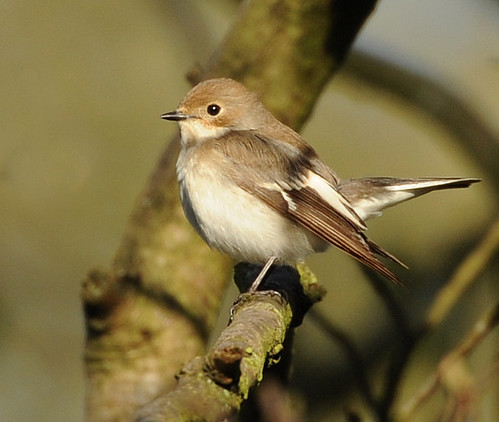
Female Pied Flycatcher
Pied Flycatcher. The Cheated. Brian Rafferty

So whilst the male PF will always be seen as a smart bird, smart in appearance whilst smart at being a devious two-timing cheat who leaves the female to get on with bringing up the young on her own - failing to do so on occasions - making him a major contributor to nest failure of which  - as claimed at the top of the post - there were some at Barbondale this year.