BIRDING THE LUNE ESTUARY THE FOREST OF BOWLAND AND BEYOND............................................................................SOUTHERN MARSH ORCHID PETE WOODRUFF
Showing posts with label Small White. Show all posts

Thursday, 9 May 2024

The Birk Bank Circuit.

Tuesday was the anniversary when Steve Graham accompanied me on a circuit of Birk Bank in May 2023. Primarily the reason that day, was to locate a Wood Warbler which had been found a few days earlier in a private woodland. But the hopes of visually finding this locally rare warbler soon died a death, though we did here the distinctive call which is often likened to a spinning coin on a marble slab.

Todays circuit with Steve was a 4 hour experience of some excellent birding which produced 7 Garden Warbler, one up on last years tally of six. Also enjoyed was 5 Cuckoo records which were represented by two audible and three visual, one of which was a female heard to call, then viewed atop of a tree with a Meadow Pipit in attendance and mobbing at times. Six Mistle Thrush seen, including one in flight carrying food into Cragg Wood.


I reckon the odds against the sighting of a Song Thrush singing in the branch below a Mistle Thrush, is a million to one chance....Pump up the volume. Two singing Blackcap, Linnet, Greenfinch, and Redpoll over, and Kestrel.

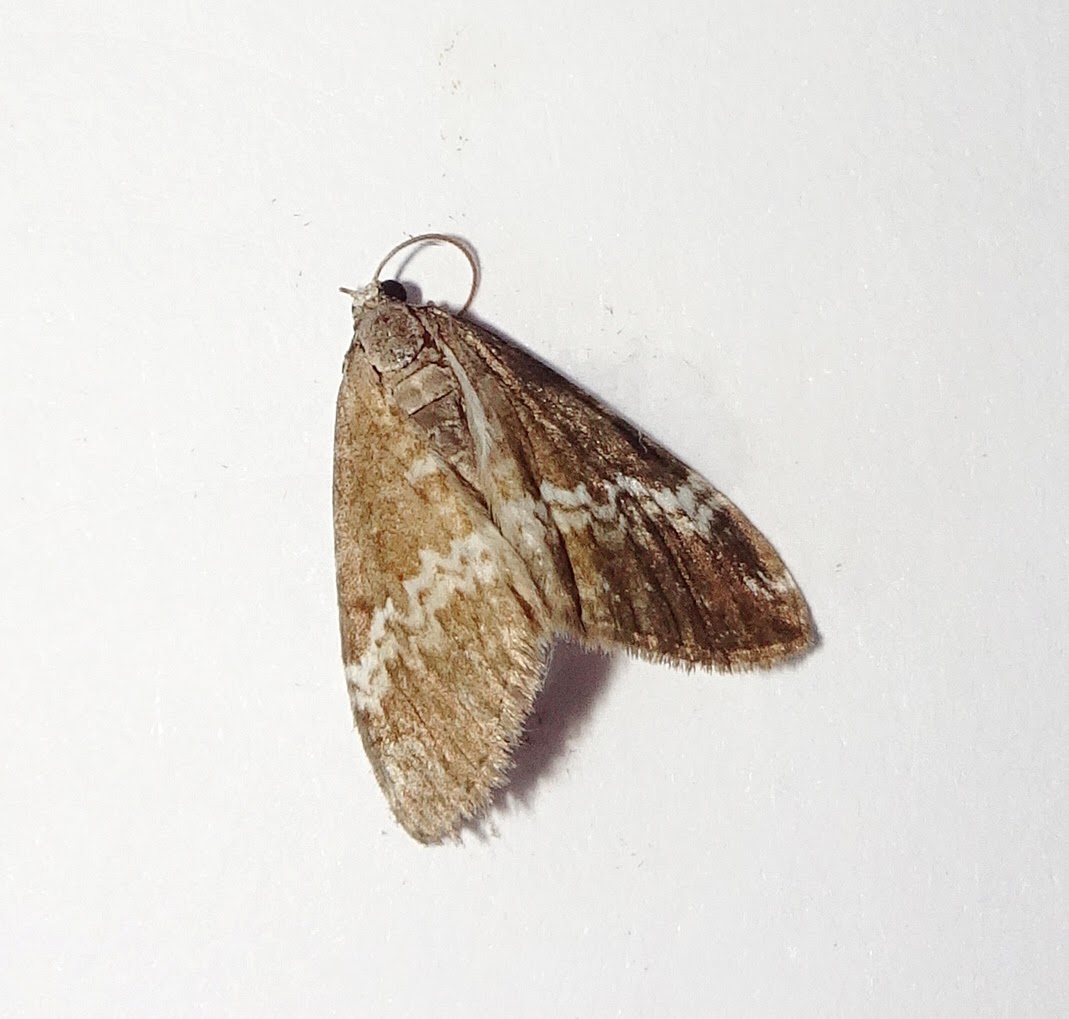
Common Heath. Ian Mitchell.

To say butterflies and bees were sparse would be an understatement, with only singles of Orange Tip, Speckled Wood, and Small White, but the Common Heath moth was out in force.

I found my first Large Red Damselflies of the year, when a f. melanotum was basking on the boardwalk at Birk Bank bog, and at least 12 teneral drying out and warming up amongst the bilberries along the path and away from the bog....interesting.   

Sunday, 8 August 2021

Hawthornthwaite West & East.

I was on the western side of Hawthornthwaite Fell during the week, and got to around 400m before finding the first of 4 Stonechat seen on the visit. It was a female, and was the highest Stonechat I ever found on this fell, before soon disappearing from view. Also to note, 6 Red Grouse, 8 Meadow Pipit, a Kestrel, and a lone Sand Martin over Catshaw Greave. Butterflies seen, 3 Peacock and a Small Heath. A check of the small pool by the nearby plantation at the foot of Catshaw Fell, a male Common Darter, a Blue-tailed Damselfly, and 3 Small Copper.

On the eastern side of Hawthornthwaite, I found 7 Stonechat, these were seen as a distant pair, both scolding and almost certainly with skulking young, another pair were seen with 3 young. The low numbers of pipits seen on the uplands of Bowland recently, continued with just 3 Meadow Pipit here today, a single Red Grouse, Buzzard and Kestrel. When I got back to the motor at Marshaw, a Grey Wagtail was on the Marshaw Wyre.

As a contradiction to the claim of the dearth of butterflies seen this year, I probably saw at least 150 Large White on the day, with a few Small Whiteand 4 Green-veined White identifiable at close range.


On the moorland edge, I found a container hidden in the long grass, the container held a moth. Thinking to myself, maybe this is a decent discovery, lost by a lepidopterist, and might turn out to be something rare.


But the excitement soon faded when the moth arrived on the computer, and became apparent it was The Rivulet. Perhaps this person thought he had found a White-banded Carpet.

The Glorious Twelfth.

If you're a Red Grouse rejoice, I have excellent news for you. 

Red Grouse. Pete Woodruff.

If you are living in the fear of soon being driven by the beaters, and then blasted out of the skies, you can take comfort from knowing it isn't going to happen this year. That's because there isn't going to be any shoots anywhere in the country in 2021. 

Fear not, and take it from me, it's official....The Glorious Twelfth Is Cancelled.

The header image serves the purpose of some successful resizing, and is appropriate for the subject of my post. Brilliant shot of the Stonechat Martin, much appreciated.   

Sunday, 23 August 2020

Gulls, Dragons, And Flutterby's.

I had other plans on Thursday, but they fell apart and I ended up at Heysham to check the gulls on Red Nab as the tide came in.

When I arrived at Heysham the tide was around 2 hours short of high and there was c.500 gulls on the seaward edge of Red Nab, so plenty to keep me interested for a while I thought. But the birds were restless and a few soon started to disperse and were flying off south, it soon became obvious they were not going to be pushed towards me by high tide at 1.00pm and there was only c.50 gulls left now. But I did manage to find 12 Mediterranean Gull including three juveniles. Worthy of note, a staggering 107 - possibly up to 117 - Mediterranean Gull were recorded at Heysham on 27 July. 

There was some added interest in the gull search, as one bird bore a green darvic ring and was probably the previously seen individual in July marked in Germany as an adult in 2012, and seen at Heysham in 2017/18/19, the bird was too distant for me to read the ring today. A second gull was also ringed, but frustratingly was again too far off to be read. This bird had a white darvic ring, and is established to have been marked in the Netherlands as a nestling in June 2019, it was seen in Wales later that year, and again in Wales February this year, before being seen again on the Heysham outfalls in mid-August.

As I came away from Red Nab, on the pond I saw, 2 Emperor Dragonfly, also a male and female Common Darter, and 2 Migrant Hawker. Though the weather was suitable, an hour at the west end of the reserve gave a small number of 7 species and 20 butterflies, 5 Common Blue, 4 Small Tortoiseshell, 3 Meadow Brown, 2, Red Admiral, 2 Speckled Wood, 2 Gatekeeper, and 2 Small White.    

The Southern Hawker.

Southern Hawker Male. Pete Woodruff.

I watched a male Southern Hawker flying around the trees on the reserve, it appeared to never be going to settle, but it eventually did come to rest at the height of about 6 meters on a not very healthy looking conifer. I managed to locate the hawker with my camera steadied on a tripod and got a half decent shot. 

The Southern Hawker was first recorded in Lancashire in 1940, although it appears that they were not recorded for another 50 years in North Lancashire in the 1990's, and in fact not in East Lancashire before 2000.

The Spotted Flycatcher.

Spotted Flycatcher. Pete Woodruff.

I hear from a reliable source....The Spotted Flycatcher appears to have had a poor season this year at regular sites visited in Bowland including the area around Tower Lodge which is a stronghold in my records for the Spotted Flycatcher. 

I was concerned to hear the compound at Tower Lodge has been cleared of up to 60% of the trees, as a consequence the Pied Flycatcher nest boxes have suffered a near death, with little if any more than four now left from at least ten originally put up. The small woodland has been developed into some sort of mini safari and picnic area, with ducks, an odd looking turkey, hens, a trampoline, and table and chairs. 

Thursday, 30 July 2020

The Little Brown Job!

I had two e-mails over the weekend, one included an image of a wader. I was amazed at how time flies when I discovered it was 6 years ago since I found a Wood Sandpiper on Conder Pool 10 August 2014.  

The second message was the reminder of a butterfly found 11 August 2018. The last time I had seen the author of the e-mail was at Glasson Dock when together we found 9 gulls all ringed, including 5 Common Gulls, a species I had never found ringed before. 

Brown Hairstreak at Gait Barrows.

Given that the Brown Hairstreak has a localised distribution almost entirely in Southern England, the South Midlands, and South Wales, with the nearest colonies in East Worcestershire some 150 miles away, the obvious question is; how did it get to Gait Barrows in Lancashire. There are three possible explanations: 1) This elusive and largely arboreal butterfly could have been ever present, but was simply overlooked or mistaken for the widespread Purple Hairstreak. 2) Brown Hairstreak eggs were inadvertently brought in by local landowners when Blackthorn from nurseries outside the area was planted in the vicinity. 3) An unauthorised release of a small number of adults, or late stage caterpillars. The latter option for the reappearance of Brown Hairstreak in North Lancashire was favoured by three experts in the field. 

Ref: Butterfly Conservation Lancashire Branch, Winnick, Dunbar, Sivell
 
I'm hoping to make a break to freedom tomorrow and I think I know where I'm going.

In the garden.


A Small White, Red Admiral, and Speckled Wood. It was also good to see a young Robin and Greenfinch in the garden. 

Wednesday, 8 April 2020

The Amazing Heysham Knot.

Copyright Howard Stockdale Clik the pik

Howard kindly sent me the collage he created of the Knot roosting over various March/ February tides at Heysham Heliport, when he achieved not just excellent photographs, but also reading an amazing 28 ringed birds.

As can be seen in the images, the birds have the flag of the country where they were ringed, together with the location and date, including one bird ringed at De Richel, Netherlands, 21 August 2012.....All round impressive stuff Howard.

Garden Birds.

The Goldfinch is the most common bird in our garden, seen daily on and off in ones and twos, but a count of 18 Goldfinch together one day, they spill as much if not more than they eat....View Full Screen.


The Blue Tit makes heavy work trying to collect string on the feeder for nesting material which ended in failure....View Full Screen.


Garden Butterflies.

Small White and Peacock.

I get a good deal of pleasure and uplifting from this kind of high end quality music, I hope you can too. We're all in this war together....TAKE CARE STAY SAFE.

Friday, 4 May 2018

Birding On The Edge....

....the edge of winter.

It was more like the beginning of March than May when I made my first visit of the year to Barbondale on Wednesday. Dull with a cold wind, but nothing dull about finding 6 Pied Flycatcher, all mobile and behaving like there was no intention of breeding just yet. In fact I had sightings of nine birds over a period of time, including at one point, two males on the same branch with less than a metre between them. But with lengthy observations, I regarded six birds seen as three pairs.

The 4 Stonechat I found take top spot from the Pied Flycatchers for me, they were seen as two pair. The place held a good number of Willow Warbler, singing within earshot pretty much all the time I was there. I heard up to 6 Redstart, but saw not a single one, 4 Tree Pipit, 2 Wheatear, 2 Mistle Thrush, and of the 3 Nuthatch seen, there was some interaction between two of them. A stunning male Grey Wagtail was on Barbon Beck, where up to 6 Swallow were flying up and down.

Quite a good number of Chaffinch were notable in the area, and 3 Small White butterflies were seen on a day when the weather had me thinking it unlikely.

The Barbondale Stonechat.

When I first started to visit Barbondale a 'few' years ago, if the Stonechats were ever present there I certainly never saw them. But I did begin to find them, eventually in double figures, for example....13 including juveniles on 15 August 2005, and 19 including juveniles on 24 August 2006. Since then numbers fell away to nothing as had been the case historically, until - with the exception of a lone male on 7 May 2015 - today's was the first multiple sighting here since I saw a pair six years ago on 29 May 2012.


Stonechat. Ana Minguez @ Naturanafotos

Nothing short of a brilliant record in my book. Hopefully signs of a come back for the Stonechat at Barbondale, and certainly warrants another excellent image on Birds2blog....Thanks Ana.

Friday, 14 August 2015

A Trip Down The A588.

The original plan on Wednesday was to leg it along the coastal path from Fluke Hall to Knott End, but in the end I did a U turn at Cockers Dyke where the gulls were a bit thin and no more than eighty strong, with not a stray wader in sight with the few Lapwing present. So the gains were a Sparrowhawk, Kestrel, and 4 Little Egret.

But it was at least a decent butterfly day and I notched up 9 species along the walk from Fluke Hall to Cockers Dyke, and probably saw at least 200 individuals. I made no attempt at accurate counts and the list notes estimates only....

Large White 80
Common Blue 40 including 2 male
Small Copper 30
Gatekeeper 25
Meadow Brown 20
Small Tortoiseshell 4 
Peacock 2
Green-veined White 2
Small White 1

Clouded Yellow.


Clouded Yellow Warren Baker @ Pittswood Patch

Nine years ago on 7 August 2006 I counted 12 Clouded Yellow butterflies all flying east along the same route as today between Fluke Hall and Cockers Dyke, a record I have yet to better, I also saw six other butterfly species here on this date.

I made a brief call at Pilling Lane Ends to see a Kestrel dwarfed by the Peregrine Falcon it was mobbing at some height. Another brief call was at Conder Green on the way back to Lancaster to find 4 Common Sandpiper and 2 Greenshank in the creeks, with just one Little Grebe noted on Conder Pool. A Sparrowhawk surprised everything in the creeks to clear the lot out before diving out of sight having taken out one of the waders.

Little Egret.


Little Egret. Pete Woodruff.

These seven Little Egret were from fifteen on the River Lune at Glasson Dock yesterday where double figure counts have been regular recently, but on Tuesday evening at Burton Mere Wetlands in Cheshire an amazing 200 Little Egret went to roost.