BIRDING ON THE LUNE ESTUARY AND THE FOREST OF BOWLAND......................................................SPOTTED REDSHANK/GREENSHANK CONDER POOL PAUL ELLIS
Showing posts with label Jack Snipe. Show all posts

Sunday, 9 January 2022

Full House At Cockersand!

Well, sort of a full house when I visited Cockersand on the best day of the week weather-wise. Sightings for the little black book looked good, and Plectrophenax nivalis hunters were out in force, with fourteen cars parked up when I arrived.

In order of being seen, 7 Goosander were the first to be noted on Conder Pool, then 22 Black-tailed Godwit arrived over the pool from the Lune Estuary, circled once and appeared to be going to land on the island, but decided against it and departed back from whence they came, they were accompanied by 2 Jack Snipe in the flyover. Two Little Grebe seen, one on the pool, one in the creeks.

The Cockersand swans were scattered over three fields, I estimated they numbered 220 Whooper Swan, with 8 Bewick's Swan accompanying 114 in fields west of Gardner's Farm. At high tide, 6 Rock Pipit were with a similar number of Meadow Pipit on the marsh, a few Snipe were driven off the marsh by the tide, and the female Stonechat of the wintering pair was constantly mobile over the shore between the caravan park and Bank Houses, it was still there two hours later on my return, but I never did see the male today.

On the circuit, I noted 4 Wren including three together, the interest there being I've never seen the species as a threesome before, though they are known to roost communally in hard weather, with numbers occasionally up to 10, but there is an amazing record of up to 61 from the archives. Also, a Reed Bunting, with 10 Greenfinch which are always a pleasure to be seen in double figures these days. Ten Eider were off Plover Scar, where 6 Turnstone was the sum total of waders on Plover Scar an hour after the tide.

View Full Screen

By the time I reached Cockersand Abbey, a happy little band of birders were enjoying the sight of an obliging and tolerant Snow Bunting quietly pecking around the front door of the abbey, at the same time 12 Twite were also pecking around the gate to Abbey Farm.

When I got back to the caravan park, a traditional look through the gate by Lower Bank Houses paid off when a Barn Owl came into view before soon disappearing again.

I didn't hang around for the sunset at Cockersand, but when I got home, this was the view looking SW from our bedroom window at 16.40pm....Another Grand Finale.

..................................................................

Belted Kingfisher Ceryle alcyon....North America, south to Panama and Caribbean coast of South America.

First recorded (shot*) in Britain at Sladesbridge, Cornwall in November 1908. The sighting stayed unrecorded until it was exhibited at a meeting of the BOU in October 1918.

*Nothing's changed in the persecution of birds in the 113 years since this man seeing the bird from a window in his house, he records himself to say....'I took my gun and went out, and successfully stalked and killed it'.

Belted Kingfisher Kevin Cole

An angler and ex-birder George Shannon was astounded to see the bird at Redscar Wood by the River Ribble in Preston on 8 November 2021. George couldn't believe his eyes that a Belted Kingfisher had crossed the Atlantic Ocean and  found itself in Lancashire, England, but his disbelief was dispelled by the fact he had previously seen the Belted Kingfisher for himself in North America. In the month that followed the birds discovery by George, twitchers in droves from all over the country have been to see this bird. 

Tuesday, 6 March 2018

7 Up.

A refreshing Lime & Lemon drink, but not as refreshing as the birds I saw yesterday, and yes, another Stonechat image, thanks to Richard O'Meara....Thanks also to Richard Peglar for his Jack Snipe. 


Stonechat. Richard O'Meara.


The Stonechats.

Seven Stonechat seen were, two male and two female at Conder Green, and two male and a female seen at Cockersand, presumably the female being the wintering bird here since 22 December. 

The Whooper Swans. 

All assembled in one field at Clarkson's Farm, with only a few out of sight, an assessment of the number was made easier for the first time this winter and stood at 625 Whooper Swan, with just one Bewick's Swan seen.  


Jack Snipe @  Pegler Birding 

The Supporting Cast.

Around the high tide, a Jack Snipe came rising off the marsh, with it's characteristic silent, direct and short escape flight, 4 Snipe also seen. Off Plover Scar, 24 Eider and 2 Great-crested Grebe, a lone Grey Plover was with Turnstones feeding as the tide dropped, c.650 Pink-footed Geese were heading SW over Cockerham Sands. Up to 60 Twite were again in the rough field behind Bank End Cottage, quite mobile, and at one point went on to the cottage roof to be counted, 65 Golden Plover were the only field waders at Cockersand today, 3 Song Thrush and 3 Meadow Pipit, a Jay flew across Moss Lane as I drove away.

At Conder Green, 2 Goldeneye, 4 Tufted Duck and 3 Greylag were of note on Conder Pool. In the creeks, 6 Little Grebe, a drake Goosander, and 2 Black-tailed Godwit. Along the coastal path to Glasson Dock, a Song Thrush, 4 Reed Bunting, 2 Dunnock, and 2 Wren. I counted at least 150 Redshank feeding close in on the marsh as the tide rose. 

Monday, 5 December 2016

Then There Was Nine!

Stonechat. Ana Minguez @  Naturanafotos  

It might have taken me a couple of hours, but it was good to eventually find 4 Stonechat on Harrisend, the result being nine pairs of Stonechat now on record wintering at four locations I've visited recently in Bowland. Hardly numbers to get ecstatic about, but thankful for small mercies on a species which has yet to return to anything like pre 2009 status.

Harrisend is a giant sponge in the boggy areas where the water drains off the fell, as I got out of the car, the drainage into one roadside ditch could be heard gushing, quite amazing the amount of water considering the dry spell of late. At least 11 Red Grouse seen, and my second recent upland Jack Snipe went into the air ahead of me, with a Common Snipe seen, a Buzzard was the only raptor on the visit.

I decided to come back down to Lancaster and do a circuit of Aldcliffe before the daylight began to fade, during which time I saw 15 Blackbird. No surprises, and definitely no exotica, with a Little Egret on the flood, 13 Moorhen, and a few hundred Black-headed Gull in the fields where the farmer was spreading, along the hedgerow bordering the flood, a good number of Fieldfare and Redwing seen. Drying up after the flood, the area and Wildfowlers Pool had a few Redshank and 3 Snipe feeding out in the open. 

Freeman's Pools had 2 Goldeneye and 2 Gadwall of note on a quick scan, and on the marsh, an estimated even mix totaling 600 Canada Geese and Greylag of which two were collar marked - probably more given a bit more time - and duly reported, c.800 Pink-footed Geese were in the air over in the west somewhere between Heaton and the Heysham bypass.

Thanks for your excellent and much appreciated 'Spanish' male Stonechat image Ana. 

Monday, 28 November 2016

There's Gold In Them Thar Hills.

A brilliant day on Saturday, and nothing was going to stop me from another visit to Birk Bank, and how pleased I ended up being about that, there was more gold to be found as I soon found out as I levelled up on the climb to the top of Birk Bank and found my first of 6 Stonechat, seen as three pairs bringing the total to seven wintering pairs in my last two days in Bowland. Fourteen Stonechat on winter territory does'nt sound like the record book is bursting at the seems with the species, until you look at the recent history book that is....This is looking good. 

Jack Snipe Marc Heath

Not many yards on after finding the first pair of Stonechat, a Jack Snipe waited until I almost stood on it before being flushed from it's secluded, well-vegetated soggy place, startling me and characteristically flying off silent, low and straight, and soon dropping back into cover. 

Also heading up to and on Birk Bank, 20 Red Grouse, 8 Long-tailed Tit, 5 Wren, 3 Blackbird, 3 Robin, 2 Goldcrest, single Coal Tit, Great Tit, Blue Tit, and a Buzzard, the only raptor of the four hours. 

Also as seen on my last visit here, a large flock of at least 250 Fieldfare were marauding between Rigg Lane and Birk Bank every time they came into view. Has this mass of winter thrushes really stayed in this area since I saw them here four weeks ago in October.    

Redwing Jan Larsson

I saw just one Redwing in a tree off Rigg Lane, where soon after a Green Woodpecker gave itself away with several strange 'half a yaffle' calls before being seen flying off.

All worthy of being called another good day in my book.

Thanks once again to Marc and Jan for their excellent images to add some sparkle and interest into Birds2blog.

Sunday, 14 February 2016

Same Again Please!

Back doing the rounds again on Friday, for once I tried for some accuracy with gull numbers on Conder Pool and came up with a total of 239 birds, 172 Common Gull, 65 Black-headed Gull, and 2 Lesser Black-backed Gull. Also noted on the pool, 3 Goosander and 3 Little Grebe, a Spotted Redshank was in the creeks. On the Lune Estuary, a good count of at least 850 Black-tailed Godwit, and the 56 Goldeneye here today was an increase of two on Wednesdays 54 peak count.

Off Moss Lane, 7 Bewick's Swans were in a field by Clarkson's Farm, the c.350 Whooper Swans had spread out once again, from here all the way south towards Bank End, but I have no reason to suggest they numbered any less than Wednesdays count, a Sparrowhawk was over Slack Lane.


Plover Scar. Cockersand. Pete Woodruff.

By the time I reached Plover Scar c.480 waders were estimated at 200 Oystercatcher, 180 Turnstone, and 120 Knot. But the photograph above a half hour later, shows the Oystercatcher and most of the Knot had departed leaving the Turnstone and a few Knot to move ever closer landward as Plover Scar disappears under the incoming tide. 

Turnstone/Knot. Pete Woodruff.


In the thirty minutes I was on the path towards Bank End 8 Snipe came up off the marsh one of which was a Jack Snipe, 3 Reed Bunting also came off the marsh. Up to 800 Curlew were again on and around the flood north of Bank End Farm, with 4 Little Egret present.

As I came back along the headland, a single Grey Plover was on the shoreline, and the local Buzzard was again in 'the' tree. I had no idea the Buzzard was so persistent in its habits, this bird has been perched in the same tree and even on the same branch on at least six of my visits to Cockersands over recent weeks.


Barn Owl. Gary Jones @  Walksnwildlife

I had the pleasure of watching two Barn Owl hunting together today at Cockersands.

Thanks to Jan for the header Black-tailed Godwits and Spotted Redshank, and to Gary - also on Facebook - for the Barn Owl, much appreciated.     

Tuesday, 15 December 2015

I'm Alright Jack!

Putting the traditional Christmas wreath on my parents grave yesterday, a few uncounted Fieldfare, Redwing, and a Jay were of note in the Lancaster Cemetery on Wyresdale Road, this is the best cemetery I know for birding with an excellent variety of trees.

It was good to find the Common Sandpiper again at Conder Green, it was alone in the creeks opposite River Winds and seen for the first time in seven visits since 16 November. On Conder Pool, 16 Snipe was a good count here, also 9 Little Grebe included two in the creeks, 6 Long-tailed Tit were working their way along the hedgerow. 

I was too late at Glasson Dock, the tide had taken over the mudflats on the Lune Estuary, but there was an absolute minimum of 2,500 Golden Plover on the mud below Colloway Marsh with at least twice that number of 5,000 Lapwing. 

Turnstone/Oystercatcher. Pete Woodruff.

On Plover Scar at high tide, a healthy count of up to 220 Turnstone with 250 Oystercatcher noted, but wait a minute, what's this crouched down on the shingle....it's a Jack Snipe which gave excellent views for as long as I hung around. Off the Caravan Park, a conservative estimate of 2,500 Wigeon and 900 Teal, with a few Pintail noted. The local Buzzard was on a fence post by Abbey Farm, a Sparrowhawk and 12 Goldfinch were around Bank Houses horse paddock.

Eight Goldeneye seen today were, 5 on the canal basin, one on Conder Pool, one off Crook Farm, and one on the Cocker Estuary.

Jack Snipe. Plover Scar 14 December. Pete Woodruff.

Not the best of photographs of a Jack Snipe, but definitely the best bird on Plover Scar yesterday.

 Harbour Porpoise. Pete Woodruff.

I found another Harbour Porpoise corpse at Cockersands yesterday to follow the one found here earlier in the year on 3 April.

Friday, 12 April 2013

Jack The Snipe....

....and some other birds.

Jack Snipe. Conder Pool. Copy Permitted.

One week later I found the Conder Pool Jack Snipe again on Wednesday. It gave excellent views as it fed and displayed its constant full body bobbing, a behaviour which fascinates me about this bird, you have to ask yourself....why on earth does it do this. 


Greenshank Antonio Puigg

Also at Conder Green, 2 Spotted Redshank, and a Greenshank were in the creeks, with 2 Snipe and a drake Goosander on the pool, a Dunnock was by the viewing platform. But the best bird of the day put in a brief appearance in the form of my first Swallow of the year which went quickly through.  

The Lune Estuary at Glasson Dock was again absent of anything of note save 16 Black-tailed Godwit and 12 Goldeneye, 3 Eider here are not particularly regular on this section of the river. 

At Cockersands....I'll spare you a launch into one of my tirades about bird disturbance, but Plover Scar was void of birds due to human activity at the best time of the day on the high tide, 3 Eider off here were all there was to note. A Wheatear was present on the abbey ruins, a sight I'm more acquainted with on autumn passage. I saw just 5 Tree Sparrow and am at a loss as to the current status of the species at Cockersands these days. A Reed Bunting, Dunnock, and at least 3 Skylark in full flight song, 35 Golden Plover were in an Abbey Farm field, and 13 Black-tailed Godwit flew by Crook Cottage in search of terra firma on the ebbing tide and landed on the marsh. The 'Cockersands' Little Egret was again by an inland ditch, and I saw one Brown Hare.

The lives of the breeding Lapwing at Cockersands are already in shreds once again this year as three large fields have been 'turned over' since my last visit here and several birds looking lost in the wilderness of soil. 

In 1.5 hours on the coastal path between Fluke Hall and Cockers Dyke at least 300 Meadow Pipit went north-east following the coastline. 

Coming Soon.      


Whinchat  
Whinchat David Cookson  


Hopefully coming soon....The bird which runs a close second to my favourite of all birds the Stonechat, is its cousin the Whinchat. I know at least one area in Bowland where I can find a double figure of adult Whinchat and sincerely hope this is going to be the case again in 2013. Sadly there aren't enough places where double figures of Whinchat can be found today, but here's hoping. 


One on a post 
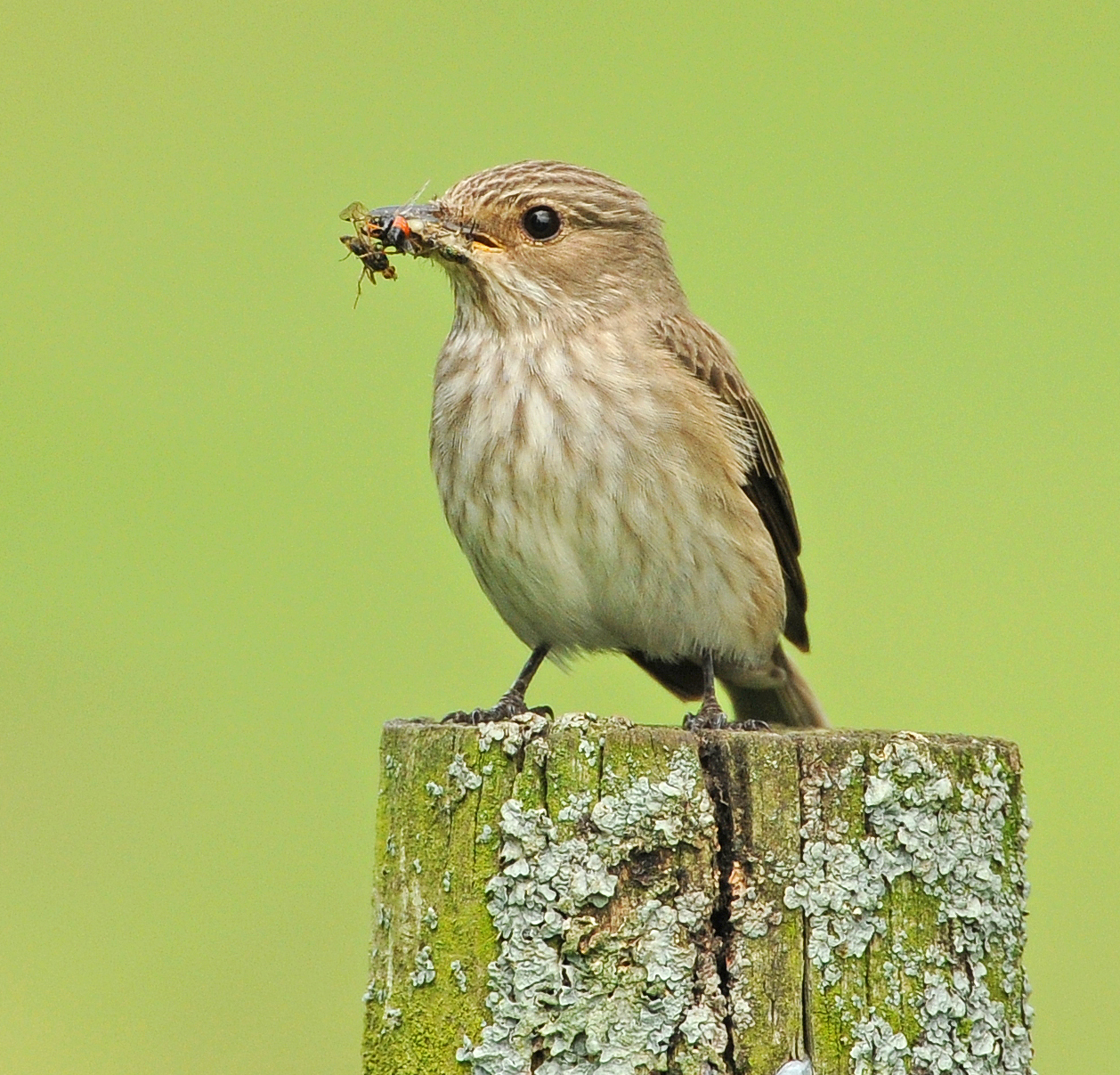
Spotted Flycatcher Brian Rafferty  


Another summer visitor I'm looking forward to seeing is the Spotted Flycatcher, but - like the Whinchat - to find it in number might also be a challenge, but here's hoping.


Pied Flycatcher Ana Minguez  

And definitely looking forward to seeing the Pied Flycatcher again....Mouth watering stuff!

Thanks to AP/DC/BR/AM for the images....brilliant once again.

Sunday, 7 April 2013

Driving Me On.

A favourite motto of mine regarding my attitude to birds/birding is....

Not what you will see
But rather what you might
The element of surprise
Never fails to delight


A decision to do the walk to follow the River Lune from Lancaster - Glasson Dock was a wise one on Wednesday last week and turned out to be the epitome of my motto when I found six Little Ringed Plover (LRP) on the flood at Aldcliffe a record which - until I find out or am told otherwise - is an all time best count of the species in this area and certainly on this excellent flood. However, I note in a search through my records that the Aldcliffe six pail into insignificance regarding numbers of this species of wader seen together in a sighting when I find a visit to the Kent Estuary at Halforth in July 2006 produced an amazing sixteen LRP's. The surprises and unpredictability of birds never fails to intrigue me, these are the kind of experiences which drive me on every time I leave home for a days birding....And then there was the Jack Snipe on Conder Pool last Wednesday too....nice one!!

The migrants are coming.     


Yesterday I received the news that snow had been falling on Friday in the south of Toulouse in France, the first time it ever has done here as late as early April according to my correspondent. But the weather has improved over here in the past two days and now perhaps we should hopefully see some northbound migration in the country and into our area.

Garden Birds.

Siskin. Richard Pegler. 

Visits to our garden feeders have increased once again with 6 Siskin seen here on Friday last week.

Brambling/Redpoll. Richard Pegler.

Richard has had some excellent visitors to his suburban garden, last year he collected the record of 32 species, a much better tally than we hope to ever achieve in our garden. Thanks for the excellent photographs of the male and female Siskin, the Lesser Redpoll and Brambling, they are much appreciated Richard   

The Mega.


Tim Kuhn: Killdeer &emdash; Killdeer
Killdeer Tim Kuhn  


A Killdeer was at Alston Reservoir at Longridge this morning at 10.10am. The bird was on Alston Wetlands and stayed until 11.00am when it flew off NW, it returned at 11.22am and stayed until 11.50am when it flew off once again, this time NE never to be seen again. The Killdeer breeds in North and Central America, South America from Peru to northern Chile, and the West Indies. 

Whilst here I noted 2 Little Ringed Plover and a Raven over. 

Thursday, 4 April 2013

Plovers and a Snipe....

....and some other rewards for the effort put into a walk yesterday from Lancaster to Glasson Dock .


Goosander Warren Baker


The walk started off in unimpressive fashion by Greyhound Bridge on the River Lune in Lancaster, from here to Marsh Point just 6 Goosander found their way into the black book.    

At Freeman's Pools, c.50 Wigeon, a 'few' Tufted Duck, and a pair of Goosander were to note. Taking the embankment route to Aldcliffe I saw 3 Little Egret and nothing of note on/around the wildfowlers pool. A casual look over the flood from the lane appeared to reveal nothing to excite, but always a want with me to get to the bottom of everything I took to the higher level path to eventually count an amazing 6 Little Ringed Plover, about which I'd wager is a possible all time record for the species in the Aldcliffe area and certainly on the flood.


Raven Gary Jones  

When I got to Stodday a Raven was flying over to land well up towards the top of one of the electricity pylons, further along the path I noted c.18 Goldfinch and a Goldcrest gave excellent views out in the open on a dead branch by way of a change. Towards Conder Green I saw a distant small group of 'thrush's' hard to say how many though knew what and suggest they were the 7 Redwing I saw on this path 8 March. It was just a 'whiz' around Conder Green today but I'd had a text a couple of hours earlier from a reliable contact to tell me of a bird I'd probably like to see if I could get there. On the way for a look on Conder Pool I saw a Common Sandpiper in the creeks.


Jack Snipe. Copy Permitted.

The bird on the pool was still showing well two hours after I got the text message and I had excellent views of a Jack Snipe feeding quietly out in the open, I think my best views to date of the species. I had counted 28 Blackbird on the walk. This morning a Buzzard was soaring low over Bowerham in the south of Lancaster.

Thanks as always to Warren and Gary for the excellent photographs of the drake Goosander and the Raven.

Friday, 1 March 2013

In Reverse.

To work around the tide I decided to do my birding in reverse on Wednesday and first went to Cockersands where the tide was an hour short of its height, but by the time I arrived at Plover Scar it was well under water and the sum total of birds there was 38 waders being, 20 Knot, 9 Oystercatcher, 7 Turnstone, and 2 Ringed Plover, a pair of Eider were off here, and a Peregrine Falcon was dinning on its latest catch on the lighthouse. Other birds of note in an extensive but relatively bird-wise quiet visit, a Jack Snipe came up off the marsh off the Caravan Park, a Rock Pipit, 7 Linnet, and 3 Reed Bunting. A Little Egret was by a ditch, it was quietly - and I thought surprisingly - roosting within a couple of metres of a Grey Heron, both obviously tolerant of each other. Driving away from Cockersands I saw a Merlin take off from a fence post and soon disappeared from view.

The 'Moss Lane Swans' had returned to the field I initially found them in on 15 January - and which peaked at almost 300 birds on 18 February - have now decreased in number to c.200 Whooper Swan and 15 Bewick's Swan on Wednesday.

On the Lune Estuary at Glasson Dock, the number remains steady here since 13 February at around 650 Black-tailed Godwit. Also of note, 10 Bewick's Swan, and - as Monday - c.80 Goldeneye, a solitary Grey Plover, 2 Little Egret were on Colloway Marsh. With only a while to spare at Conder Green I was only able to check Conder Pool where I found 2 Spotted Redshank, 7 Little Grebe, 65 Tufted Duck, 3 Snipe, and birds of the day for their being unusual at the location were 2 Pochard drakes on the pool.

I have no appropriate photographs for the post, but how about this little trio of excellent 'Pegler Pics' which illustrate each bird in its natural environment. Thanks for these Richard, no photographs here of birds looking like they were in glass cases in a museum....I luv 'em!


Redshank. Richard Pegler.   

An excellent and typical image of the Redshank in one of its favourite environments of a flooded field or marsh.

Little Owls. Richard Pegler.

This image has to be the the best example of a picture of birds in their natural habitat. The main subjects of the image are the Little Owls, though not immediately apparent....but that's how its supposed to be isn't it.

Treecreeper. Richard Pegler.

And the Treecreeper brilliantly caught on camera doing what it does best....creeping up a tree. Thanks for these Richard  

And the early bird....


Swallow
Swallow. David Cookson.


A Swallow was reported in Merseyside flying north yesterday. A very early bird, the average earliest Swallow in Lancashire being 25 March making this individual ahead of time by almost a month. A long time before we can expect to find an adult feeding young as in the image above thanks to David Cookson 

Thursday, 11 October 2012

Seeing Double!

I got a double in on Tuesday with two days birding in succession.... what's the world coming to!


With the weather as good as it was it was essential I got myself out again if only to give the area a repeat looking over, and as on Monday it was 11.00am by the time I got to Conder Green where I took note of the Common Sandpiper again, but could only count 7 Little Grebe today despite a multi count, a Kingfisher was in the creeks quietly on the sand bank.

The adult female Scaup gave excellent views close in and allowing the opportunity to get some good detail of this bird on the canal basin at Glasson Dock. On the Lune Estuary, 2 Spotted  Redshank, c.90 Black-tailed Godwit, 4 Little Egret, and the 'August' Whooper Swan which was in the very same area of Colloway Marsh as it has been the last three sightings, I'm beginning to wonder if this bird is as well as it appears to be. Talking of which, a Mute Swan on the river opposite the bowling green was frantically preening which - on close inspection through the telescope - revealed it to be injured and bleeding, it appeared to have an injury to its right wing, or maybe in the area of its right wing.

I gave Cockersands little time today, too many people, too many dogs, but noted a Little Egret on Plover Scar before the dogs did, and a bird glimpsed in flight was almost certainly a Jack Snipe. On Pilling Marsh off Lane Ends, 4 Barnacle Geese were distant with c.2,000 Pink-footed Geese and a Little Egret.

Weatherwise the day was brilliant and some legwork from Fluke Hall to Cockers Dyke was a joy, though it turned up nothing of note in either direction, but was rewarded at the dyke with a Curlew Sandpiper and 4 Little Egret.

Note....An interesting sighting - albeit distant and in poor light late afternoon - on the Lune Estuary at Glasson Dock, was of a godwit sp - thought to be Bar-tailed Godwit - which had very unusual pale upperparts, and a pure white head, neck, and underparts, worth looking for if you're planning a visit here or elsewhere if it moves on. 

And the photography....


Redwing. Marc Heath.

The Redwings are coming....in fact they've already arrived in Kent where Marc took this photograph yesterday. 

Brown Hawker. Marc Heath.

Dragonflies in our area this summer have been in short supply, but in the south its probably been a different story....Thanks to Marc Heath who has posted numerous photographs of dragonflies recently, for the Brown Hawker on blackberries.

Black Darter Cliff Raby 

And thanks to Cliff for this photograph of the Black Darter....

Ichneumon Wasp Cliff Raby  


....and the excellent macro image of this wasp. All four photographs have helped to put some much needed colour and interest into Birds2blog.

No more birding for me I'm afraid until next Monday at the earliest.... what's the world coming to!

Saturday, 29 September 2012

The Twite Are Coming.


Twite at Knott End Geoff Gradwell

It isn't all good news about the Twite, a species with a lot to say about too. I'll keep it brief this time to avoid any boredom, but the Twite is a rare and decreasing species, and as a consequence finds itself on the 'Red List'. But I'm hoping to find them this winter, anywhere along the coast between Aldcliffe and Knott End.

Just south of Burnley in East Lancashire, the Twite at Cant Clough are encouraged with all year round seed feeding station/s in an effort to maintain a local breeding population that has crashed over the last 20 years, but human intervention of putting out the seed has certainly been the reason why this population has remained here throughout the year rather than join their kin on the coast during the winter months.

Ringing at Heysham Harbour has proved that the Twite there are almost exclusively from Scottish breeding sites, Heysham has produced counts just reaching three figures at both ends of 2011 in January and November, also in January 2011, 90 Twite were seen at Glasson Dock. 

Perhaps worth while making some more notes in a later post, in particular about the demise of this smart little 'Mountain Linnet'.

The Inner Farne White's Thrush.


If you watched the video of this bird in my earlier post - and you're in my 'club' - you will have seen some behaviour not seen before of this species, at the time I was intrigued by this not ever having seen or heard of it, but with a little help from a friend and the Helme Identification Guides book 'Thrushes' I was enlightened by the quote from the book....‘has peculiar shivering or nervous bobbing or jerking gait recalling similar motion of Jack Snipe, apparently uses as a method to bring worms to the surface’....learning something new every day.

And finally....


Conder Creek. Peter Guy.

I'm grateful to PG - who I met at Conder Green on Wednesday - for sending me this photograph of the River Conder in flood, and....

Off Jeremy Lane. Peter Guy. 

....for this one of the floods off Jeremy Lane. Not good news for the farmers, but excellent conditions for migrant waders to drop in, some of which were seen taking advantage of these fields and those in Moss Lane, with Curlew Sandpiper and Ruff amongst the finds here this past week.


And definitely finally this time....

If its colour and a lovely songster - if you're wired for sound - you're looking for, take a look below....