BIRDING THE LUNE ESTUARY THE FOREST OF BOWLAND AND BEYOND..............................................................................HUMMINGBIRD HAWK MOTH PETE WOORUFF

Sunday, 24 November 2013

A Bowland Bash.

Not a big bash, but a look in on one or two locations in Bowland with BT on Friday which started off quite interesting but soon fizzled out to nothing. We first pulled up at Blea Tarn Reservoir where I noted a single Goldeneye and 20 Wigeon. 

Brambling
Brambling Astland Photography 

The interesting bit was a stroll on Plantation Lane, a beech lined road for about a quarter of a mile and found 4 Brambling with Chaffinch, at least 3 Nuthatch, a Treecreeper, Goldcrest, Coal Tit, Great Tit, several Blue Tit were of note, with 3 Buzzard soaring overhead. At Stoops Bridge in Abbeystead, 3 Long-tailed Tit seen and c.45 Greylag over.


Buzzard Antonio Puigg

By now the day had 'fizzled out' and we spent little more than 15 minutes at Tower Lodge where 2 Buzzard went over, and a trip over the hill from here to Langden proved to be the road to nowhere and BT dropped me off back home again just after 3.00pm. To be realistic, hardly front line birding, but it was nice if cold up there today.

During a couple of periods we went different ways, BT claims 2 Siskin at Stoops Bridge, and 5 Buzzard over Plantation Lane.

Thanks to Antonio, Susan and Peter (Astland Photography) for the images.

Friday, 22 November 2013

Birdbrain....

....and six hours coastal stuff!

KT called me 'birdbrain' the other day and it wasn't meant as a compliment either I assure you, I was told I don't listen and that my brain is full of feathers....but I don't care about any of this! 

At Conder Green yesterday I counted the falling number of 6 Little Grebe on Conder Pool, also 3 Goldeneye again, 9 Snipe, 12 Wigeon, and 47 Mallard. The Scaup was on the canal basin again at Glasson Dock with uncounted Tufted Duck and a female Pochard, I failed to find the drake.

On the Lune Estuary, although Golden Plover and Black-tailed Godwit numbers were much fewer than my count here on Tuesday 12 November, there was a least the same number as then of 7,500 Lapwing, 6,000 Knot, and 450 Bar-tailed Godwit viewable from the bowling green. But I'd put money on it being a Peregrine Falcon which put the entire River Lune upstream population of waders to flight and I witnessed probably in excess of 25,000 birds in the air as far as the eye could see....an amazing spectacle, a build up of 35 Goldeneye here today too. On Jeremy Lane at least one Bewick's Swan identified in a mid-distance field hidden behind reeds.

At Cockersands, Plover Scar at high tide held c.320 Oystercatcher and 40 Turnstone, 12 Black-tailed Godwit were in a field feeding with predominantly Curlew, with Lapwing and Redshank, 5 Meadow Pipit, 2 Kestrel, and 3 Little Egret seen may have only been two birds, today I noted 2 Brown Hare

Cockersands.

Just in case anyone wonders why Cockersands rates as one of my favourite birding destinations - birds aside - here's just one reason....


 Looking West. Pete Woodruff.

The scene was ablaze with one of Morecambe Bay's renowned sunsets at around 4.00pm, this one looking west....

Looking North West. Pete Woodruff. 

....and this one looking north west.

And finally....can't have a post on Birds2blog without the photograph of a bird.

Tawny Owl. Howard Stockdale.

Not just a photograph of a Tawny Owl, but a brilliant photograph of one, 'clik the piks' they just might blow your socks off!....Thanks Howard.

Thursday, 21 November 2013

A Nice Little Owl....

....and even more Bewick's Swans. 

Little Owl Noushka Dufort 


It was high tide at Cockersands when I visited on Tuesday and Plover Scar was deserted, but the visit was made all the worth while if only for finding my first Little Owl here, void of searching my records possibly three years since the last one seen. The bird flew out of a tree by the road and flew across the horse paddock at Bank Houses where the Little Owl was regular for many years. Another decent record at Cockersands yesterday was that of up to 30 Greenfinch feeding on the wild bird cover crops. Also noted, 12 Eider, 32 Black-tailed Godwit, 2 Little Egret, and 3 Reed Bunting

On the Lune Estuary at Glasson Dock 15 Bewick's Swan, ten - including two juvenile - were off Bodie Hill, and five adult Bewick's Swan were seen from the bowling green where I counted up to 20 Goldeneye. On Glasson Marsh, estimates of 2,000 Golden Plover, 1,500 Lapwing, and 240 Black-tailed Godwit, a Raven went over having the same effect on the assembled waders as any raptor would have done.


Pochard Simon Hawtin

On the canal basin I counted at least 90 Tufted Duck and noted male and female Pochard again. At Conder Green I got the count to 10 Little Grebe on this visit, with 3 Goldeneye, 3 Goosander, 8 Wigeon, and 2 Little Egret all on the pool, up to 200 Teal are still present in the creeks.


Brown Hare. Howard Stockdale.

I rarely fail to see Brown Hare in the Cockersands area, but don't record them in my book these days. I've lost touch with how the figures add up today compared to a year ago....perhaps its time for me to put things right on Brown Hare records.

Thanks to Noushka/Simon/Howard for the excellent images.

Tuesday, 19 November 2013

A Local Wander.

Yesterday I decided to take a look at the birdlife in our local Williamson Park and ended up giving the place a good three hours.


I have little idea of the history of the birds of this park, whether or not anyone regularly - or even occasionally - monitors the park these days I've no idea. Today I had about 20 sightings of Blackbird, but a phone conversation later with a birder having more experience than yours truly on such matters indicated in excess of 60 pairs of Blackbird recorded here in the 1980's.


Great-spotted Woodpecker Warren Baker 

I took notes of all other species I saw in the three hours which included, a Great-spotted Woodpecker, at least 4 Nuthatch, a 'few' Redwing, 2 Song ThrushMistle Thrush, Coal TitBlue Tit, Great Tit, Long-tailed Tit, a Goldcrest, Robin, Chaffinch, 6 Magpie, and a SparrowhawkThe biggest surprise was of a lone Little Grebe on the old Moor Hospital reservoir below Fenham Carr. 


Autumn In The Park. Pete Woodruff. 

Some excellent autumnal photo opportunities in the park at the moment....

Leaf Litter. Pete Woodruff.

....'clik the pik' and you can read the info board at the top too. Thanks for the female GSW Warren....Excellent.

Sunday, 17 November 2013

Teal Bay & Migration.

Another of those compromises with KT whilst on a visit to Morecambe had us at Teal Bay just after high tide when the waders were assembling to feed and I noted in excess of 1,000 Dunlin, 55 Black-tailed Godwit, and a 'few' Knot. A female Scaup was off here, with 3 Pintail, 6 Wigeona Red-breasted Merganser and 4 Great-crested Grebe2 Little Egret were in the area.


Great-crested Grebe Martin Jump

An interesting record of note was of 124 Great-crested Grebe off Starr Gate at Blackpool today Sunday 17 November.

Migration.

There were predictions of huge movements made last week, some of which came true when almost 60,000 Wood Pigeon were counted flying over Swanscombe Marshes in Kent in a single morning, Fieldfare also arrived in number when 20,000 were counted coming in off the sea in one hour in Norfolk. Cold winds straight from Greenland and Iceland look like they could bring snow to parts of the UK, along with Greenland White-fronted Geese....

Ross's Gull. Pete Woodruff.

 ....and maybe a Ross’s Gull taking refuge on Plover Scar at Cockersands!

The Ross's Gull is a stunningly beautiful bird, and one of the most stunning of all the gulls. My photographic efforts of the bird at Lytham St Anne's in April 2008 resulted in the brilliant sun at the time bleaching out the birds pale grey upperparts to make them appear brilliant white.

Saturday, 16 November 2013

On Tour With BT.

Long time no see BT, so a tour was on the cards yesterday and we started at Conder Green to find in list format.

Common Sandpiper
Spotted Redshank
Greenshank 2
Little Grebe 14
Little Egret 2
Wigeon 9
Tufted Duck 3
Sparrowhawk
Kingfisher

On the canal basin at Glasson Dock the Scaup was again with uncounted Tufted Duck, the drake Pochard has been joined by a female.


Goldeneye Simon Hawtin

Not enough time spent to evaluate 'what's about' on the Lune Estuary - on my own I can be here at least an hour often more - but noted were 12 Goldeneye, and the 'regular' Peregrine Falcon squat on the southern end of Colloway Marsh quietly surveying for the next target. From Bodie Hill of note, c.300 Golden Plover, c.180 Black-tailed Godwit, and 2 Goosander9 Bewick's Swan included two juvenile, to make up the the count of twelve Bewick's Swans seen Tuesday, the other three adults were off Jeremy Lane today. On Moss Lane a Song Thrush always good to see.


Greenfinch Isidro Ortiz

At Cockersands, although I walked the headland from the lighthouse to meet BT at the caravan park I drew a blank save 12 Greenfinch which themselves are a good record. A Jay and 3 Little Egret at Pilling Lane Ends, and at Fluke Hall 11 Whooper Swan.

Whooper Swan Behaviour.


Temper, temper....
Whooper Swan David Cookson 

After counting 40 Whooper Swan in a stubble field flood off Fluke Hall Lane a few more came in from the south, soon followed by more until by the time we departed the number had risen to 88 Whopper Swan in the space of no more than ten minutes.

I've witnessed this before in the same field at the same time of day a few years ago when the number built up from just a few Whooper Swans to over 250 individuals. I've observed interesting behaviour many times by these swans presumably gathering to roost, in that they arrive in variable number loudly 'trumpeting', on landing some of the birds begin to display which can be taken as a 'greeting', but I regard the behaviour as a 'threat' display in that wings are quivered in a half open lifted position, the neck is repeatedly bent and extended, and the head nods up and down whilst the birds call loudly. 

Thanks once again to Simon/Isidro/David for the excellent photographs, and to John for the new header of the smart Merlin....the smartest of them all in my book.

Thursday, 14 November 2013

Chasing The Piper.

Semipalmated Sandpiper. Copy Permitted.

The Semipalmated Sandpiper was reported again yesterday morning at 9.55am and although five minutes later another message was that the bird had flown off at 10.00am, I decided to chance my luck. The plan was to walk the coastal path from Fluke Hall possibly to Knott End if needs be. 

Meeting two birders soon after I set off from Fluke Hall caused me to have a little less enthusiasm as they were returning from the morning 'empty handed'. When I arrived at the halfway point of Cockers Dyke there was at least eight other birders ahead of me and I set myself up to scan the area for almost an hour by which time no mention of the bird from the pager service or from the other birders in the area since the bird had flown off four hours earlier. I decided to react to the silence about the bird by calling off my plan to go as far as Knott End and I called it my cut off point and returned to Fluke Hall.

The sting in the tail....The Semipalmated Sandpiper was reported at Cockers Dyke again, 'briefly' at 2.25pm, though no mention again for the rest of the day.


Twite. Howard Stockdale.

On the way back from Cockers Dyke I found at least 95 Twite on the saltmarsh east of the dyke and saw a Little Egret.


Black-tailed Godwit Martin Jump  

I decided to walk east from Fluke Hall to check out an excellent looking stubble field I had noted on the way here a couple of hours ago, in the field I found 3 Curlew Sandpiper and 85 Black-tailed Godwit22 Whooper Swan, and at least 7 SnipeI reckon the stubble field was 'packed' with Snipe but very difficult to pick out and by the time I reached the seven count a predator - presumably a raptor which I did'nt pick up - had put the entire field to flight.

Thanks for the Sandpiper, the Twite on the sea wall at Cockersands, and the in flight Godwits, the images are much appreciated.    

Tuesday, 12 November 2013

Keeping The Faith!

 Semipalmated Sandpiper. Copy Permitted.

A bit of a tussle inside my head today when the RBA pager service told me of a Semipalmated Sandpiper at Knott End not a million miles away from where I was at Conder Green at 11.02 this morning....I decided to remain faithful to the Lune Estuary and continued my birding there. I parked the motor at Conder Green and gave the area three hours of footwork.

At Conder Green I counted 8 Little Grebe on the pool and noted 5 Goosander, 8 Wigeon, and a drake Pochard a species something of a scarce - if not rare - record on here, a Sparrowhawk went over. A Spotted Redshank was the only bird noted in the creeks today though Teal remain in good number.

I checked the Lune Estuary as I walked along the coastal path, it was impressive and alive with waders, I have no hesitation to suggest - including gulls and swans - probably in excess of 20,000 birds present today viewable from the bowling green. My reasonably accurate estimates were, 7,500 Lapwing6,000 Knot, 3,000 Golden Plover, 450 Bar-tailed Godwit, 180 Black-tailed Godwit, 800 Wigeon, 200 Mallard, and best wildfowl record of the day 12 Goldeneye back on the River Lune at Glasson Dock. The other best record of the day was 12 Bewick's Swan including two immature and an immature Whooper Swan. Also noted, a Greenshank, Red-breasted Merganser, and 3 Little Egret.


  Scaup. Copy Permitted.

On the Canal Basin at Glasson Dock, Saturdays Scaup still present with 95 Tufted Duck and a drake Pochard to note. 

The Semipalmated Sandpiper remained in the Knott End area all day and was last reported at 3.22pm between Knott End and Pilling Lane on Preesall Sands.

Sunday, 10 November 2013

Barnacle Overshoot....

....and a murmuration.


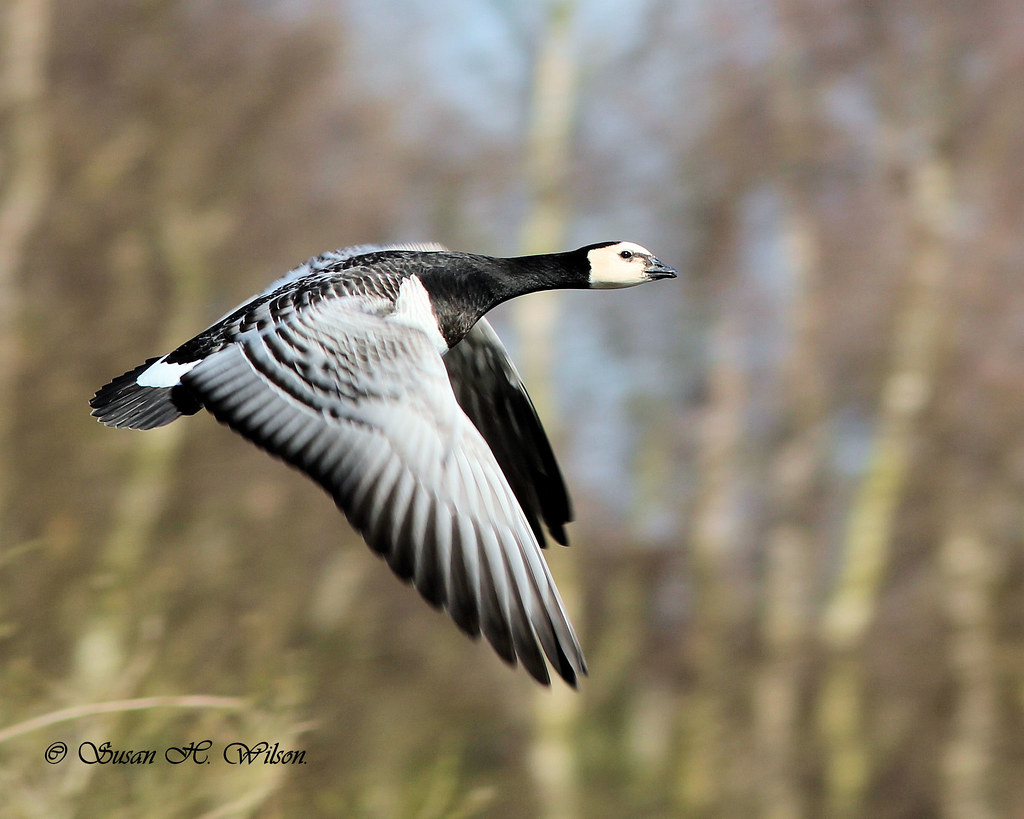
Barnacle goose in flight
Barnacle Goose Astland Photography 

A Barnacle Goose has earned itself a record by being the first ever to have reached Spain having flown 900 miles further south beyond Dumfries and Galloway in Scotland. 

Having migrated for six consecutive years between Arctic Svalbard and Caerlaverock WWT where the bird was ringed in 2004, this individual - a male - was marked CBZ and failed to turn up on the Solway Firth last winter, and has failed to do so again this year. Caerlaverock WWT had feared that he'd not survive to return to Scotland, that was until a birder in Spain reported the bird in the sunshine of the Rouxique Marshes near Vigo on north-west Spain's Atlantic coast.

WWT's ringing programme originally identified three separate populations of Barnacle Geese breeding in Svalbard, Greenland, and Siberia, and WWT's protection has helped the Svalbard/Solway Firth population on the road to recovery from just 300 birds in the 1940's to 30,000 today.

Barnacle Geese are often at the mercy of extreme weather and food shortage during their lifetime, and CBZ had been thought to have failed to make it back to Scotland for two consecutive years, only to turn up in Spain sunning itself. The big question now is whether or not he'll find his way back to the Solway Firth en-route to Svalbard to breed there again next year.    

A Murmuration.


There'll be more than a few people who know what a murmuration is today than did'nt know previous to the recent BBC Autumnwatch programme which was filmed this year at Leighton Moss RSPB Reserve in Lancashire, and which featured the Starlings aerial gatherings to go to roost in the reedbeds at the reserve providing us with one of natures amazing spectacles called a murmuration.


Starling Martin Jump

Amazing....that a single Starling like this one which Martin photographed over his garden, can be joined by several thousand of its kind to create spectacular formations like the ones over Leighton Moss. 
Starling Murmuration. Brian Rafferty.
  
Brian joined the assembled crowds one evening recently to witness this amazing natural phenomenon and to achieve some spectacular images of the equally amazing Starling mumuration.... Shapes In The Sky 

Thanks to The Rambling Artist for the brilliant Raven.

Friday, 8 November 2013

The New Post.

I ran out of title ideas again....HELP!!

'Clik The Pik' Pete Woodruff.

I think you'll appreciate I thought of hot-footing it back to the car when I saw this brewing up over the Fylde and heading toward Cockersands yesterday, but it passed by and actually cleared up to make a decent afternoon.

At high tide there was c.80 Turnstone on Plover Scar, a similar number of Oystercatcher departed and left them to it as I approached. I made my way along the headland though the wind was quite strong and blew the sea-spray over the top, 8 Twite were on shingle near the caravan park as was a Rock Pipit. Good numbers of waders were in the fields with uncounted Skylark noted again as Monday, though Golden Plover were only in small number, predominately Curlew, with Lapwing, Oystercatcher, Redshank, and curiously a few Turnstone, I don't recall seeing Turnstone inland in fields before. I briefly saw a Stoat as it dived towards a ditch for cover, the female Kestrel was seen again, and 5 Whooper Swan went over south.

A Kestrel was over Jeremy Lane on the way to Conder Green where I counted 11 Little Grebe on Conder Pool, I also saw a Spotted Redshank, Greenshank, Little Egret, and 6 WigeonUp to 200 Teal were in the creeks again, and the Common Sandpiper was way down the Conder channel towards the estuary, a Rock Pipit also seen.

The Cormorant Problem. 


Cormorant Ana Minguez     

Three Cormorant were fishing on Conder Pool yesterday - something I've noted here recently but not a regular occurrence - sensibly steering clear of the 'fisheries boys' who are at liberty to blast them out of the water in as many numbers as they see fit. 

In a review, no evidence was found that predation by the Cormorant is worsening, but permits to kill up to 2,000 each year are still in place and this is claimed by the fisheries to be insufficient to meet their needs. But their calls to be allowed to kill unlimited numbers was rejected following the review. In my opinion this scale of killing is unacceptable and is all despite the existence of non lethal deterrents.  

Thanks for the Cormorant image Ana. I think it's been featured on Birds2blog before, but no less brilliant even if it has.