BIRDING THE LUNE ESTUARY THE FOREST OF BOWLAND AND BEYOND..............................................................................HUMMINGBIRD HAWK MOTH PETE WOORUFF
Showing posts with label Black Grouse. Show all posts

Monday, 13 August 2012

Fair Game!


I've just read an interesting post on a blog. 

Cock Pheasant
Pheasant. Brian Rafferty.


Of course its no coincidence that I read this particular post today, though it does coincide with the Glorious 12th which of course was yesterday, but assuming the country gents do in fact abide by the rules, they cannot shoot on Sundays so the tradition started today. 

There's this gamekeeper who has recently visited a game fair and met up with many friends old and new, lots of them were asking this fella how were his Pheasant poults doing, at this point he covers up the main issue slightly by relating to the bad weather in addition to Buzzard predation.

I have no idea what the definition of 'the first week' is in this context but during this first week he 'lost a good few poults to Tawny Owl'....so now the Tawny Owl is a problem, well maybe it always has been for all I know. He goes on to say....'and Sparrowhawks and then the Buzzards, we loose one a day from each pen'....so these birds select a different pen each day to equal out the loss to the gamekeeper....Mmmmm!!

At this point he tells us....'as well as these losses from predation, my poults once again are on the verge of leaving me because of the onslaught'....does he mean they're walking out on him?

He mentions someone else in the post now, who is 'astonished at the death and destruction these Buzzards are meting out, not only to the poults but the other wild birds we have on the estate'....So do we assume the 'other wild birds' are all vegetarians or seed eaters then!    

Red Legged Partridge 1
Red-legged Partridge. Brian Rafferty.


I could go on but can't be bothered to be honest, instead here are two more birds, one of which lives its life in fear of being shot by someone still living in the dark ages, and is reared by the thousands - like the Pheasant - solely for that purpose.

Black Grouse 1
Black Grouse. Brian Rafferty.

The other....well, not many of these left to shoot anyhow and are the subject of re-introduction programmes to many areas from where they disappeared.  


Thanks for the trio of game birds BR personally I rate them as stunning photographs.

I'D SOONER BE BIRDING...AND TOMORROW WILL BE COME HELL OR HIGH WATER!

Friday, 10 September 2010

Cumbria Birds....

....of thirty years ago, but first....

Steam Crane. Peter Guy.

Another remarkable and interesting photograph of the old steam crane at Lamb Hill Quarry on the moors of the Forest of Bowland and all that remains of the stone extraction for the construction of the dam at Stocks Reservoir. I'd wager the average birder/visitor to Birds2blog didn't know about this piece of history....I certainly didn't. Thanks for this Peter, the second the the two B/W photographs you sent me recently for which I'm truly grateful.

Well, they say something good comes out of everything in varying degrees and I suppose my currently being 'off the road' gave me the opportunity to do some searching through old records to come up with something of interest from our neighbouring county of Cumbria thirty years ago. I know little detail of the birds of Cumbria today but was intrigued to find the following records/notes from 1979 when Cumbria was broken down into five areas for the purpose of recording. Randomly but systematically chosen with varying degrees of interest some of which can be regarded as 'very interesting' making you realise how things have changed both locally and nationally.

Black-throated Diver. Five records one of which stood out as being seen 2 March on the River Kent at Watercrook, Kendal inside the town boundary.

White Stork. At Brocklebank, Wigton, 3-6 June regularly seen roosting on a chimney.

King Eider. A male seen 10-23 June, South Walney B.O.

Hen Harrier. Bred at two sites in Cumbria for the first time in many years.

Black Grouse. Breeding recorded in all districts with single birds in possibly new sites.

Dotterel. A pair bred successfully on a Cumbrian site.

Temminck's Stint. At Hodbarrow 17 May. The record also reads, quote....'The last Cumbrian record quoted in R. Stokoe's 'The Birds of the Lake Counties' was September 1891.

Baird's Sandpiper. Arnside Marsh 25-30 September. The bird - a first for Cumbria - was seen by many observers and was flushed by a male Peregrine Falcon one day.

Nightjar. One seen in May at Heversham Marsh was the only record.

Yellow Wagtail. On 17 April, 25 seen at Tarn House Tarn, on 5 May, 20 at Kendal Sewage Works, on 29 August, c.30 at Killington Reservoir roost.

Stonechat. A note reads....The hard winter produced a notable decrease in most areas especially on inland sites where many were deserted in the breeding season.

Ring Ouzel. Breeding recorded in all five districts.

Willow Tit. A note reads....Still regular in woodland around Carlisle e.g. High Stand. No records from the south of the county.

Nutcracker. Two records one of which was accepted by BBRC and was seen on 22 October 1978 at Fallow Park, Bowness-on-Windermere and was the first record for Cumbria. The second record is of a bird seen on 1 December 1979 by the warden and four other observers at South Walney B.O.

Two-barred Crossbill. A female seen on 10 August at the southern end of Lake Thirlmere by an observer with experience of this species.

All interesting stuff and I personally wonder just how much things will have changed with at least seven of these fifteen records in the thirty years since they were collected in Cumbria in 1979.

I'D SOONER BE BIRDING! 


Tuesday, 24 August 2010

This is serious!

More to the point....very serious. I'm not going to 'get out' again today and staring at this monitor is definitely not good for the mind or soul but that's what I'm doing right now. So to help combat the ill effects all this is having on me I did the following research with my thanks to John Wilson who allowed me access to the LDBWS Annual Reports from the societies birth in 1959....


I did some 'digging' into the archives and as always came up with some interesting results from the 1990 LDBWS Annual Report. I also decided to give Lamberts (Lancaster) Ltd a plug with the front and back cover of the report from 20 years ago.

The year was noted in the report as an interesting one which included a Night Heron, Serin, and singing Marsh Warbler all at Heysham. Other notable records included a mass arrival of 95 Black Terns at Leighton Moss on 2 May which represented the largest number recorded in the area but which was a fraction of the in excess of 1,000 recorded in North-West England as a whole.

There was two attempts of breeding by the same pair of Mediterranean Gulls both of which ended in failure. Other negative news for 1990 was the no breeding success of 'terns' or Bowland raptors the latter which thankfully has now changed for the better  in 2010. Another record which had a particular interest for me was that of a Black Stork which many observers saw soaring over Leighton Moss. Five years later this is a species which I myself had the good fortune to find in flight over Little Fell Lane east of Lancaster on 24 April 1995. More interesting records appeared in this report with up to four Black Grouse recorded on Beatrix Fell, and two pairs near Hollins. This was the year my birding friend JB had the the good fortune of finding a White-winged Black Tern at Leighton Moss and then earned himself some honour in pursuing the bird to Dockacres, and then went on to Heysham to alert fellow birders who were there out of 'telephone' circulation which resulted in a large number of people having cause to be grateful to John for his efforts regarding this sighting and getting the news out. Of course I take particular note that no breeding records of Stonechat were discovered in 1990. It was noted in this report that a Subalpine Warbler found in Freeman's Wood in Lancaster in 1989 had been accepted by BBRC. 

To end, I note my name is absent from this report as of course it will be, a clear indication of my 'late' arrival on the birding scene....How I will always wish I'd have taken an interest in birds many years sooner than I did. 

I'D SOONER BE BIRDING!  

Saturday, 15 May 2010

The Quickie!


This is the shortest post ever on Birds2blog but may be added to later if time allows.


The image above along with....


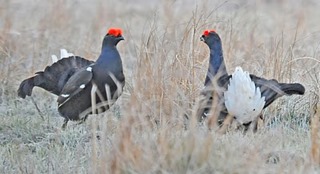
....this one, are two of a set of photographs by Brian Rafferty and I'm not prepared to say more on them as I strongly recommend you visit Brian's website HERE  - or at the top of my sidebar where he belongs - to read about a memorable experience he had this week involving these brilliant Black Grouse. 

Friday, 14 May 2010

Did you know!


Bass Rock. David Cookson.

But first this stunning image of Bass Rock, location for up to 80,000 occupied nests and photographed by David earlier this year.

I've been rooting through some 30 year old Cumbria records and have noted the following ones of interest in varying degrees all from 1980.

King Eider. One recorded from Walney B.O. as it/one had also been the year before in 1979.

Ruddy Duck. A North American species introduced into Britain in 1948, it is thought that over a period of time seventy juveniles flew away from the captivity of Slimbridge. The species was admitted to the official British and Irish list in 1971 and this bird was found on Longtown G.P. on 27 August 1980 and was the first record for Cumbria.

Black Grouse. Was recorded at six locations in Cumbria in 1980.

Corncrake. Records of calling males were collected at three locations.

Little Ringed Plover. This bird is noted as a rarity in Cumbria in the 1980 records and was located at three sites in this year....I must now look up it's status in 2010.

Dotterel. This record I found very interesting and was of a successful breeding at an undisclosed Cumbrian site.

Turtle Dove. Another very interesting record in that it was claimed that over-wintering of these birds had increased over recent years....How things change!

Short-eared Owl. Now this one really intrigued me and gave details of a study of pellet content at a roost near Barrow which it is claimed contained five rings, those of a British Turnstone, plus two British, one Swedish, and one Norwegian Dunlin....amazing.

Stonechat. Showed a recovery from 1979 when there was a decrease in numbers recorded but still remained scarce inland in 1980.

Whinchat. I could find no mention of this species in the 1980 report which poses me the question....was it omitted in error?

Wood Warbler. A good breeding season throughout Cumbria. So how things have changed there in thirty years.

Nutcracker. Walney B.O. had the record of a bird seen on 1 December 1979 accepted by the BBRC. 

 
Bass Rock. David Cookson.