PLOVER SCAR LIGHT COCKERSAND PETE WOODRUFF
Showing posts with label Turtle Dove. Show all posts

Sunday, 23 October 2022

October Chats.

Being the last visit to Hawthornthwaite Fell was on 11 July, I hadn't realised my birding had made such a dramatic nosedive, but I was here on Tuesday, and also back on Harrisend again to find 15 Stonechat on the day.

I was only on the track up Hawthorthwaite for 15 minutes before I found 6 Stonechat, all in this small area of heather looking east in the picture. The birds were mobile, and moving generally south east. Walking on for about 50 metres, when I looked again there was no sign of the birds.

Other than the chats, I saw just 4 Red Grouse and several airliners in the couple of hours spent here.


Whilst spending a few therapeutic minutes by Cam Brook, I was reminded of the smart male Ring Ouzel I saw here on 27 May. This was my fifth consecutive year of finding the mountain blackbird on Hawthornthwaite, only one sighting of which I ever had evidence of breeding here and was a female in flight with food in its bill. 

There was also a pleasant 3 hours spent on Harrisend, where I found 9 Stonechat. As with the Hawthorthwaite birds, five were together in a small area of gorse. Also 4 Raven over and 3 Red Grouse seen.

Clougha Pike From Harrisend. Pete Woodruff.

Wish I had a pound for every Stonechat I've ever seen atop of this remnant of the Hawthorn. I reckon I could get myself a couple of bottles of Jack Daniel's in for Christmas!

The Gannet.


There was a little sadness about a walk along the promenade at Sandylands last week, when I found the corpse of an adult Gannet on the shore, seen as a possible victim of avian flu.

Only a vagrant Albatross in the Western Palearctic is a larger seabird than the indigenous Gannet. Of the worlds breeding population, 48% are found in Scotland. This year there was a 90% breeding failure of Gannet on Bass Rock.

Turtle Dove.

Turtle Dove Hest Bank. Howard Stockdale.

A 1st winter Turtle Dove has been at Hest Bank since 13 October. There has been a mix of opinion about the bird, some seeing it as a sickly bird, dicing with death at the hands of the mutt brigade and their charges, others saying the bird looks well as it does in Howards image, it feeds well, and is a tame individual. Whatever....the bird would be better advised to stay put at Hest Bank, up to 100,000 Turtle Dove are shot annually on migration over Malta.  

Bearded Tit.....Another one of those must see images.

Bearded Tit Leighton Moss. Martin Jump.

Many Thanks to Howard and Martin for sending me these excellent images.

And Finally.

Hummingbird Hawk-moth. Peter Rhind.

Couldn't possibly end this post without mention of the brilliant Hummingbird Hawk-moth which gave us about 60 seconds of pleasure as it checked out the Verbena in our garden yesterday afternoon.

Pity I didn't get a pik of the moth, but I did get 30 seconds of comic relief with these two ponies at Heysham in the week....You scratch my back, I'll scratch yours!

FULL SCREEN....SOUND ON

Monday, 11 May 2015

Sign Of The Times..

Turtle Dove. Author Unknown.

Malta's spring hunting referendum resulted in the country voting in a national poll to allow the privilege of a few to continue to kill for fun in spring. The rapidly declining Turtle Dove and Quail will be/will have been legally shot this spring, along with other species in their thousands. 

Truly amazing this isn't it, it's all illegal under the terms of the island's membership of the EU, and as such they could be thrown out, but nobody does anything about it, or more to the point maybe doesn't want to do anything about it.  


Quail. Author Unknown.

It is unfortunate that amongst other campaigners, an independent team led by Chris Packham last year to address this issue and to confront the shooters, has had no impact this time, but I'm convinced nobody will be giving up the fight against this tragic situation both in Malta and elsewhere in the world.

Meanwhile some slaughtering back home.... 

An interesting thread developed on a local website I visit daily, interesting if only for the one response to a brief comment I made regarding the disappearance of three male Hen Harriers in Bowland recently. 

I've deleted the 
authors name as I have no permission to publish it and am not prepared to do so without it. Iv'e also deleted the opening comments which are irrelevant to the main subject, but otherwise have copied word for word what was said in the thread but not including the sign. 

Pete Woodruff.

Everyone - birders or not - should be aware that three male Hen Harriers have gone missing from active nests in Bowland.

Anonymous

….but I did notice that beneath the road sign denoting the boundary of the Forest of Bowland ANOB (between Dolphinholme and Abbeystead) someone had added a second handwritten sign which read 'Twinned with Malta'.

Pete Woodruff

This is an excellent piece of info 'anonymous'.


The sign you mention is presumably the one depicting the Hen Harrier, which in itself is - and always was - an insult to the species, totally inappropriate, and should have been dismantled years ago. 

Now more bad news. 

More bad news from me is that 'other things' have taken me over for at least four days, but looking like the possibility of a week off the road with no birding/blogging. 

Well, that won't drastically change anyone's life at all....but it certainly will mine. 

Monday, 12 May 2014

Back Down To Earth.

It looks like the curse of other things in life has taken over my birding addiction once again, and to make matters worse it looks like lasting all this week. So my birding is set to be patchy and I'm going to be stuck with grabbing every opportunity I get - when I get it - to put in some time with the birds, which is what I did on Friday when I found myself 5 miles north of Lancaster with a little time on my hands, so off I went to take a look over the Eric Morecambe Complex at Leighton Moss RSPB Reserve for a couple of hours, better than no birding at all and thankful for small mercies.

After Thursdays brilliant Woodchat Shrike experience, I think this mediocre report below is called....back down to earth. 

Sedge Warbler Martin Lofgren 

A Chiffchaff was in song when I pulled into the car park, and I heard my first Sedge Warbler from the path to the hide. I grabbed a brief look at a flight of c.40 Black-tailed Godwit which promptly dropped down out of sight at the back of the flood where I could just make out 2 Greenshank. Between this pool and the Allen Pool there are currently up to 70 Avocet with some first chicks hatched I'm told. Also noted was a 1st winter Mediterranean Gull in the midst of a large number of screaming breeding Black-headed Gull, 3 Pintail, 4 Gadwall, 4 Shoveler, and 2 Little Egret.  


House Martin Astland Photography 

A brief visit to the Lillian Hide was well worth it if only to watch at least 100 Swift hawking, with which I kept seeing a 'few' House Martin and Swallow.

High pressure on the cards mid-week, and amongst lots of other places I need to get to I have a few upland locations in mind. So here's hoping the curse of 'other things' buggers off.   

Saturday, 10 May 2014

The Pipit, The Shrike, And The Dove.

 American Buff-bellied Pipit. Stuart Piner.


I appreciated a personal text message recieved last Sunday evening telling me of an American Buff-bellied Pipit at Cockersands, a MEGA find and a first for Lancashire. Unfortunately for those hoping to see the bird the following day they were to be disappointed as it was never found again.

The nominate race of Buff-bellied Pipit breeds from Greenland, across northern Canada, down the Rockies into the USA. It winters in southern USA and Central America. Until 28 years ago it was treated as conspecific with the Water Pipit.

In 1910 two ornithologists spent the autumn on St Kilda in the Western Isles and found 35 new species of birds to the island. In late September they were attracted by an unusual call amongst a flock of Meadow Pipits which proved to be the first Buff-bellied Pipit Anthus rubescens for Britain, though two previous claims from elsewhere were rejected. Ireland's only acceptable report was of a bird in County Wicklow in October 1967.


I'm grateful to SP for the images of Sundays bird at Cockersands.


Woodchat Shrike. Dan Haywood.

Could I ever have dreamt that four days later whilst on a prowl around the Aldcliffe Marsh area I would find my own rare vagrant in the form of a stunning male Woodchat Shrike, seen as the kind of sighting which goes to spur us all on in our pursuit of birds.

I recalled 28 August 1999 when I was with my much missed mentor John Leedal, watching Honey Buzzard in the Rusland Valley in the Lakes when news came of a Woodchat Shrike found in a hedgerow north of the Eric Morecambe Complex at Leighton Moss and JL and I became instant twitchers and went off to get good views of this bird, a juvenile and not half as attractive as the Aldcliffe male on Thursday. The LM bird stayed on all day here and was enjoyed by many visitors to the site.

A rare vagrant, though it was removed from the list of BBRC birds in 1990, by which time almost 700 had been recorded in Britain, and didn't include in excess of 60 birds recorded Ireland. The bird winters in a broad band south of the Sahara, and breeds across southern Europe, through the Balkans and Asia Minor into Iran.

The first acceptable record of the Woodchat Shrike was of a bird in Bradwell, Norfolk in 1829 which had been shot by a farmer who had the bird preserved and kept in his possession, the bird was recorded by the Paget brothers.

Turtle Dove. Howard Stockdale.

According to a report the following day whilst at the Woodchat Shrike location at Aldcliffe, another rare bird - the Turtle Dove - put in a brief appearance in flight, though no mention of this bird has been made since, it made up a trio of quality birds in our area of North Lancashire over five days. 

I'm grateful to Dan for the image of Thursdays Woodchat Shrike at Aldcliffe, and to Howard for the photograph of the Turtle Dove.

Tuesday, 14 May 2013

Another Afternoon Job.

 Wigeon Martin Jump  


I didn't make it on to the birding scene today until 1.00pm at Conder Green where 115 Mute Swan have taken over Conder Pool, accompanied by 3 Wigeon, 14 Tufted Duck, and a Goosander. In the creeks 2 Black-tailed Godwit one in full breeding plumage, 3 Dunlin, long time no see Dunlin in the creeks at Conder Green. On the circuit, just into a double figure of House Martin at River Winds this year again, with a similar double figure of Swift over the area. Also noted, Sedge Warbler, Reed Bunting, and a dead Grey Heron. Thanks for the Wigeon Martin, another excellent 'pic with a difference'.


Reed Bunting. Howard Stockdale.

At Cockersands, if you'd have been walking a dog you would have been forgiven for thinking Plover Scar was void of birds as viewed off the headland at high tide today, but following a close look I spent the best part of an hour grilling c.3,500 Dunlin, in excess of 200 Ringed Plover, a Whimbrel, and a solitary Turnstone with its back to me and its head deeply embedded into it, and which - for 1.5 seconds - had me jump to attention. Three Eider and a drake Red-breasted Merganser were off the scar, and 4 Wheatear, 4 Linnet and a Skylark noted. A Peregrine Falcon put up the entire c.4,000 aforementioned grilled waders and a Dunlin singled itself from the mass but escaped the falcons talons. I just don't understand how this small wader got away with its life from an attack by this accomplished aerial predator, but this individual killer and small wader proved a point....they don't win them all. Thanks for the Reed Bunting Howard. 


Turtle Dove. Copy Permitted.    

This Turtle Dove was found yesterday in a field 1 mile SE of St Michaels-on -Wyre but not seen since....Certainly a very big 'WOW' bird for our area and beyond. 

Thursday, 27 December 2012

Two Turtle Doves....

....and a Partridge in a pear tree.

Turtle Dove. Copy Permitted.


These two species of birds are once again telling us that some of our wildlife is in crisis, and that they are heading to become just two icons as memories in the 'Twelve Days Of Christmas' festive classic. 

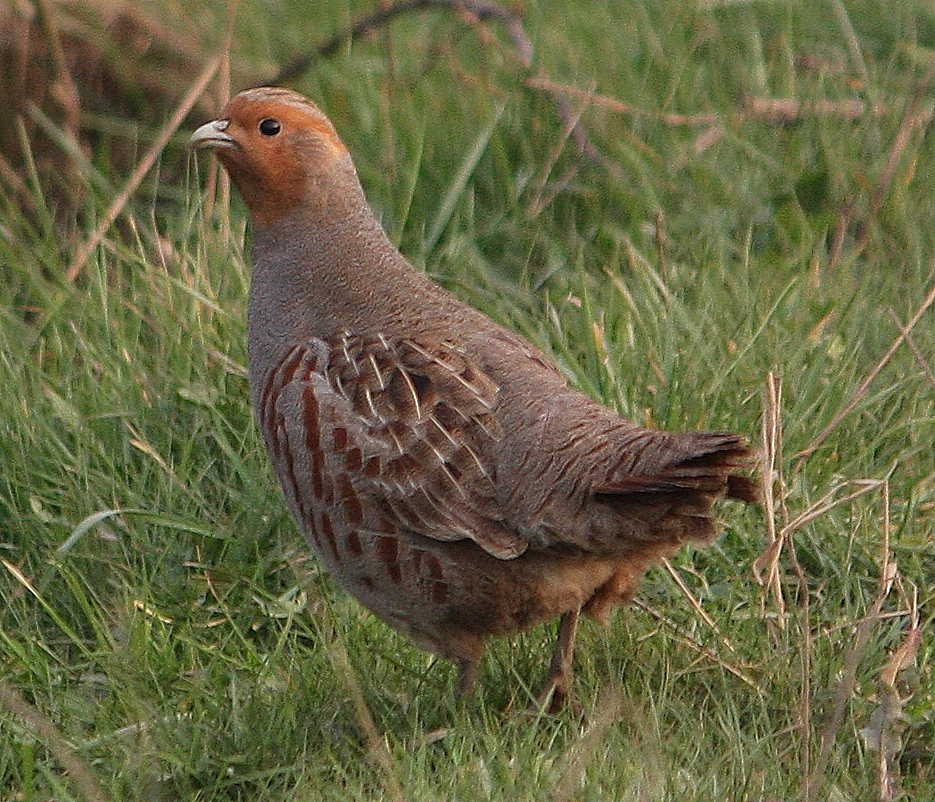
Birds which are reliant on farmed landscapes are continuing to decline dramatically, and the Turtle Dove (TD) and Grey Partridge (GP) are displaying alarming reductions in their numbers. Once widespread particularly in southern Britain, the TD population is hanging on a thread in the UK, with almost 60% lost in the five years to 2010. The loss of six out of ten TD's, and three out of ten GP's over the same period is surely nothing short of a wildlife disaster. The TD is in serious danger of becoming a population of fewer than 1,000 pairs by the middle of the next decade, leading to the distinct possibility of complete extinction.

Grey Partridge Geoff Gradwell


The UK population of Grey Partridge has been estimated at around 43,000 pairs, but this has also fallen by 30% over the same period as that of the TD. One farmer has claimed....with funding for wildlife-friendly farming, increases of Grey Partridge numbers have been noticed, but most noticeable this summer has been up to eight Turtle Doves compared to just one bird. But this farmer goes on to say....with species like the TD and GP in such rapid decline it is of concern that the reform of the Common Agricultural Policy may not ensure funding continues and is enhanced to help the farmer to help his farm wildlife.     

Grey Partridge Geoff Gradwell 


Nine juvenile Grey Partridge of the twelve along with two adults GG saw in July 2011. I can't help but feel these arrived in the UK in cages labelled 'imports' but I wish I could be proved wrong by someone.

Many thanks for the photographs Geoff....A rare sighting of a bird almost a rarity, and therefore rare and excellent images....

Iv'e never seen a Turtle Dove in my life....birding or not birding!

Wednesday, 29 August 2012

In Brief....


....and no names.

Turtle Dove Antonio Puigg 


Its my intention to be brief here, but the escalation of bird persecution throughout the world dictates that I should draw attention to visitors to Birds2blog from around the same world to the intention of a couple of companies - one of which is close to my home town of Lancaster -  which are making arrangements to visit foreign parts for the purpose of engaging in the 'sport' of shooting Turtle Doves....I'll just repeat that in case you think I'm hitting the wrong keys on my keyboard....shooting Turtle Doves.

But there is a glimmer of hope here, in that having sent an e-mail to one of these companies expressing my concerns over these trips I received the following reply....

Many thanks for your email.

As a result of the Turtle Dove being put on a ‘red list’ status by the RSPB, we have recently removed these shooting trips from our website and itineraries.

If we can help in any other way, please don’t hesitate to let me know.

Kind Regards

And the pics.... 


Tim Kuhn: Killdeer  Killdeer
Killdeer Tim Kuhn

I've recently been in touch with Tim to see if he keeps well, and to check if it is still OK that I use his images on Birds2blog. Thankfully Tim agreed it was and so I decided to post a couple of his images of two waders most of us are never likely to see, though it must be said, both have occurred in the UK and are probably likely to again in the future....who knows. 

The Killdeer is a rare vagrant to the UK the last record of which was of a bird in Co Wicklow, Ireland, in December 2009. 

Tim Kuhn: Least Sandpiper  Least Sandpiper
Least Sandpiper Tim Kuhn

The Least Sandpiper is an extremely rare vagrant to the UK and the last record was at Butt of Lewis, Isle of Lewis, Western Isles in October 2007.

Many thanks for these two excellent images which I appreciate very much Tim. Good to know you are well and keeping up the photography which - in the case of them being on Birds2blog -  are a much needed dash of colour and interest on an otherwise gloomy post for reasons not of my doing.

Saturday, 26 June 2010

The Nightingale.


White-legged Damselfly. Warren Baker.

Regular visitors to Birds2blog won't be at all surprised to find the photograph above is totally unrelated to today's subject, but a good picture always gets the post off to a good start. The White-legged Damselfly is uncommon but can be locally abundant on rivers and canals in the south and a few sites in Wales....Thanks for the photograph Warren.

I've found up to twenty Spotted Flycatchers this year at five locations, an excellent result for a bird in serious decline and one I'm particularly fond of and always a pleasure to find and see. The SF joins a number of migrants to this country which are the subject of mounting concern through their - often referred to as dramatic - decrease in populations, three other examples being the Turtle Dove, Cuckoo, and Nightingale.

Nightingale numbers have seen a fall of more than 90% in the past forty years and is the biggest fall since records began of any bird still breeding in the UK to the exclusion of the Tree Sparrow whose numbers have been decimated by intense agricultural practices. So if you were born in 1970, for every ten Nightingales singing in Britain then, now that you're forty there's just one today and that makes for pretty unpleasant reading. We're talking here about one of the worlds most popular songbirds, famous for it's powerful singing in the dark and celebrated by many poet's down the years.

According to research one major cause of the Nightingales decline in Britain is brought about by the population explosion of deer, the browsing of which is destroying woodland undergrowth which the bird nests in. But there are also problems in the wintering grounds as other British species which winter in the same areas of West Africa are also in trouble, including the Willow Warbler, Garden Warbler, and Cuckoo, the former of which I myself have experienced smaller numbers in the areas visited this summer.

All very sad that we are entering an age where many people may not ever have the chance to hear the once familiar sound of the delightful song of this equally delightful songbird. The so called Red List is updated every five years and the Nightingale will appear on that update.   

Friday, 14 May 2010

Did you know!


Bass Rock. David Cookson.

But first this stunning image of Bass Rock, location for up to 80,000 occupied nests and photographed by David earlier this year.

I've been rooting through some 30 year old Cumbria records and have noted the following ones of interest in varying degrees all from 1980.

King Eider. One recorded from Walney B.O. as it/one had also been the year before in 1979.

Ruddy Duck. A North American species introduced into Britain in 1948, it is thought that over a period of time seventy juveniles flew away from the captivity of Slimbridge. The species was admitted to the official British and Irish list in 1971 and this bird was found on Longtown G.P. on 27 August 1980 and was the first record for Cumbria.

Black Grouse. Was recorded at six locations in Cumbria in 1980.

Corncrake. Records of calling males were collected at three locations.

Little Ringed Plover. This bird is noted as a rarity in Cumbria in the 1980 records and was located at three sites in this year....I must now look up it's status in 2010.

Dotterel. This record I found very interesting and was of a successful breeding at an undisclosed Cumbrian site.

Turtle Dove. Another very interesting record in that it was claimed that over-wintering of these birds had increased over recent years....How things change!

Short-eared Owl. Now this one really intrigued me and gave details of a study of pellet content at a roost near Barrow which it is claimed contained five rings, those of a British Turnstone, plus two British, one Swedish, and one Norwegian Dunlin....amazing.

Stonechat. Showed a recovery from 1979 when there was a decrease in numbers recorded but still remained scarce inland in 1980.

Whinchat. I could find no mention of this species in the 1980 report which poses me the question....was it omitted in error?

Wood Warbler. A good breeding season throughout Cumbria. So how things have changed there in thirty years.

Nutcracker. Walney B.O. had the record of a bird seen on 1 December 1979 accepted by the BBRC. 

 
Bass Rock. David Cookson.