BIRDING THE LUNE ESTUARY THE FOREST OF BOWLAND AND BEYOND..RUFF CONDER POOL PETE WOODRUFF
Showing posts with label Cuckoo Bee. Show all posts

Sunday, 16 July 2023

The Dead Duck!

Excuse the pun title, an American slang used politically in the mid 19 century and basically meaning useless....Rings true in the early 21st century, but politics and religion are barred on B2B.

My last two visits to Birk Bank have been almost useless, but truth is, there are never useless birding days, and Thursdays certainly wasn't one. 

Keeled Skimmer Birk Bank 13 July

I had to try for a video of the male Keeled Skimmer because it was the only dragonfly I saw on the day at Birk Bank or anywhere else, and was the only one seen on my previous visit there on 5 July. If this isn't related to the cloudy and breezy weather, then the hot dry conditions of late have had an impact on odonata....Nothing serious I hope!


Towards the end of the video, the Keeled Skimmer sharply lifts its head and opens its mouth....Quite a gape!

There was no sign of life when I went to Cragg Wood to find zilch on the River Conder. On my return to do a double check at the bog, I met Ian Mitchell who told me he had seen just the one male Keeled Skimmer I had found three hours earlier. In our conversation I told Ian I had found 2 Purple Hairstreak in the Oaks east of Ottergear Bridge. When we parted, Ian said he would take a look in the hope of finding a butterfly he had never seen before....There is evidence that he was successful with his brilliant header image of the Purple Hairstreak.

Common Carder Bee/Cuckoo Bee. Pete Woodruff.

At Birk Bank, a Common Carder Bee, and a faded male Cuckoo Bee which I am unable to identify to species.

Sundew Birk Bank 13 July. Pete Woodruff.

And on the bog, after finding Sundew there in August last year, I found more again on Thursday, this time two plants seen. This plant is noted to be in need of protection. 

Garden Hovers.

Some sunny weather brought hoverfly and a leaf cutter bee of interest into our garden, to keep me entertained and to photograph them with their elaborate scientific names.

Eupeodes corollae on California Poppy

Eupeodes latifasciatus on Chicory
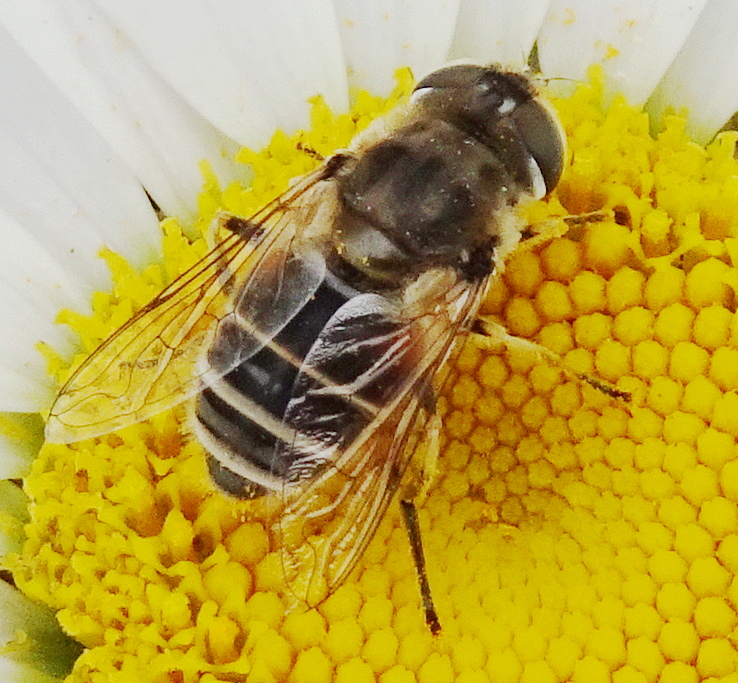
Eristalis arbustorum on Shasta Daisy

Xanthogramma pedissequum on Willow

Eupeodes corollae (right) with Megachile centuncularis (leaf cutter bee) on Elecampane

Sunday, 19 June 2022

Bonanza On The Bog!

I've been having a good old whinge to myself, about the paucity of dragonflies at Birk Bank, having not found one yet, despite two recent visits over the past few days, and it was now mid-June. But Thursday changed all that big time for Steve and myself, when a couple of hours pacing up and down the boardwalk at Birk Bank, with periods of standing and staring, yielded a decent haul of 36 dragonflies, including a couple of date and number surprises.

The day started at Bull Beck were I was keen to establish the Sand Martin situation. I had found none here on my visit 22 April, today we found the bank had partly collapsed and counted just five nest holes, and no more than 30 Sand Martin. But compensation came in the form of a Banded Demoiselle, a good record anywhere in North Lanc's, but overshadowed by 50+ reported at St Michaels on Wyre on Wednesday 15 June. Our individual at Bull Beck was followed a couple of minutes later by a Hummingbird Hawkmoth....A good start to what was to develop into a good day.

Thursday wasn't particularly a birding day, but we were welcomed to the car park on Rigg Lane by a singing Garden Warbler. Just up the track a juvenile Stonechat was on the fence post, seen as a lone individual, it was at least my first proof of breeding here. More evidence of breeding was a pair of Meadow Pipit, with one bird carrying food, later a singing male Blackcap.

Keeled Skimmer Birk Bank Bog 16 June. Ian Mitchell. 

On to the bog, and the surprises came in the form of 5 Keeled Skimmer, including a female seen ovipositing.

Golden-ringed Dragonfly Birk Bank Bog 16 June. Ian Mitchell.   

These were followed by the surprise of the day, when the first of 2 Golden-ringed Dragonfly flew across the bog to go to rest on bracken beyond the boardwalk. This species was more likely to have been seen two weeks later, with average emergence from the beginning of July. 

There was a sum total of 15 Four-spotted Chaser, and 14 Large Red Damselflies, also pleasantly surprising was the count of 32 Small Pearl-bordered Fritillary. Other butterflies were less impressive, with 4 Small Heath and a lone Small Tortoiseshell seen.

Bombus sylvestris. Pete Woodruff.

A saunter along the track to Ottergear Bridge, where we found parasitic Cuckoo Bees Bombus sylvestris on Heather, which is more expected to be in flower in August than mid-June. Earlier we had seen in the near distance, a dragonfly in flight, and eliminating the few possibilities, although like the Golden Ringed Dragonfly an early date, and would have been less of a surprise in a couple of weeks time in early July on first emergence, we concluded it was a Common Hawker

I'm grateful to Steve Graham for his company on what was a memorable day for the pair of us. I'm also grateful to Ian Mitchell for the excellent images including the stunning Four-spotted Chaser header. 

Zebra Spider.

This Zebra Spider was on the frame of our greenhouse, the speed of the hapless insect was such, that my camera wasn't able to record it arriving on the frame. The camera also struggled to record the spider pouncing on its prey, but I did slow the motion down in the second video to show the attack. The Zebra Spider can jump up to 10cm, it anchors itself by gluing a silk thread to the surface it is jumping from, you can see it dangling from the thread after it pounces on the victim....View Full Screen.


Saturday, 16 April 2011

The tale of the TMB!


Another interesting diversion from birds.

Emerging Tawny Mining Bee.

With KT having reported seeing a 'large' number of bees over a friends lawn she had visited the other day I had to go and investigate and soon discovered that KT had witnessed the recent emergence of a colony of Tawny Mining Bee (TMB) like the one in the photograph above leaving her nest.

Female Tawny Mining Bee.

The female TMB with her rich orange-red coat is unlikely to be mistaken for any other bee, she is a common visitor to currant and gooseberry flowers in April-June and frequently nests in the garden lawn where she throws up little volcano shaped mounds around her nest entrance which I found at this location soon after their emergence.

On the other hand....

Cuckoo Bee.

The 60 second video below is quite good and shows the Cuckoo Bee (CB) waiting for the TMB to wander off before entering it's nest to perform it's evil deed. You can initially just see the CB at the bottom of the frame.


The CB gets its name because - like their avian namesake - they are social parasites, they lay their eggs in the nests of various bumble-bees, which then rear the 'Cuckoo' grubs as their own, when the Cuckoo larva hatches they eat the host pollon ball and larva. There are six British species which - like the avian Cuckoo - sticks to a particular host species normally resembling it quite closely. A quite amazing characteristic of the female CB is the fact that it wakens from hibernation when the host nests are already well established making its parasitic behaviour much easier.