BIRDING THE LUNE ESTUARY THE FOREST OF BOWLAND AND BEYOND..............................................................................HUMMINGBIRD HAWK MOTH PETE WOORUFF
Showing posts with label White-fronted Geese. Show all posts

Thursday, 26 February 2026

A Few Hits & A Big Miss!

The hit and miss day started at Conder Pool - no surprises there then - where another first for this amazing site was finding 16 Shoveler present. Seen as migrants in a group never seen in this number on Conder Pool ever before according to my records. Another good record was 2 Gadwall drake, seen as a species I last recorded on Conder Pool 10 years ago, on 8 April 2016.

My other notes from Conder Pool, up to 130 Black-headed Gull, 28 Wigeon, 12 Teal, 8 Tufted Duck, and 2 Little Grebe. In the creeks, 65 Teal and 2 Goosander noted.

Black-tailed Godwit Conder Pool. Pete Woodruff.

Up to 3,000 Black-tailed Godwit were on Conder Pool 2 years ago today 26 February 2024.

I paid an all time briefest of visits to Cockersand to find a female Stonechat playing hide and seek in the long grasses behind Bank Houses, where I spent a little time behaving like someone hunting down the owls and raptors for a picture without success.

Todays big miss came when I drove past Haresnape's Farm twice, on the way to and returning from Cockersand, and failed to spot 135 Russian White-fronted Geese on the north side of the farm....FBC WhatsApp


The Pink-footed Geese were dropping into the field north side of Cockersand Abbey as I arrived on a recent visit here.

Bewick's Swans. Ian Walker.

On the receiving end of a heads-up about some swans at Cockerham, I went off to find 2 Bewick's Swan with 105 Whooper Swan off Hillam Lane.

Thanks to Ian Walker for his excellent image of the Cockersand Bewick's December 2025.  

Black Redstart male Bank End. Paul Ellis.

I then continued down the road to Bank End to gain the brief view of a stunning male Black Redstart before flying off to disappear amongst the farm buildings, then standing around for an hour to see if it returned....I'll leave that story there then!

Thanks to Paul Ellis for the excellent image of this stunning bird.

This female Black Redstart I found on the flood defences 21 years ago at Fluke Hall in March 2005.   

The swans at Cockersand and Cockerham where all over the place today, spread over six fields, and amounted to an estimated total of up to 400 Whooper Swan.

Brown Hare. Pete Woodruff.

On my wanderings today, I found a pair of Brown Hare, they had been behaving like it was the Mad March season, but just chilled out as I got the camera out.  


Videos best viewed Full Screen.

Sunday, 5 March 2023

Geese And Chats.

Thursdays birding was a day that started just about as bad as gets, but soon took off to be as good as it gets as far as geese and to a lesser degree chats were concerned. 

Conder Pool, was virtually void of birds save 4 Wigeon, 2 Tufted Duck, 2 Cormorant and a Little Grebe, and to make matters worse the wintering Stonechats appear to have moved on. But there was a little interest on the coastal path, with the sight of a Greenfinch being no better than an occasional bird here, in fact I'm struggling to recall the last one I saw at Conder Green. Something more positive from Conder Pool, 6 Avocet had moved in on Friday with news published by AC@FBC....But not reported since.

Along with Pete Crooks and J.C.Wood who joined me on Moss Lane, and later in the day Barrie Cooper at Cockersand, to quote Pete Crooks we enjoyed....'the best birding experience currently on offer in North Lancashire'.

Over the 3 hours spent at Cockersand, at one point I estimated a total of up to 5,000 Pink-footed Geese in the air, with 8 Barnacle Geese, and 3 White-fronted Geese seen earlier in fields opposite Lambs Farm on the south side of Moss Lane. 


With the first count made in fields, geese were in the air several times following human disturbance, and up to 4,000 were in this field immediately north of Bank House Cottage.

Worth a mention, over the past few days during these pre-migration gatherings of geese, a peak count was made of 12 White-fronted Geese, with 3 Bean Geese and a Lesser White-fronted Goose per FBC. 

A little wandering had me find 5 Stonechat, seen as two male and a female on roadside fence posts east of Abbey Farm, and a pair on the spoil heaps in the field south of Lighthouse Cottage.

Disturbance.

Throughout my observations of 'the best birding experience currently on offer in North Lancashire' on Thursday, I witnessed or was reliably informed of several incidents of wilful disturbance of geese and swans in recent days.

In addition to my personal experiences, there was disturbance being seen as deliberate a few times in a field south of Moss Lane. Add to this, earlier on Thursday and on two occasions earlier in the week, Whooper Swans had been disturbed more than once in fields west of Jeremy Lane, and on 23 February south of Cockerham, up to 3,000 geese including Bean Geese, White-fronted Geese and Pink-footed Geese were disturbed by 'someone' on a quad bike.


This incident isn't directly related to the current post about geese and swans disturbed in fields, but....Wildlife is a low priority to some, you can educate a minority, but definitely not the ignorant majority! 

Edit.

The 5,000 Pink-footed Geese were flushed this p.m. again today by a farm vehicle deliberately driving through the birds in the same area as Thursday. We have collectively to somehow try to stop this wildlife persecution, but an uphill struggle will ensue. Like I have said....it's nigh on impossible to educate the ignorant!     

Sunday, 26 February 2023

Fourteen Days Later.

Two weeks since my last birding day, one word springs to mind about that....chronic. But I was back in business on Thursday when the day should and could have been a decent one to start and end with a geese bonanza, but wasn't.

To start with, a Fylde birder joined me on the viewing platform, with news that he had been alerted to sightings of a Bean Goose on Conder Pool earlier in the day. As the saying goes - to cut a long story short - I left Conder Pool one hour later unconvinced a Bean Goose had ever been anywhere near Conder Pool.....To end with follows later.

Snipe Conder Pool. Pete Woodruff.

At least 8 Snipe were hunkered down amongst the stones and vegetation on one of the islands on Conder Pool, difficult to see let alone count, and even more perfectly camouflaged than the four Snipe in the image above, taken on Conder Pool 8 years ago in 2015. Three Pink-footed Geese were with a small group of Greylag and around 10 Black-tailed Godwit. Also noted, the Kingfisher obliged with a couple of visits to the sluice, up to 70 Wigeon, and 120 Black-headed Gull. The Stonechat pair were busy at the east end in the long grasses, and a male Ruff was seen in the creeks.

As I drove to Cockersand, I estimated at least 250 Whooper Swan in four fields, mostly distant and inaccessible, including 50% being in fields off Hillam Lane at Cockerham. The visit to Cockersand had to be a success in that I found 7 Stonechat, though the circuit proved quiet, with a Reed Bunting and a Skylark which was in song seeming to pronounce the early arrival of spring. Four Snipe came off the marsh as the tide pushed in.

On Plover Scar c.60 Turnstone and 6 Ringed Plover, and when I got back to Bank Houses, 5 Black-tailed Godwit dropped in and spent a few minutes on the shore before flying off.

To end with, the geese bonanza that wasn't....

As I got back to the motor, I was alerted with a text at 14.08....'3 Bean Geese, a White-fronted Goose, 7 Barnacle Geese, and 2,950 Pink-footed Geese' were on pasture not far from Cockersand. I was set to go but, 6 minutes later at 14.14, another text told me....'geese all flushed by someone on a quad'.....I luv these 'somebodies', lets face it, what would we do without them, well for starters there would be a few more million birds around in the countryside!

Little Egret.

It must be very rewarding to be able to watch a Little Egret in the field behind your house at Cockersand.


Grey Plover.

I must note, since my claim regarding the paucity of Grey Plover on the Lune Estuary and my finding 26 on Plover Scar 9 February, 39 Grey Plover were seen there 24 February per FBC. This record now stands as the best count to date of the Grey Plover on Plover Scar and the Lune Estuary. 

Avocet.

An Avocet made landfall on Conder Pool Wednesday at 11.00am, but didn't hang around very long flying off towards the Lune Estuary and hasn't been seen since. This bird arrived a day earlier than last year on 23 February 2022. 

Sunday, 4 December 2022

An Estuary Dash!

Compared to more like the average six hours in winter, four around Conder Green and Cockersand is a dash in my book. 

Conder Pool continues to be almost void of birds recently, with no muddy edges and looking more like Conder Lake following the recent high tides, but I did note a pair of Goosander, 3 Little Grebe, 3 Greylag, and a 'few' Wigeon with probably more in hiding behind the islands. During an hour spent at Conder Green, I counted 16 Blackbird, 12 of which were counted in a few minutes from the viewing platform feeding on berries along the canal side.

Stonechat Fairhaven Dunes. Paul Ellis.

At Cockersand, the negatives first, there was no sign of the winter Wheatear or any Snow Buntings. The positives were, 2 Stonechat seen, one along Slack Lane, and another in the rough field behind Lower Bank House which is a favoured haunt annually of the wintering Cockersand chats. Can never resist the image of a Stonechat....Many Thanks to PE.

In the area around the Caravan Park, 16 Greenfinch were a count exceeding any I've made anywhere for some time, also a bouncing flyby of c.30 Twite destination Bank End it seemed. A lone Tree Sparrow was the first seen in 12 months when I saw 3 at Bank Houses on 14 December 2021, also here today, a lone Fieldfare was my first of the winter.

The only notable reward for a circuit trundle was up to 500 Black-tailed Godwit off Crook Farm, and I saw an egret seeing off another which looked a bigger bird, probably the Great White Egret I saw on the estuary 14 November. I took my eyes off them for a moment, but noticed one made a U turn and went down to a pool off Plover Scar. I thought this was the larger bird, but the video proves me wrong....again!!

Garden Birds.

We had 10 Goldfinch in a flock visiting the feeders yesterday. We also have a healthy resident flock of House Sparrow this year. There are up to 30 in the video....Watch 'em disappear in sync at the end...Sparrowhawk around perhaps.


Thanks to Howard Stockdale for the record image of 9 White-fronted Geese in the header, present at Aldcliffe on Wednesday 30 September.

And Finally.

I wanted to end the post to feature this photograph of a Grey Wagtail. 

Grey Wagtail. Martin Jump.

Firmly in the stunning category, with thanks to Martin Jump.

Sunday, 1 March 2020

A Wild Goose Chase....

....turns into a dead duck!

I'm often heard to say things like 'every birding day is good birding day' and rarely have cause to put my birding down, but Thursday was an exception to the rule.

Five White-fronted Geese were reported on Aldcliffe Marsh on 16 February, since then they have been seen on Heaton Marsh and were reported to be conveniently there on Wednesday at the corner of the Snatchems and Overton Roads. So Thursday, full of hope, I set off to the location....Nil, but heyup, there's around 300 Pink-footed Geese on the opposite side of the river on Aldcliffe Marsh which I scoped to no avail and found no WFG with them.

Off I went to Knowleys Road at Heysham to see if the Brent Geese were there, they had made a return to Heysham on 20 February. A week later they were seen again, seen as two adult and four juvenile, in which case the Canadians had returned as a family group....great stuff. 

But today was turning out to be a bad one for me, no WFG at Heaton Marsh, and no BG at Heysham despite eight being reported there earlier in the morning, but if they were keeping to a pattern they built up previously they would perhaps now be at Red Nab, so off I went.

No sign of the Brent Geese at Red Nab, nor did I find the earlier reported Little Gull and Kittewake over the outfall, despite legging it to the south wall at the harbour, followed by a visit to Ocean Edge salt marsh, where there was no sign of the recent Stonechat.

Ne'r mind, in the end it was exhilarating seeing the tide roll in at Half Moon Bay before I threw the towel in on a bad day at the office.


View Full Screen

Tuesday, 7 February 2017

Good Quality Geese....

....and 406+ good quality swans too.

Pink-footed Geese Brian Rafferty  

As I drove along Moss Lane yesterday, the geese were in fields at Thurnham and I pulled in to get good views which got better from an advantage point later off the A588 during which time c.2,000 went into the air north of Hillam Lane to make a total of at least 5,000 Pink-footed Geese which were accompanied by 3 White-fronted Geese and a Pale-bellied Brent Goose....See these geese - 'clik the pik' - as they really should be seen. Thanks Brian.

It was a biting wind to stand in and count geese, so I drove to Cockersand to thaw out, and saw 6 Bewick's Swan at Clarkson's Farm, with the herd of c.400 Whooper Swan noted again.  From here I went to check out the Lune Estuary at Glasson Dock, where I reckon there was initially in excess of last Friday's 550 Black-tailed Godwit, but which took off in a dread as I arrived, some of which flew south and inland towards Jeremy Lane. Also of note, up to 100 Golden Plover, and 8 Goldeneye which were both low counts, in the case of the GP's extremely so. On the canal basin I saw 3 Goosander

On the way to Conder Green I heard the Song Thrush singing again around Saltcote Cottage. At Conder Green, the Spotted Redshank and 2 Little Grebe were in the creeks, and the Common Sandpiper was again seen towards the iron bridge....if your looking for a guarantee to see this bird, I recommend starting here.

White-fronted Geese.

Greenland or Russian....A pretty good short video - best seen Full Screen - for White-fronted Geese ID, albeit windy and not ideal conditions, though that's what the situation often is when your trying your best to get to grips with ID.


Wednesday, 18 January 2017

Geese, Swans, And Ducks.

The Geese.

Pink-footed Geese. Pete Woodruff.

I reckon there's about seventy five geese in this picture, a small group of the c.2,500 Pink-footed Geese I saw in a field off Jeremy Lane on Monday, with which I found 3 White-fronted Geese.

The Swans.

Just west off the A588 at Thurnham, 8 Bewick's Swan were in the field on the left off Moss Lane, and the herd in fields towards Cockersand are even more spread out now, from west of Thursland Hill and south towards Bank End, there appears to be still up to 300 Whooper Swan, though I made little attempt to assess them today.

The Ducks.

Yet another peak count arrived at on the Lune Estuary at Glasson Dock when I counted 37 Goldeneye drifting by on the rising tide, they appear to have deserted their favoured canal basin for the time being.

And some other birds.

Conder Pool was pretty deserted, though I noted the currently resident 3 Goosander still on here, with 3 Little Grebe noted in the tide flooded creeks. As the tide raced in I saw c.600 Golden Plover loafing on the mud at the Colloway side, with 45 Snipe, 32 Black-tailed Godwit, and a Spotted Redshank all viewed from the bowling green.  

The tide was at it's height at Cockersand, any waders around were in the fields with a mix of at least 500 in the Abbey Farm area, most notable was a good number of Turnstone, with Golden Plover, Dunlin, Redshank, and Lapwing. The flock of 80 Twite were flighty between Bank Houses and the shore, with 15 Linnet seen.

Life in the fast lane isn't all that easy anymore, and my birding opportunities are at a low at the moment, but hopefully I'll be back in business on Friday to check out what the local estuary birds are up to.

Thursday, 25 February 2016

Here And There....

....but I can't be everywhere!

I was grateful for a text I recieved on Tuesday morning telling me of geese in the Thurnham area. Though I put in my best efforts I did'nt get there until around 11.00am just as they were disturbed to fly off south and out of sight. I returned about four hours later at 3.00pm to find the area deserted. Not my lucky day, there had been 2 White-fronted Geese, and 7 Barnacle Geese with c.4,000 Pink-footed Geese....Pooh! 

I decided on going south to see if I could find any Fylde Fayre that might excite me, and called at Wrampool for my second showing of the male Stonechat there for three months now since 22 November, the bird appeared to be feeding well in the set-aside whilst I was there. By comparison to the usual high numbers seen here recently, little more than 8 Linnet seen today, with a Reed Bunting noted.

Twite. Fluke Hall. Pete Woodruff.


It took a while to find them - I'd been looking in the wrong area - but eventually up to 60 Twite were in the field and hedgerow behind the car park at Fluke Hall, at least 8 Skylark were in the same field, and in the hedge 2 Linnet, a Reed Bunting, Great Tit, and Goldfinch seen.

At high tide wader numbers by usual standards weren't all that impressive off Pilling Lane Ends, though good numbers of 17 species were noted, most notable but uncounted were, Grey Plover, and 2 Snipe, with a few Skylark and Rock Pipit. I scanned c.2,000 Pink-footed Geese a couple of times to find nothing odd amongst them, and heard a Little Grebe whinnying somewhere on the west pool.

A look in on the Lune Estuary at Glasson Dock on the way back to Lancaster had me note, c.600 Golden Plover, 450 Curlew, 45 Black-tailed Godwit, 2 Bar-tailed Godwit, and 12 Goldeneye.

The Bar-tailed Godwit.


Bar-tailed Godwit Brian Rafferty

The Bar-tailed Godwits have disappeared from the Lune Estuary and beyond. Albeit I made an exceptional count of up to 2,000 two weeks ago on 10 February and two other records made at Glasson Dock barely reaching 100 this winter, I've seen just two birds here on 18 and 23 February, and a single bird at Cockerham Sands 21 February, I don't recall seeing any other reports anywhere....Where are all the Bar-tailed Godwits?

Saturday, 3 January 2015

Buses, Boots, And Binos.

The last days birding of 2014 for me was on Tuesday, the initial plan was to walk along the River Lune from Skerton Bridge in Lancaster, do a loop of Aldcliffe and return back to Lancaster, in the end I walked all the way to Glasson Dock.....as it turned out, quite a good decision. 

This is an excellent 5 mile birding walk on which today I encountered - and noted in the little black book - a few thousand gulls and waders, Oystercatcher/Curlew/Lapwing/Golden Plover/Redshank/Dunlin, and good numbers of small birds not all noted here below....

Song Thrush. Martin Lofgren @ Wild Bird Gallery

Highlights were seeing 3 Song Thrush together - not an every day occurrence these days - finding 40 Blackbird along the way, with 12 Robin another excellent count, at least 90 Redwing in a field adjacent to Ashton Golf Club. On the river in Lancaster I found 4 Goldeneye and 6 Goosander, and on Freemans Pool, notable were 6 Gadwall, a duck I'm always pleased to see, and a Sparrowhawk flew across the pools. Around the mainly frozen wildfowlers pool I noted 22 Moorhen pecking away in a line.  

White-fronted Geese Jan Larsson 


Frustration took a hold on Aldcliffe Marsh when I picked out a distant Barnacle Goose with c.150 Canada Geese, and five smaller geese which were obviously 5 White-fronted Geese, but which instantly took off the minute I put my binos up and disappeared over the by-pass road towards the fields around Oxcliffe Road where I could see a 'few thousand' Pink-footed Geese in the air. 

Also noted along the coastal path, 3 Greenfinch, 2 Dunnock, 2 Mistle Thrush, and a Meadow Pipit. By the time I got to Conder Green dusk was setting in, but I picked up the Common Sandpiper in the creeks, and in the semi darkness I saw 10 Little Grebe, six in the creeks and four on Conder Pool. I then had to hot foot it to Glasson Dock....my bus was due.

Thanks to Martin and Jan for their photographs, they are much appreciated.

Sunday, 17 November 2013

Teal Bay & Migration.

Another of those compromises with KT whilst on a visit to Morecambe had us at Teal Bay just after high tide when the waders were assembling to feed and I noted in excess of 1,000 Dunlin, 55 Black-tailed Godwit, and a 'few' Knot. A female Scaup was off here, with 3 Pintail, 6 Wigeona Red-breasted Merganser and 4 Great-crested Grebe2 Little Egret were in the area.


Great-crested Grebe Martin Jump

An interesting record of note was of 124 Great-crested Grebe off Starr Gate at Blackpool today Sunday 17 November.

Migration.

There were predictions of huge movements made last week, some of which came true when almost 60,000 Wood Pigeon were counted flying over Swanscombe Marshes in Kent in a single morning, Fieldfare also arrived in number when 20,000 were counted coming in off the sea in one hour in Norfolk. Cold winds straight from Greenland and Iceland look like they could bring snow to parts of the UK, along with Greenland White-fronted Geese....

Ross's Gull. Pete Woodruff.

 ....and maybe a Ross’s Gull taking refuge on Plover Scar at Cockersands!

The Ross's Gull is a stunningly beautiful bird, and one of the most stunning of all the gulls. My photographic efforts of the bird at Lytham St Anne's in April 2008 resulted in the brilliant sun at the time bleaching out the birds pale grey upperparts to make them appear brilliant white.

Friday, 1 November 2013

The Cockersands Crawl....

....and ten minutes at the dock.


 Penduline Tit Noushka Dufort


Other than being a bird, this image of the Penduline Tit - a vagrant from central or eastern Europe - is nothing remotely connected with what follows, but its a stunning photograph of a stunning bird. Thanks Noushka.

Stock Dove. Copy Permitted.

I made another three hour 'crawl' around Cockersands on Wednesday and found 2 Mediterranean Gull both adult, and 5 Stock Dove in the 'Lapland' stubble. Between Crook Farm and Plover Scar I noted 43 Black-tailed Godwit, 4 Bar-tailed Godwit, up to 200 Dunlin, with uncounted but nothing like big double figures of RedshankLapwing, and Curlew, 3 Eider, and a Sparrowhawk. The rest of the time spent here turned out to be a void, empty, fruitless affair, and I ended up counting in excess of 100 Herring Gull on Plover Scar. Now when you're birding is reduced to counting Herring Gull its time to go home and think about taking up knitting!

With a few minutes to spare on the way back to Lancaster the Lune Estuary at Glasson Dock showed little of note, but I eventually picked up a - routine these days  - Mediterranean Gull and noted 2 Red-breasted MerganserBut by now it was 4.30pm, the light had been fading for thirty minutes, and the rain was coming in....its winter.

Twite and Stock Dove at Cockersands.


Twite. Howard Stockdale.

I'm reliably informed of 11 Twite at Cockersands last Saturday 26 October. Thanks for the photograph of one of them Howard....look no rings! Also at Cockersands on Wednesday, 60 Stock Dove reported, an unprecedented record hot on the heels of another unprecedented record here of 17 Greenland White-fronted Geese last Sunday.

Monday, 28 October 2013

The Pale Swift.

One or two Pallid Swift have been seen in the country including in Norfolk and other east coast locations, with more than one bird seen on the south coast in Kent.

Pallid Swift. Marc Heath.

The Pallid Swift is so closely similar to the Common Swift that it mitigates against its discovery, and an individual found in Cleveland has caused some discussion about its ID. But if you use the link below to see the discussion, be warned it was six pages long last time I viewed it but very interesting HERE


Considering the species is locally common in the Mediterranean, and breeds as close as southern France it is remarkably rare here. An interesting historical fact about the Pallid Swift is that the first record for the UK lay in a museum for 77 years after being collected at St John's Point in Co Down, Ireland in 1913, before being positively identified in 1990. The first record for Britain was at Stodmarsh, Kent in 1978. 

Pallid Swift. Marc Heath.


Thanks to Marc Heath for his excellent images of the Pallid Swift he saw at Foreness in Kent, in particular the lower image which shows the bird about to take an insect....Amazing Marc and many thanks.

Nearer home....

 
White-fronted Goose.Copy Permitted.

An amazing 17 White-fronted Geese - an unprecedented record - were found at Cockersands yesterday in a field at Abbey Farm. Struggling to find a photograph of adult birds, the one above is of a juvenile at Eagland Hill on 17 October....Beware of what you may think is a Greylag in the middle of 10,000 Pink-footed Geese perhaps!

Firecrest Martin Lofgren

And a little gem the Firecrest was found on the South Harbour Wall at Heysham yesterday too, and was still there mid-afternoon today. And these records are topped by a Black Redstart at Heysham Harbour today, and one on the sea defences at Heysham near Grosvenor Road yesterday. 

So who was it said birding the west coast will never be birding the east coast. Well maybe it won't ever be....quite!!

                                     Red Deer Grisedale Hide Leighton Moss. Copyright Paul King.

Leighton Moss RSPB Reserve, Lancashire. Autumnwatch 8.00pm BBC 2 Tuesday for four nights....be there.

Yes you guessed it....I'm off the birding scene once again.

Saturday, 24 December 2011

With Best Wishes.


By way of a change from the birds, I've been looking back on 2011 with regard to butterflies and have discovered how the hot dry spring and the warmest autumn on record had many species appearing much earlier and much later than in a typical year with some on the wing from early March to December.

Black Hairstreak. Steven Cheshire. 

The endangered Black Hairstreak was recorded this spring in May, a month ahead of the norm for the species.... 

Lulworth Skipper. Copyright Steven Cheshire.

....and the Lulworth Skipper - which is restricted to the south in Dorset - was also seen on the wing several weeks earlier than is usual, as was the Pearl-bordered Fritillary.

Grizzled Skipper. Copyright Steven Cheshire.

And my personal favourite of the three is the Grizzled Skipper - a little beauty - also emerged weeks ahead of the normal date in the warm spring weather. Red Admirals were still being recorded on the wing in the mid-December run-up to Christmas, and a rare Marsh Fritillary was seen in mid-September almost two months after the butterfly should have disappeared for the year.

The warm autumn weather also saw a large influx of migrant moths from Southern Europe with species such as the Crimson Speckled and the Vestal being seen into October. Other moths - including one with the bizarre name for December of Spring Usher - have been recorded regularly since November, months earlier than you would expect to have them appear, and the Humming-bird Hawk Moth is thought to have had its best ever year in the UK with in excess of 9,000 records submitted beating the previous one of 6,500 in 2006....intriguing stuff! 

Painted Lady. Copyright Steven Cheshire.


On a personal note void of a records search I rate my self lucky to recall finding one Painted Lady this summer on 7 July at Cockersands and don't remember seeing more than a couple of records from other observers in our area in the entire year. Thanks to Steven Cheshire for four excellent butterfly images.


Well....I still can't get to see these views of Conder Green. These were taken at high tide one day during the freeze of last year as seen from the viewing platform at Conder Pool, a couple of photo efforts by yours truly. But don't worry, I know all about the influx of large numbers of White-Fronted Geese into the UK and a good many more Bean Geese than is the norm, and the comings and goings of all the rare and scarce birds both nationally and locally like the....

Glossy Ibis. Colin Bushell 

Glossy Ibis at Leighton Moss above - thanks for the image CB, much appreciated - and the Glaucous Gull, Snow Geese, Snow Buntings, Shore Larks, and Great White Egret to mention but a few.

Greater Yellowlegs. Gary Jenkinson

And the Greater Yellowlegs which GJ saw in Northhumberland last month is almost certainly the very same bird now present in the Highlands of Scotland, its wintering grounds being in the southern coastal areas of the USA. It's interesting that given both the Lesser Yellowlegs and Greater Yellowlegs  are long distance migrants the number of records in the UK are something in the order of up to 300 of the LY yet little more than c.30 of the GY. Incidentally, the first record for the Greater Yellowlegs in Britain was of a bird at Tresco on the Isles of Scilly in September 1906, and the Lesser Yellowlegs 52 years earlier in Nottinghamshire in 1854. Thanks for the image Gary, much appreciated.

Thanks for the comments in 'At it again!' they are much appreciated, and....I'd like to wish everyone who supports/visits Birds2blog and reads this post despite the continuing attempts to keep it afloat until normal service is resumed....A VERY HAPPY CHRISTMAS and many hours of excellent birding in 2012....I'm sure I will....eventually!

And finally....I'd like to pass on another Christmas Wish sent to me by one of my ardent supporters and good friend who - like so many others - obviously knows me well....

Monday, 21 March 2011

Walkies!

Not the most appropriate of titles, not particularly original, and doesn't sound like one for a birding blog but....


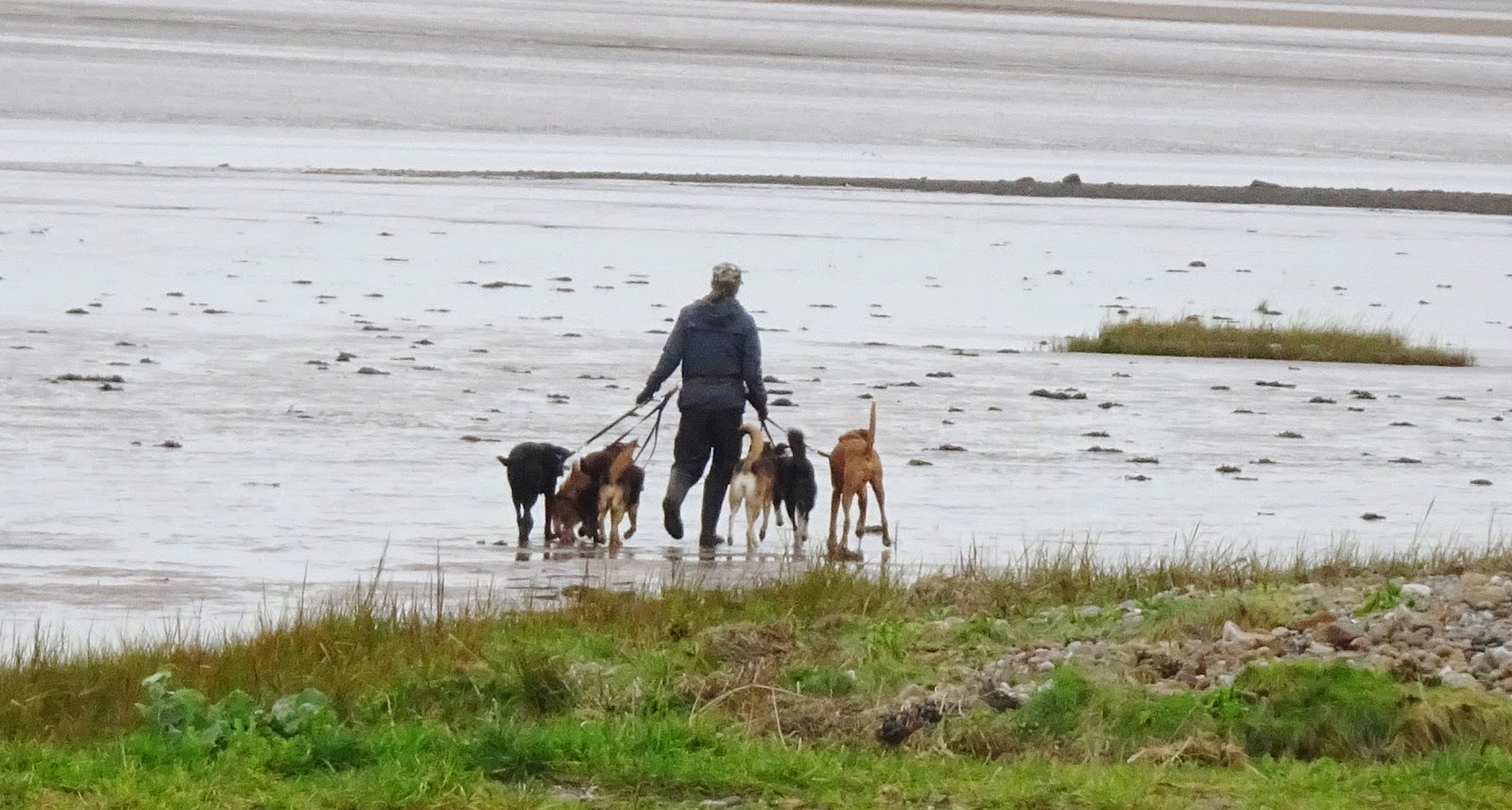
I found this posted at Aldcliffe today, something in my view the birds/wildlife of Aldcliffe Marsh and surrounding area could well do without 'cos if these people get new customers from this advert - and thats the idea - bet your life their coming here to Aldcliffe and they'll beat the record of the two women at Cockersands recently with 18 of these creatures. Just one more note, I don't like the sound of 'off the lead'....so thats within the law now then is it with the 'on the lead' law scrapped?  

As usual on a Monday I was 'working' within a time limit and I soon forgot the idea of Conder Green etc as the tide was a mega one and almost at it's height submerging just about everything including the roads, but I did see a Spotted Redshank at CG, and from Bodie Hill, 2 Little Egret, c.130 Black-tailed Godwit, and c.45 Bar-tailed Godwit before deciding to give Aldcliffe a couple of hours.

I noted 2 White Wagtails around the flood with 14 Pied Wagtails, 2 male Bullfinch, a single Reed Bunting, and a Greenfinch. The biggest surprise here today was the sight of a pair of Gadwall - a species averse to a marine environment - on the River Lune with 18 Wigeon, completely out of context, and certainly a first for me. I found just one Greenland White-fronted Goose today with c.4,000 Pink-footed Geese as opposed to two seen here last Friday when circumstances - not least of all distance - prevented any assignment to race.

And finally....

Buzzard. Phil Slade  

If you're looking for a photograph of a Buzzard to study underpart plumage detail this is an excellent one.