BIRDING ON THE LUNE ESTUARY AND THE FOREST OF BOWLAND...................................CURLEW SANDPIPER/RUFF/LAPWING CONDER CREEK PETE WOODRFF

Wednesday, 24 November 2010

Iceland Gull.

But first....

Bowland. Peter Guy.

Anyone who follows Birds2blog will know how much I appreciate any/all photography and I can no longer resist posting this excellent image of the early morning sunrise through the trees just on the east side of Trough Bridge near Tower Lodge. Thanks for this Peter....pretty impressive stuff.

Iceland Gull. Ian Tallon.

There's been - and still remains -  an Iceland Gull (IG) at Preston Docks since 19 November, the bird was first found on the River Ribble the day before. The IG is a regular visitor to Britain and in the main are immature birds, they breed on cliffs and offshore stacks across northeast Canada, Baffin Island, and east to Greenland, they winter south to New England, the eastern Great Lakes, Iceland, and northwestern Europe.

From over 550 ring recoveries only seven were of movements outside the local breeding area, two of which were immatures which reached northern England and northeast Scotland, they are the only two IG's ringed in Greenland to be recovered here, another one demonstrated the potential for movements from Greenland to North America with this individual recovered in Labrador.

Although there is variation from year to year estimates wintering in Britain are between 100-200 annually, as is often the case influx years are related to unfavourable weather conditions further north. A small number of reports involve long staying birds with an extreme case of one in Dublin, Ireland from October 1968 for over eighteen months until May 1970.

The vast majority of winter records in Britain are of birds of the race glaucoides which breeds in Greenland, but there are also records of the race kumlieni which breeds further west into Canada, but the degree of plumage variation is such that it is difficult to establish a clear distinction between the two and many birds cannot be readily distinguished in the field, as a consequence the British Birds Rarities Committee have taken the stand that records of birds showing characteristics associated with kumlieni should not be differentiated from those of glaucoides.

Some brief data of a bird which interests me very much. Thanks for the photograph Ian, I'd suggest some telepathy at work here as you sent me the pic at the same time I'd decided to 'look up' this fascinating gull.

It was excellent to see at least 50 Waxwing the nearest to my home they've ever been, in trees by Bowerham School this afternoon.

Tuesday, 23 November 2010

Reality Birding.


The reality of my birding today was the fact that in 5.5 hours in the Bowland uplands fringe of the Clougha/Birk Bank area I found nine species and - excluding the counts of just two of them - totalling just seventeen birds, just as a reminder....this is in 5.5 hours no distractions and serious searching.

Windy Clough. Pete Woodruff.

Having found no Stonechats again on here I have decided to give the area a break perhaps until next April. Particularly with the Stonechat in mind there seems little if any point in pursuing an already established fact that there are no birds on here or almost all other upland locations, in fact from personal observations and the reports of Stonechat in coastal areas amounting to no more than three/four birds with a pair seen at Cross of Greet Bridge the other day, it remains to be seen how long it will take to 'build up stocks' again. The pic above is a small section of Clougha known as Windy Clough, an area I only once ever attempted to attack which  I found to be not much fun but a little adventurous.

I decided to note everything - other than a very few corvids and gulls - I saw today, otherwise I was in danger of returning home with an empty notebook. The best results were up to 200 Fieldfare - of course some could very well have been Redwing - seen distant on Littledale Road from Birk Bank, and an excellent count of 48 Red Grouse including two flocks of 15 birds in flight, something I've not seen here or anywhere before and I think the total being the highest count ever in my book. Also noted, 5 Blackbird, 4 Robin, 3 Wren, 2 Blue Tit, a Coal Tit and Mistle Thrush.


It will always be easy to find this kind of disregard for our countryside and is a war we'll never win, but in my opinion these kind of people are just as big a threat to our heritage as any other type of threat. This example was in the car park on Rigg Lane and although admittedly causes nothing nor anyone any harm it simply shows no respect for such areas which demand it.  

I note with interest of a Willow Warbler seen today south of Freckleton, apparently near Freckleton Boatyard along the Lancashire Coastal Way.

Monday, 22 November 2010

Here and there.


But first....

Iceland Gull. Mike Watson  

An excellent photograph of the juvenile Iceland Gull currently present at Preston Dock and obviously showing well as the picture above clearly illustrates, more via the link below the photograph....Thanks for this Mike.

I paid two visits to Conder Green today, the first one was abandoned until the tide receded when I returned three hours later. Birds noted were a Kingfisher, Goldeneye, 2 Wigeon, and 2 Little Grebe all on Conder Pool, two of the latter were in the creeks along with a solitary Black-tailed Godwit, Greenshank, Spotted Redshank, Common Sandpiper, Grey Plover, Red-breasted Merganser, a flock of 14 Chaffinch were also of note from the coastal path.

On the canal basin at Glasson Dock, a Little Grebe and 6 Pochard interestingly two of which were female, much more unusual than the drakes on here as per past records. On Glasson Marsh, educated estimates of 5,000 Lapwing, and 2,000 Golden Plover.

Little Owl. Phil Slade

From Jeremy Lane the Little Owl was on the roof of the old farm building once again, this one isn't it but is one of 'Phil's birds'....Thanks Phil, an excellent photograph of the smart Little Owl.

I decided to give Cockersands a miss today and went off to the Pilling area where I saw 10 Whooper Swans way out at the seaward end of Pilling Marsh, with c.350 Pink-footed Geese seen, on the sea I noted a single Great-crested Grebe, 2 Red-breasted Merganser, and a 'few' Pintail. I was looking forward to a good grilling of the excellent stubble field's off Fluke Hall Lane but with the usual unpredictability of birds was disappointed as the field's where totally void of birds. At Fluke Hall a short circuit resulted in at least 22 Meadow Pipits in stubble, and c.350 Jackdaw were also of note in a ploughed field. Single Little Egrets seen on the day were....Conder Green, Glasson Marsh, Fluke Hall, and 2 on Pilling Marsh. 

And finally....


Nothing glamorous about the pic of the boat above but it isn't supposed to be, for those acquainted with Conder Green you will know this boat. I've no idea how it got there but I picked up a Stoat running along the rim of the bodywork of this boat soon followed by it disappearing into the hull from whence it came out with what I took to be a Rat in its jaws but it quickly disappeared once more never to show again before I ran out of waiting time. I remain mystified by how this animal actually got on to the boat....not via one of the ropes surely!  

Saturday, 20 November 2010

A 'pecker and a wader.


But first the wader....

Turnstone. David Cookson

An excellent portrait image of one of my most favourite waders the Turnstone, a bird I must say more about sometime soon in a 'gap filler' between my birding. A brilliant photograph David for which - along with the LSW below - I am truly grateful.  

Lesser-spotted Woodpecker. David Cookson

I was prompted to make a few brief notes on the Lesser-spotted Woodpecker (LSW) when I found this image of DC's, a bird you'll be hard pushed to find in our recording area in North Lancashire where it bred in the Silverdale-Leighton Moss area during the 1960's and 70's with frequent records during the 80's. In 1978 three pairs of LSW bred at a location on the River Lune with one or two annually until the mid-90's, apart from a single pair at Melling in 2000, no breeding has ever been confirmed in the Lune Valley since. To the south of Lancaster nesting was recorded at Scorton and Street Bridge between the early 1960's and 90's with only occasional sightings since then, the most recent I'm aware of was of a male - at a site I'm not at liberty to disclose on Birds2blog - in the spring of 2003, surely raising the possibility of a breeding foothold of this reclusive little bird.

It is the reclusive behaviour of the LSW which makes the species a difficult one to observe/survey but it has been shown to be restricted to England and Wales having never been recorded in Ireland, in this country it is also absent from the uplands and treeless lowlands. The LSW has declined at sites with a high density of Grey Squirrel, although the Great-spotted Woodpecker is a more likely predator which - if some opinion is to be considered - will also evict LSW from their nest holes.

The combination of a scarce and declining species that inhabits a difficult habitat means that further required research into the LSW will be something of a challenge. With regard to our own recording area I reckon there are isolated pairs of breeding LSW somewhere out there, finding them is another matter, but I've been in touch with someone recently who has told me he's going to take me to a location where he almost guarantees a sighting of the LSW....I'll let you know the result.

I'D SOONER BE BIRDING!    


Friday, 19 November 2010

Going from bad to worse!


Well it didn't go from bad to worse actually as it started quite well and ended quite well too, but the bit in the middle was almost crucifying, in any case you should read 'Straight Talk' by Alan Tilmouth before my miserable records from today's efforts with JB/BT, as it says just about everything I would have said on the matter had I decided to.

Linnet. John Bateman.

Thanks to JB who took the photograph of the female Linnet last Tuesday near the set-aside at Cockersands which has attracted an estimated 200 'finches' at times.

So off we went in the direction of Kendal in search of Waxwings - not my kind of birding but there you go - we called in at Pine Lake to see the Slavonian Grebe giving good views in good light at the eastern end of the lake. Now the day becomes a bloody bore to be perfectly honest as we call at Holme Mere to find everything taking to flight as we arrived but I did get the chance to note a solitary Pink-footed Goose flying off with Pochard, Wigeon, and Tufted Duck. Now we're at Sizergh Castle for goodness sake looking in vain for Hawfinch and if I'm not careful I'm going to scream like a spoilt little brat. We came away from here with 4 Long-tailed Tits in my notes. 

Now we're at Kendal driving round Kendal Green looking for bloody Waxwings, followed by a run up Appleby Road looking for the same,  well OK I know they're an enigmatic bird but....come on, from a personal point of view I'm trying my best to convince everyone that I really am a birder!

We're now into our fourth hour of the day just riding around and I'm silently becoming something of a wreck, but wait - in keeping with the title of today's post it's - 'going from bad to worse' - 'cos now we're in the 'Hawfinch Hunters Heaven' at Woodwell, this is not funny anymore and we leave with a Jay and 2 Coal Tits in my notes.

But wait....nearly five hours into the JB/BT/PW Friday and the final push in search of the 'target bird' found us on Stankelt Road in Silverdale and yes you guessed it, 20 Waxwings at the junction of Stankelt Road/Hazelwood and all's well that ends well....Alleluia and Amen.

And finally.... 

Lanceolated Monklet. Colin Bushell. 

Two young little beauties in Peru with my thanks to CB who recently returned from his trip there, his website is HERE for some more accounts and photographs of trips to the Amazon and beyond. 

Thursday, 18 November 2010

The Kingfisher.


For many of us the Kingfisher in usually seen as an electric blue streak as it flashes by close to the surface of a stream or river.

Kingfisher. David Cookson.

I've been watching Kingfishers at Conder Green for almost 20 years now, a coastal area on the estuary of the River Lune and can truthfully claim to have observed the bird perched just as many times as in flight. This location is as good as anywhere within our recording area to see the Kingfisher having personally amassed nearly 200 records of the bird over the years.

I noted the following records about 7 years ago now - so for this reason obviously not up to date - and in 2003 I drew up an article which claimed that I had only recorded the Kingfisher at Conder Green during the months between July - November, therefore between this period of about seven months I never saw the bird/s after a given date in November until a date in July the next year and was always intrigued by this, I still wonder where was the Kingfisher during this period covering so many years. 

There are six different races of Kingfisher, the birds we see in Britain - Alcedo atthis - is one of the most northerly members of a mainly tropical family, most of its relatives are confined to remote islands, mainly in the Pacific. In world terms the Kingfisher can be found from Europe eastwards across Asia and southeast Asia to New Guinea and the Solomon Islands. The species needs clear waters that are rich in small fish prey and this particular aspect of the birds habitat needs makes the Conder Green birds absence over the long period of seven months an even bigger mystery simply because the small River Conder is an all year round ice-free environment. 

Another interesting fact is the mortality rate which is quite high in very harsh winters, but with breeding birds able to rear two broods - sometimes three - each of which having the potential of six young rapid recovery is likely, though such successes are probably not common. More interesting facts are that young birds disperse from their natal territory soon after independence, even as early as July the young can reach remote places like the Isles of Scilly, and records from Cape Clear Island are not unknown. A small number of individuals ringed in Britain in the breeding season have been recovered on the continent, with one exceptional record of an immature bird ringed in Wales and caught on the north coast of Spain just nineteen days later.

The Kingfisher is a highly vulnerable species, its breeding requirements are such that pollution and disturbance are a threat, and this - along with drainage and drought - all pose problems for the birds. Hopefully the day will never dawn when these threats have become so acute that we never again see the delights of the blue electric flash as it flies by on the streams and rivers.

Thanks for the photograph David, though I think he's - it is a male - been on Birds2blog once before.

ONLY 2 DAYS LEFT TO SIGN THE 'SAVE THE TIGER' PETITION LINKED FROM MY LEFT HAND SIDEBAR....PLEASE.

I'D SOONER BE BIRDING!

Tuesday, 16 November 2010

Flying your Kite!


White-tailed Kite. Colin Bushell.

Well hows that for struggling for a title and not remotely connected with the post I'm about to write. But connected to an excellent photograph of the bird above - which I'd hazard a guess you won't be seeing in the UK any time soon - seen by CB on his latest trip to Peru....Thanks for this - and the one below - Colin.

With JB today we started at a quiet Conder Green with just 2 Little Grebe seen again on the pool though 5 Wigeon is something of an increase, and the Kingfisher brightened up the visit here. At Glasson Dock on the Lune Estuary the Bar-tailed Godwit/Knot were more obliging today being opposite the viewpoint and allowing us a more accurate estimate of 1,500/6,500 respectively until they took to flight in a spectacle you'd pay money to see. Also of note, 5 Goosander, a solitary Black-tailed Godwit, and a Little Egret. From Bodie Hill yesterdays 2 Whooper Swans, c.800 Wigeon, 22 Goldeneye, and a Black Swan in company with c.95 Mute Swans

In a field opposite Sand Villa, 4 adult and a juvenile Whooper Swan. At Knott End c.15 Twite, but a visit to LDBWS will show JB saw more including a comprehensive list from elsewhere. At Cockers Dyke an adult Mediterranean Gull and a Little Egret were to note. On Fluke Hall Lane, 12 Whooper Swans and 2 Ruff, a brief look in at Pilling Marsh produced 4 Whooper Swans and 2 Little Egrets.

And finally....

Pectoral Sandpiper. Colin Bushell.

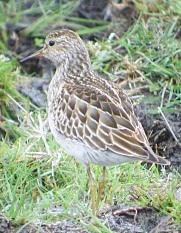
As opposed to the bird at the top here's one you have a very good chance of finding/seeing in the UK. The Pectoral Sandpiper is the most numerous Nearctic wader on this side of the Atlantic, during the years 1958/85 an average of 52 a year were found, and in fact as many as 150 were recorded in a single year in 1984.

Monday, 15 November 2010

The Monday Trawl.


Whooper Swan. David Cookson.

A photograph with a difference and an excellent study of the Whooper Swan by David Cookson. I know I'm always plugging someone elses website 'cos thats the way it is and they're always worth a look I promise you.

Mondays - four hours only - Trawl began at Conder Green to uncover nothing of any great note and only 2 Little Grebe were on the pool with 3 Wigeon and a Goldeneye. In the creeks 3 Goosander, a 'few' Redshank, and c.90 Teal noted. On the Lune Estuary at Glasson Dock the c.8,000 Bar-tailed Godwit/Knot wader flock of 9 November seen again, as ever mixed and distant, I just wish these birds would come within easy viewing range and separate, 4 Red-breasted Merganser and a Little Egret seen in it's favourite area below Waterloo Cottage. On the canal basin 52 Tufted Duck and 3 Pochard drakes seen, interesting that this species here are invariably drakes. From Fishnet Point 2 Whooper Swan were excellent, 32 Goldeneye are shaping up to becoming the best location for the species in the area again this winter, also in excess of 1,000 Wigeon and 3 Black-tailed Godwit noted.

On Moss Lane c.30 Fieldfare from a moving car. Cockersands produced three surprises - though none in the 'mega' bracket - a Little Owl in the bushes surrounding the horse paddock at Bank Houses was the first in more than twelve months void of searching my records, a Great-spotted Woodpecker is - as far as I can recall - the first I ever saw in this area, and a Grey Plover in an inland field was to say the least a bit unexpected and is certainly a first for me. A Meadow Pipit on the shingle had me jump to attention for a moment until I got my binoculars on it. Others noted on the circuit, 4 Skylark, a Snipe, up to 550 Golden Plover in an Abbey Farm field, and the set-aside Linnet/Greenfinch flock topped 100 again today with my ratio estimate still standing at 90/10 respectively.

Notes.

There were three records of note today, 1) At Wintersett Reservoir in West Yorshire six Mealy Redpolls were controlled one of which was discoveresd to have been a bird ringed in Norway. 2) An American Coot was found on Termoncarragh Lake, Co Mayo in the West of Ireland. 3) Nearer home a Barred Warbler was found near Fleetwood.

Sunday, 14 November 2010

Another American!


Pied-billed Grebe. Mike Watson.

We have yet another American vagrant in the country, a Pied-billed Grebe which was found on Tuesday 9 November on Hollingworth Lake in Greater Manchester and is still present today to the delight of the many who have traveled to see this amazing little bird. Thanks to Mike for the photograph which can be seen HERE along with other interesting accounts and photographs of birding in the UK and beyond.

The first record of a Pied-billed Grebe (PBG) in Britain was only made 47 years ago in December 1963 at Blagdon Lake in Somerset. The PBG breeds over much of Central, North and South America, the last time I checked there had been 40 records in Britain at scattered localities in all months. It is difficult to imagine the ability of this apparently weak-flying bird being able to cross the Atlantic Ocean to find itself at these various locations in this country. Once here, some males have stayed for long periods, even setting up territory and advertising for mates with one particular individual being observed attacking a Whooper Swan which had straying into what the grebe had claimed as it's territory, but the behaviour of this bird was put into the shadows of another one which paired with a Little Grebe producing three hybrid young, remarkable in that the two species are not in the same genus. No mercy is on offer in the natural world when one unfortunate individual PBG was killed by a Peregrine Falcon on the day it arrived in Britain on the Isles of Scilly in October 2000.

Wren. Phillip Tomkinson.

I couldn't resist this excellent image of the Wren photographed in the grips of winter, when you view a picture like this one you have to hope this winter won't be as harsh as the last one for the sake of these tiny creatures. Thanks for the photograph Phillip, please take a look at some stunning images on Phillip's website HERE   


Friday, 12 November 2010

Back in the Trough!

But first....

Great Northern Diver. Brian Rafferty.

The GND was found on the Marine Lake at Fleetwood on last Sunday 7 November and still remains there today. There are three 'bits' of good news about this bird, firstly BR has been to see it, secondly he photographed it, and thirdly I have access to his photographs. So the plug is....Please visit his website HERE for more of the same.

Well BT's car - with JB and I inside it - didn't shoot off to Aldcliffe today, instead we started with a failed 'twitch' - oh dear - to see some Waxwings which were no longer in Booths car park in Lancaster, followed by what turned out to be a quite enjoyable days birding in the Trough of Bowland.

We first halted at Blea Tarn reservoir where I noted 2 Little Grebe, as with the rest of the day JB's records will show that we actually saw much more than these two little beauties on here. A call in at the car park on Rigg Lane produced a Raven over and a Mistle Thrush to note. At Abbeystead 2 Coal Tit, and 2 Dipper on the River Wyre with one just downstream from Stoops Bridge, and the other upstream, from the road away from here, 2 Buzzard and c.2,500 Starling turning a large portion of the field they were in black.

Between Marshaw and Tower Lodge, yesterdays 80 Brambling were eventually accounted for, but today they were even more mobile and fragmented into three flocks between these two points, up to 50 Wood Pigeon also appeared to be feeding on beechmast here, and a Treecreeper noted. At Langden, as we arrived 2 Raven overhead and a Kestrel. The short walk to the pump house produced not a single bird but of note was the serious erosion which has taken place since I was last here, at one point towards the small pump house little now remains of the track.

Fieldfare seen on the day probably numbered 400 with my 'at least' figures being, 50 on Long Lane, 200 on Rigg Lane with a 'few' Redwing with them, and 120 in the Cam Brow area.


In an e-mail from the WWF I was told of just eight days to go before the summit in St Petersburg to 'Save The Tiger'. The WWF have already had their target of 100,000 signatures smashed and are now hoping to collect a massive 150,000 to which we can contribute, so please will you Sign The Petition