BIRDING THE LUNE ESTUARY THE FOREST OF BOWLAND AND BEYOND..RUFF CONDER POOL PETE WOODRUFF

Thursday, 31 March 2011

The Dartford Warbler.


Dartford Warbler. David Cookson 

It doesn't come as much of a surprise that the first Dartford Warbler (DW) was discovered on Bexley Heath near Dartford in Kent in 1773, incidentally the same man who found this bird was also responsible for naming the Kentish Plover which had been first discovered in Kent 14 years after the DW in 1787 when it was then an unknown species, yet again the same man was involved with the Sandwich Tern the first of which was again found in Kent in 1784.

The DW is a species almost exclusively insectivorous which suffers adversely in long cold winters and habit loss, favoured heathlands have been converted into housing and agriculture. They previously bred as far north as Staffordshire but a massive loss of 80% of lowland heath severely reduced populations. Having barely recovered from the harsh winter of 1946-47, the winters of 1961-62-63 almost wiped out the entire British population and the number of breeding birds was thought to have been as low as twelve pairs.

The DW now breeds in most counties of the south coast of England, distribution has also expanded, and as climate change continues towards warmer summers and milder winters a further expansion in the birds range might be expected, how long before we can have them here in Lancashire, in the winter months they are known to follow Stonechats around, but finding a Stonechat now seems hard enough never mind a DW.

The bird in the stunning photograph above is that of a Dartford Warbler which has been at the curiously named World's End in Denbighshire, Wales since Wednesday 2 March....Another image with a 'brilliant' tag with thanks to DC.

Footnote. 

Interestingly also in Wales and with no stragglers further north than Staffordshire a bird was observed for two days at Tremadoc, Caernarvonshire in May 1932. 

Wednesday, 30 March 2011

The LRP Twitch!


Argyll Sunrise. Colin Bushell

It would have been great to have got up this morning with a sunrise like this one CB had in Argyll recently and head off out for a days birding, but not so here in Lancaster where it was dull and grey and I didn't have the day to myself for birding anyway. But I did head off out on a local 'twitch' - yes I do it sometimes - having been given the tip off from a contact about two LRP's on Conder Pool Tuesday morning, as it turned out they either left for better things, or they were in hiding, so in twitching jargon  I 'dipped' but did see a Spotted Redshank and Greenshank before leaving for Aldcliffe with thoughts that if I 'needed' to see LRP's this was going to be my best bet. With limited time before having to be back home by mid-day the plan was to do a circuit at a crawl for a couple of hours but the weather had other plans and it was reduced to a walk from Aldcliffe to Freeman's Pools where I did in fact find 2 Little Ringed Plover and noted a drake Shoveler and 2 Goldeneye on here.

All in all a bit of a miserable episode in my birding life. Still....you can't win'em all can you!

Couldn't resist this one to follow on from yesterdays 'Hobby' and you won't be able to either, and there's another three you can view here too.

ARKive video - Eurasian hobby feeding on dragonfly

And if you'd like a Red-throated Diver as your desktop background an invite to do so is HERE:

Tuesday, 29 March 2011

The Hobby.


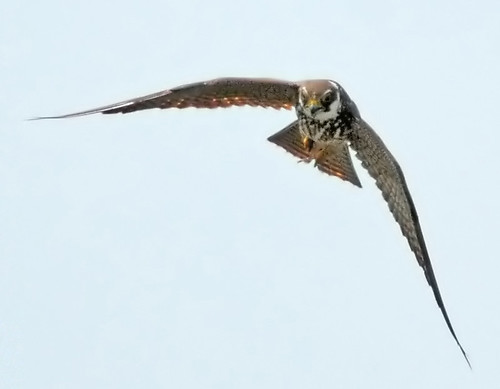
Hobby Fly Past

For most birders the casual sighting of a Hobby - whether it is soaring on crescent wings or dashing in pursuit of  dragonflies or perhaps Sand Martins - causes the heartbeat to increase in pace....well it would mine!

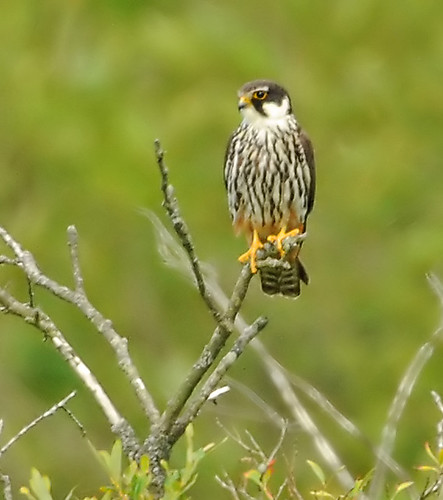
This falcons lithe form instantly conjures up an image of compact power, with strokes of the wing and graceful flight equally matched by the sight of this little beauty when perched. There are few who have been fortunate enough to observe this creature in its hidden haunts of heath and down, broken forest or farmland, in particular when this bird is engaged at the time when its unobtrusive breeding period is in full swing. Despite the inconspicuous behaviour of the Hobby, it is a species which has been studied by numerous ornithologists in the Western Palearctic, but my being as far removed in knowledge from such people as is imaginable, I thought I'd make a few notes of my own about this stunning falcon. 

Hobby 3

My very first post on Birds2blog included the only photograph of a Hobby I ever achieved and I'll probably need more than a little luck to ever have another chance as the species is to say the least a pretty hard one to come by in our area in North Lancashire and beyond, though to be honest breeding has been thought to be probable in the area in recent years, brought about by the sightings of 'one or two' birds seen regularly during July at various sites in the Lune Valley and also at Leighton Moss, circumstantial evidence also appears to be strong enough to bring about this probability. However, with the situation regarding 'collectors' of various kinds still on the rampage since the dark ages, plus all other types of people 'on the loose' with no regard for wildlife, your not ever likely to be on the list of 'the permitted' to know the whereabouts of breeding Hobbies I can assure you. All this said, because of its habitat requirements the Hobby is never going to be numerous in Lancashire.

Of course I can always be accused of being negative when it comes to making notes on some aspects of birds, but I regard my comments as 'realistic' rather than negative. Regarding the Hobby's migration, favourable weather conditions will assist it to migrate at a considerable height - and here's where I go negative - when two weather systems meet causing less favourable conditions with overcast skies, this brings the birds down to visible height when they - and other raptor species - come within range of the notorious Maltese hunters guns which can result in a staggering 600 Hobby's being brought down in some years out of totals of 5,000 other birds of prey.

On a more 'positive' note, at a time when so many other bird species are in decline - some seriously - the elegant little Hobby is spreading northwards in Britain and now breeds regularly in Cheshire and Yorkshire, but in Lancashire and North Merseyside I'm not aware of any fully authenticated records of successful breeding of this enigmatic and exciting falcon, but then....who am I to be privy to such info!

Thanks for the photography BR, they've been on Birds2blog before but are still worth a few more views and are....Brilliant. 

EDIT

I am reliably informed of 2 Little Ringed Plovers on Conder Pool this morning....I'm not at liberty to publish my informants name but who already knows of my appreciation for this report. 

Monday, 28 March 2011

Quiet but....


At least five birds reminded me it was spring and included one which was something of a surprise. But it's the calm before the storm of migrant birds flooding in and by the way, if you were anywhere near me this afternoon and thought it was a lovely spring like day, well you should have been at....


Cockersands, where this was the kind of scene....


....and this too. The place was cursed with fog for the entire two hours I spent there in the hope it would burn off but didn't and just kept rolling in off the sea.

At Conder Green where it really was like spring - though we wait some more before the birds arrive - 2 Spotted Redshank and a Greenshank were in the creeks, the Common Sandpiper was on Conder Pool but I had to search from the west end to find it. The Lune Estuary from Glasson Dock was almost a void and empty space, though to contradict that I had just estimated 370 Bar-tailed Godwits when a bird seen flying across the river from one side to the other was instantly not a Shelduck, and if it's a bird in flight which looks like a Shelduck but isn't one, then it's an Avocet which promptly put itself down in the midst of the BTG's I'd just counted, I also noted c.50 Dunlin. On Jeremy Lane 3 Whooper Swans still - an adult and two immatures - but for how much longer.

Golden Plover. John Bateman.

At Cockersands during one or two periods of  thinning fog I found c.600 Golden Plover in the Abbey Farm field, a reduction in number of at least 400 from last Fridays count of in excess of 1,000 birds. Also of note, 4 Wheatear, 13 Eider, a single Grey Plover, and 22 Linnet, a Skylark sang it's constant flight song despite the murk. Thanks for the pic here John - a mere fraction of Fridays 1,000+ - with about two dozen of them coming in to land. 

Talking of Avocet....


Probably the best lager  in the world Avocet photograph with perfect symmetry I've ever seen. Thanks for the pics JB/DC, I know it's an old and much played record on Birds2blog but....much appreciated.

Sunday, 27 March 2011

The Cuckoo.


Cuckoo. David Cookson 

I think anyone who doesn't know the difference between a Blackbird and a Thrush would be able to identify the call of the Cuckoo in the spring. Here are a few brief notes of a bird about which many articles and books have been written to do justice to this remarkable and complex species of which the female has the ability to lay eggs that perfectly match those of the host.

A harbinger of spring, I look forward to seeing my first on Clougha/Birk Bank, Harrisend, or maybe Barbondale perhaps sometime in the middle of April. The photograph is that of the juvenile that spent some time at Cockers Dyke on the Fylde coast during August 2010 having probably been the result of a breeding success in one of the few remaining lowland pockets in areas like Pilling in the north Fylde, this bird performed well to the many birders who visited the site showing off its ability to catch hairy caterpillar's to perfection.

In Oakes time in our area of north Lancashire the Cuckoo was regarded as 'universally distributed' but by the mid 70's it was generally accepted to be in decline, today the population in the county probably doesn't reach 200 pairs, mainly breeding on the moors where the Meadow Pipit is the main host, whilst the Dunnock and to a lesser extent the Robin are hosts in what few lowland farmland locations are left where this parasite still breeds.

Amazing isn't it, that the juvenile Cuckoo not ever having known its parents because of their parasitic habits, embark on the first southward migration without any guidance whatsoever from adult birds. There is a remarkable total absence of any recoveries of British Cuckoos in North Africa in Autumn which seems to bear out one theory that fewer birds are seen there at this time of year because having reached the northern shores of the Mediterranean Sea the birds fatten up then overfly that sea, North Africa, and the Sahara in a single flight of at least 3,500km. There is only one recovery of a British Cuckoo on its wintering grounds, that of a bird in Cameroon, a Dutch bird was found in nearby Togo.

The earliest spring record of the Cuckoo in Lancashire and North Merseyside was at Martin Mere on 23 March 1990, but the record of twelve birds flying east over Anglezarke Moor in half an hour at the end of April in 1983 must have seemed like a dream for the observer. As the status of the Cuckoo stands today I'll settle for one bird seen or heard this summer, though last years total in my records was four seen at Harrisend, Birk Bank, Tower Lodge area, and Cross of Greet.

Cuckoo. Pete Woodruff.

This photograph has made a previous appearance on Birds2bog but I have no hesitation in posting it once again as it represents probably the one and only opportunity I will ever have of achieving such an image of a juvenile Cuckoo I observed below Birk Bank one day in July 2006. This little monster was being fed by the unfortunate Meadow Pipit which had unwittingly become its parent having been parasitised by the youngsters devilish mother.

You will no doubt agree, the photograph at the top of the post is to say the least pretty impressive, with thanks to DC whose website I thoroughly recommend you visit.

Friday, 25 March 2011

....and a couple of eye poppers!

Swallow. John Bateman.

I saw my first Swallow of the summer today and JB's photograph shows the bird on the aerial of a house on Moss Lane. If you just stare at the pic for a moment and ponder what this tiny feathered creature has just achieved it'll blow your mind...it did mine.

At Conder Green 2 Spotted Redshank, and a Greenshank. On Conder Pool, the Common Sandpiper - which will move on sooner rather than later having spent the entire winter period here - a solitary Black-tailed Godwit, and 4 Dunnock in the area. On the Lune Estuary at Glasson Dock I noted c.160 Redshank, 80 Golden Plover, and 5 Black-tailed Godwit.

From Bodie Hill, at least 230 Black-tailed Godwit, 135 Bar-tailed Godwit and 170 Curlew. On Jeremy Lane, 3 Whooper Swan being an adult and two immatures. At Cockersands, c.20 Linnet at the winter seed field, 20 Eider off Plover Scar, singing Skylark, and 8 Tree Sparrow. A count of a little in excess of 1,000 Golden Plover in a field at Abbey Farm makes for a number of this species I'm not sure I ever encountered before in one flock at this location.

On the marsh at Bank End, 4 White Wagtails were with 6 Pied Wagtails. Opposite Sand Villa, 7 Whooper Swans represent an ever dwindling number here. The Gulf Lane detour produced a pair of Kestrel, and on Pilling Marsh a Little Egret and Sparrowhawk from the talons of which a small passerine narrowly escaped, the Raven - seen here on Tuesday- was seen again. In a stubble field west of Fluke Hall, 10 Meadow Pipit, 7 Skylark, and 2 Reed Bunting.

As for the 'eye poppers'....

Yellowhammer. Phil Slade   

How about these for a couple of brilliant 'portraits', this one for starters of the Yellowhammer, and....

 Chiffchaff. Phil Slade

This one to follow up of the Chiffchaff....Nice ones PS and thanks a bundle.

MEGA NEWS.

A Short-toed Treecreeper (STT) - Central Europe and North Africa - is still at Landguard NR in Suffolk today, it was trapped and ringed there yesterday. Britains first record of this species was of a bird in 1969 at Dungeness, Kent where the majority of STT records in Britain are held. 

Thursday, 24 March 2011

Back to Life!


It was good to find Harrisend coming back to life today, my first visit since 27 January when I could find no Stonechtas here and which then had been my first visit since 4 October 2010....but I gave Conder Green and Cockersands three hours before going up there.

Kestrel. John Bateman.

I managed to find 2 Spotted Redshank in the creeks at Conder Green, and on Conder Pool, a Common Sandpiper with 3 Whooper Swan being an adult and two immature, the circuit produced a big zero. Interestingly 3 Whooper Swan were on Jeremy Lane, these being two adult and an immature. At Cockersands, 2 Wheatear, 2 Whooper Swan on the estuary by the lighthouse, with 14 Eider, and 6 Red-breasted Merganser, a Skylark heard in full song.

The real purpose for a visit to Harrisend was rewarded by the encouraging sign of 4 Stonechat in 2.5 hours, so chance of the Stonechat pool being increased here by 'maybe' 24 birds by the end of the breeding season - though actually a potential of 36 - but what about the others still to take up territory on here yet!
I also noted 10 Meadow Pipit, 2 Wren, and a Buzzard.

Merlin. John Bateman.

Thanks for yesterdays Falco tinnunculus and columbarius John, well worth parking the car broadside and stitching the road up whilst you got the shot of the Kestrel don't you think, and I/we waited all winter to find a Merlin at Cockersands cunningly perched up overlooking the winter seed field, obviously with not a Linnet in sight at the time.

Snow Leopard. Copyright Christian Sperka.

The decision to allow Snow Leopard hunting - 'Leopards at Risk' yesterday - has been revoked according to THIS

Wednesday, 23 March 2011

Leopards at Risk.


ARKive video - Snow leopard climbing across rocks


All a bit gloomy but this is the real world....So if you have a few moments to spare please take a look at Leopard Alert and maybe sign the petition.

Greylag Goose. Phil Slade


On a lighter and interesting note I have information on a Greylag seen by a Fylde birder at Hakenshall Hall recently. Thanks to Kane Brides at WWT and to Dr John Bowler, Tiree Officer, RSPB Scotland who forwarded me the information on this bird, and to the birder who gave me permission to make enquiries about it on his behalf.

The bird was collar marked in a programme at Loch an Eilein on the Isle of Tiree, Argyll on 4 July 2009. This individual stayed on Tiree until February 2010 when it then moved to Martin Mere WWT in Lancashire and seems to have then wandered around in Yorshire/Lancashire. This bird is the only one out of over 1,250 Greylags ringed on Tiree and Coll since 1998 that - as far as is known - has ever ventured beyond the west coast of Scotland.

If you're reading this AC I need to contact you with some more for your interest on this sighting but have no contact details for you, you can find my email address in my sidebar under 'Contact Me'. Many thanks again to all three for this, much appreciated and very interesting.

No birding today, but can't wait until tomorrow to get out there and do some.

Tuesday, 22 March 2011

The Long List.


Water Pipit. Copyright Granted.

JB and I collected a good number of records on a most enjoyable day along our excellent coastline, and from a personal point of view in the company of a birder who sees birding in an all round very much the same light as me. One place we didn't visit was The Heads were the Water Pipit/s are pretty reliable - two today - on tides similar to today's 10m plus.

At Conder green where the tide was rapidly swallowing everywhere up we saw Spotted Redshank, Greenshank, and on the pool, a Goldeneye, 3 Canada Geese, and a Moorhen noted on a nest. On the Lune Estuary I thought I'd better don my recorders hat for a while or leave with nothing of note. Circa counts were of 240 Redshank, 50 Dunlin, and 10 Wigeon. Accurate counts were of 2 Grey Plover, 28 Bar-tailed Godwit, 15 Cormorant, and 28 Mute Swans. I found another interesting wildfowl on the River Lune today in a drake Shoveler - as with the pair of Gadwall yesterday - the Shoveler is another species which avoids the marine environment and seen out of context here.

On Jeremy Lane an extra bird here today with 4 Whooper Swans being two adults and two immatures. At Cockersands, a male Merlin gave excellent views, and c.24 Linnet on the winter seed. Shore and offshore, 26 Black-tailed Godwit, a high count of 10 Grey Plover, 21 Eider, and 4 Red-breasted Merganser.

Brown Hare. John Bateman. 

An excellent sight was that of 12 Brown Hare chasing one another around a field, the best area I know to encounter this brilliant and entertaining creature. The one in the photograph above obliged JB by running towards him in the parking area at Cockersands lighthouse. Thanks for the pic John....nice one.

From the A588 opposite Sand Villa, 18 Whooper Swans remain from a count exceeding 90 birds on one report I read just a couple of weeks ago. On Pilling Marsh - under water now - another male Merlin, this one tucking into lunch on the embankment, a Raven and a solitary Whooper Swan was below the embankment, the bird appeared OK but strange it was alone I thought. Cockers Dyke was also awash but a Little Egret, a pair of Pintail, and 3 Red-breasted Merganser were to note.

And finally....

Goldeneye. Brian Rafferty

Another of those BR 'specials' of the drake Goldeneye taking off. Thanks for this Brian, much appreciated.

Monday, 21 March 2011

Walkies!

Not the most appropriate of titles, not particularly original, and doesn't sound like one for a birding blog but....


I found this posted at Aldcliffe today, something in my view the birds/wildlife of Aldcliffe Marsh and surrounding area could well do without 'cos if these people get new customers from this advert - and thats the idea - bet your life their coming here to Aldcliffe and they'll beat the record of the two women at Cockersands recently with 18 of these creatures. Just one more note, I don't like the sound of 'off the lead'....so thats within the law now then is it with the 'on the lead' law scrapped?  

As usual on a Monday I was 'working' within a time limit and I soon forgot the idea of Conder Green etc as the tide was a mega one and almost at it's height submerging just about everything including the roads, but I did see a Spotted Redshank at CG, and from Bodie Hill, 2 Little Egret, c.130 Black-tailed Godwit, and c.45 Bar-tailed Godwit before deciding to give Aldcliffe a couple of hours.

I noted 2 White Wagtails around the flood with 14 Pied Wagtails, 2 male Bullfinch, a single Reed Bunting, and a Greenfinch. The biggest surprise here today was the sight of a pair of Gadwall - a species averse to a marine environment - on the River Lune with 18 Wigeon, completely out of context, and certainly a first for me. I found just one Greenland White-fronted Goose today with c.4,000 Pink-footed Geese as opposed to two seen here last Friday when circumstances - not least of all distance - prevented any assignment to race.

And finally....

Buzzard. Phil Slade  

If you're looking for a photograph of a Buzzard to study underpart plumage detail this is an excellent one.