BIRDING ON THE LUNE ESTUARY AND THE FOREST OF BOWLAND................................................SPOTTED REDSHANK PETE WOODRUFF

Monday, 13 June 2011

The Short List.


I actually started my four hour Monday at Cockersands doing the traditional circuit including the nooks and crannies. If anyone had seen me on the headland today and asked what I was hoping to achieve there I'd have been posed a problem to come up with an intelligent answer. So I start with my 'weather whinge' which goes something like....I could have been fooled into thinking today was the 13 March whilst also thinking 'shouldn't I be doing something more useful in life than wandering around this place getting blown about in a force I don't know what westerly'.

Oystercatcher. David Cookson  

On the estuary the high tide didn't help and the waders were almost non existent, even the guardians of Plover Scar were reduced to no more than 25 Oystercatchers. From the road 5 Sedge Warbler were all in song as was a Skylark, and I saw a single Whitethroat....Flaming June!

But it was all worth while - as any birding is - when I arrived at Conder Green to find c.220 Bar-tailed Godwit in the creeks again with at least 20 Knot in their company, c.12 Swift were over, and I noted a male Reed Bunting. But the best came when I gave Conder Pool a serious grilling and after doing so for the past nine weeks found the Little Ringed Plover sitting - faint hearted me - but a few more weeks and a  fair measure of good fortune for this bird and any results from the breeding attempt before we can sing our Alleluias on seeing any fledged young.

Arctic Tern. Gary Jones  

At Glasson Dock on the Lune Estuary I watched a graceful Arctic Tern fishing opposite Waterloo Cottage though little else, but did count 7 Eider hauled out on to the shore.

Landart. Richard Shilling.

If you've been visiting Birds2blog for a while now you'll know RS, but whether you do or not he's the man with a keen eye, an inventive and creative mind, and a pair of hands to go with all this. You can find out the background to the artwork above HERE and some of his work is to be shown at this Exhibition....you may like to go and see it.

Sunday, 12 June 2011

Old Books....Good Books!


I've mentioned before on Birds2blog about the book stall often on Market Street in Lancaster where KT finds some good second-hand books and occasionally buys them on my behalf.


This 'Wild Birds of the Americas' is now one of the latest additions to my library thanks to the stall and KT.

According to the introduction in the book published in 1977, Terence Michael Shortt is claimed to have probably seen and sketched from life more species of the worlds birds than any other person alive. Well I'm not too sure about such a claim, but thats not the purpose of this post. I chose a couple of colour plates from the book, the first of which is the Blue-footed Booby.

Blue-footed Booby. Terence Michael Shortt.

There are a couple of reasons why I chose this illustration, the first of which is because of the explanation why this species is so called. They suffer the maligning appellation of booby, 'a silly dull-witted fool' because the guileless birds often alighted on the deck or rigging of ships allowing themselves to be added to the ships larder, the implication being that any animal that has no fear of man is stupid....a sorry indictment of the human race I'd say.

The second reason I chose the 'booby' is because it reminded me of a rather large one which befell someone somewhere today when a Brown Booby was reported this morning to be later claimed as a being a Gannet. Take heart all ye who hath fallen into the trap of mis-id, a club I'm man enough to admit being a member of....are you!! 

    Peregrine Falcon. Terence Michael Shortt.

There are a number of excellent colour plates by this man and the Peregrine Falcon is another example.

Peregrine Falcon. Brian Rafferty.

But BR has achieved some excellent images of the Peregrine Falcons nesting on a church in Preston.

Peregrine Falcon. Brian Rafferty.

I think this is a brilliant photograph of the juvenile which appears to be looking skywards to its parent and wondering if the next meal is on its way. You can see more of these stunning birds on BR's website HERE  

Saturday, 11 June 2011

Return to Bowland.


Yesterdays birding was in subdued mode as is often the case with BT....but thats not a complaint you understand, in any case the weather held us up at one point. BT suggested a visit to Bowland which meant a return for me having been there the day before....but thats not a complaint either you understand!

Redshank. John Bateman.

Lots of birds have become at least scarce - if not rare - in the uplands and the juvenile Redshank above is certainly one of them but was a welcome sight today with one of its parents feeding in a field near Marshaw. In the same field JB/BT and I were able to witness at first hand the dangers faced by young birds when a 'large' gull swooped down on a Lapwing chick, took the small creature in its gaping bill and consumed the unfortunate bird in less than five seconds....raw nature.

Sand Martin. Gary Jones

The Sand Martin colony at Cam Brow this year appears to consist of about four occupied nest holes in the small bank where they return to each year, a Mistle Thrush was noted here. Plenty of activity in the photograph at GJ's colony which is elsewhere I must add.

At Marshaw I established what I suspected in a particular area during recent visits here, that the Common Sandpipers have bred and one today was accompanied by a young bird. During the visit to the Tower Lodge area I added another two birds to Thursdays count which now stands at 10 Spotted Flycatcher. The pair of Pied Flycatchers seen Thursday were seen feeding young again. A brief visit to Langden produced a Dipper, 3 Grey Wagtail, a Common Sandpiper, and at least 4 House Martin hawking the beck.

Common Spotted Orchid. Pete Woodruff. 

At Blea Tarn Reservoir a Little Ringed Plover flew along the east side of the reservoir before banking to head over the fields towards Langthwaite Reservoir. There appears to be a healthy number of Common Spotted Orchids at the Wyresdale Road location this year with a 'large' number of spikes found and where in some seasons the Bee Orchid may also be seen.

It is interesting a Little Ringed Plover was reported at Conder Green on Thursday on the Fylde Bird Club website, not seen here by me since in flight on 6 May. There's never any telling whats going on in the world of LRP's on Conder Pool year on year and this one is no exception, they may yet surprise us all by bringing young into view one day soon, but somehow this year I'm not feeling confident....but its happened before! 

Thursday, 9 June 2011

The Flycatchers Have It.


I gave Marshaw-Tower Lodge-Trough Bridge a good going over today and it took me 4.5 hours legwork to do so on a day more like 9 April than June....but what results!

Pied Flycatcher. Peter Guy.

The Flycatchers get the Gold Award for today, not least for the first record for the area of 3 Pied Flycatchers two of which were a pair feeding young 10 mtrs up an Oak Tree, the other was a female which I encountered briefly but couldn't find thereafter despite a 15 minute 'stand'.

Spotted Flycatcher. Brian Rafferty. 

Today this location established itself once again as the best in our area - and beyond - for the species when the final tally was of 8 Spotted Flycatcher suggesting the strong possibility of five pairs based on my observations. 

Redstart. Brian Rafferty.

Also noted on this excellent visit to this equally excellent area of Bowland, 2 Cuckoo were heard, one somewhere distant behind Tower Lodge, the other in the Trough Bridge area, 2 Redstart, 4 Common Sandpiper, 5 Grey Wagtail, 2 Dipper, 6 Mistle Thrush, a Song Thrush, 4 Nuthatch, 2 Red Grouse, and a Buzzard.

I gave a look in on Stoops Bridge at Abbeystead to find no activity at the Pied Flycatchers nest hole in a fifteen minute 'stand'. A Garden Warbler and 2 Blackcaps all sang half heartedly, not surprising given the positively lousy weather, the sight of a Nuthatch feeding a begging young bird was a delight and ended a day which can be best described in my book as one of many perfect examples of what I think birding is about. Having found a species in an area for the first time - being the Pied Flycatcher - possibly five pairs of a species in serious decline - being the Spotted Flycatcher - and hearing another species in serious decline, being the two Cuckoos.

    Christ Church Abbeystead. Pete Woodruff.

I couldn't resist putting up another pic of Christ Church at Abbeystead, home to at least 16 House Martin nests occupied in years past but not a bird in sight today, and few - if any - bred here in 2010....Mmmmm!

Thanks to Peter Guy and Brian Rafferty for the photographs. 

Wednesday, 8 June 2011

Bad Decision!


A very bad decision yesterday actually as I took too much notice of the weather man who got it badly wrong today and having planned to go 'uplanding' I decided that the showers - that never were - would be no good to me and stayed home and behaved like a couch potato all day, add to this no birding again today....not good for me, body, mind, or soul!

And to make matters worse I'm about to post an article unrelated to birds on a bird blog about some beetles found in Spain.

Photo Credit: SINC-Ignacio Ribera.

Two new endemic beetles have been discovered in the Iberian Peninsula.

With Spanish participation a European research team has described two new beetles measuring little more than 2.2 millimetres in length. The beetles were found in streams in the Pyrenees in the Sierra de la Demanda Mountains. Some experts had previously thought they had belonged to another European species.

One of the two new beetles species  - Hydraena diazi - was found in the Montseny National Park in Barcelona, it measured no more than 2.4 mm in length, the insect also inhabits the Pyrenees. The other new beetle - Hydraena fosterorum - was discovered in the Sierra de la Demanda 

An expert explained that they most probably originated in the same geographical regions that the are now found in, meaning we can use them to reconstruct their history and biogeography. Research has also suggested that all the species in the in this particular Hydraena group - including these two new ones - result from the splitting of a common ancestor which spread throughout the Iberian Peninsula half a million years ago. Today they still remain in their original distribution areas.

Puffin. Gary Jones. 

Shag. Gary Jones.

Gary kept his promise and posted some excellent photographs of the enigmatic Puffin and Shag seen on his recent visit to the Farne Islands....You'll find them HERE

Eyed-Hawk Moth. Brian Rafferty

Brian found this brilliant moth which I'd loved to have seen for myself.

And....
Large Skipper. Linda Gilhespy  

Linda got an excellent photograph of this smart little moth. Thanks to GJ/BR/LG for the excellent images....Many Thanks. 

Hopefully tomorrow, some serious birding somewhere in the Forest of Bowland perhaps! 

Monday, 6 June 2011

A pretty smart Robin!


ARKive photo - Female white-throated robin
'Click the pik'

I did get an hour or so birding today, but to be honest this bird created much more excitement for many a birder who has been  - or is going to be - burning the rubber on many a motorway whilst speeding off to Hartlepool Headland in Cleveland to see the female White-throated Robin as in the pic via the link above, the male is as usual a more attractive creature. 

ARKive photo - Male white-throated robin, side view
'Click the pik'

The White-throated Robin  breeds from Turkey eastwards to Kirghizia, and winters in East Africa. There are only two previous records, a male on the Isle of Man in 1983, and a female in Pembrokeshire in 1990. It is interesting that both records are of birds on the west coast, pretty surprising that given this birds apparent north-south orientation of its migration route it is quite amazing that the species has ever occurred here at all.

Three people were involved in the finding of the first record in Britain, that of the bird above on the Isle of Man in 1983. The bird caught the eye of one of these three when he described it as a Wheatear-like bird, but all three noted the bird showed no white rump as it flew off. The bird re-appeared on a wall and they agreed the possibility of it being a White-throated Robin, but it soon flew off once again and out of sight and despite further searches it was never seen again.

As for my four hour birding stint today....

I did a circuit of Conder Green to find 2 Whitethroat, 2 Reed Bunting, a single Black-tailed Godwit was surely the bird I saw on 31 May as it dropped in on Conder Pool where the pair of Lesser Black-backed Gulls are nesting, a Sand Martin over was a little unexpected. The Lune Estuary at Glasson Dock was as expected pretty quiet though it was rewarding to find the c.300 Bar-tailed Godwit here - recently they had graced the Conder creeks on a couple of my visits - a pair of Eider and 2 Shelduck with 17 young noted.

At Cockersands I can assure you the recent Quail is no more as every field in sight has been made to look like a 'Bowls Tournament' is about to take place any time soon. I noted c.20 Eider, the rest I found on a circuit, at least 15 Tree Sparrow, 2 Whitethroat, 2 Skylark, a Dunnock, 3 Sedge Warbler one of which gave me excellent views and was one of the best songsters I've heard in years, 2 Red Admiral also seen. 

Sunday, 5 June 2011

Truly Amazing....


....some Grey Seals, and a Crossbill.

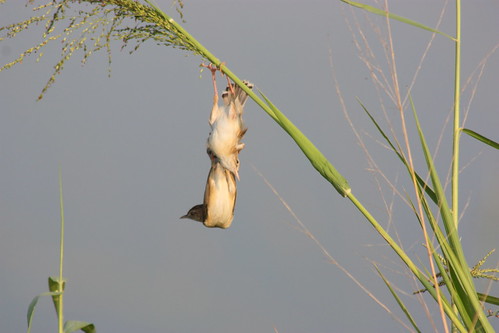
Mating Zitting Cisticola
Zitting Cisticola. Copyright Farash Samat. 

I don't think I've ever been more amazed at any photograph of birds like this one ever before. The image depicts a pair of Zitting Cisticola, having mated they are photographed in this amazing 'post-coital trapeze act' having dropped into this inverted position the female clings on to the grass stem, with the male - also upside-down - holding on to her at the shoulder. Apparently this is a post-copulation behaviour normal to the species whereby the male grips the females back tightly after coition, perhaps in a bid to increase the likelihood of fertilisation.

The first record of the Zitting Cisticola in Ireland was a bird found in Co. Cork in 1962 by an observer who had already seen the species in Spain only a few months previous. The first record for Britain was in Norfolk in 1976, then five days later at another location in Norfolk and regarded then as being almost certainly the same individual. It is interesting that despite the close proximity of breeding birds to Britain, the Zitting Cisticola appears to be reluctant to cross the North sea.

Well, I've often been seen to quote on Birds2blog....'Birds, they fascinate me in a thousand ways'....but never quite like this before.

Grey Seal. Gary Jones.

Grey Seals. Gary Jones.

Gary has been on a recent trip to the Farne Islands and brought home a 'bag full' of images to share with us. Please visit Gary's Website to see an excellent selection of photographs of these wonderful creatures with the promise from him of an upload of sea birds at the Farnes sometime soon.

Two-barred Crossbill. Gary Jenkins. 

Gary went to see THIS BIRD in Yorkshire in 2008, but I don't think it would be a good idea for most of us to hold our breath until we find one for ourselves. The first record of this species in Ireland was in Co. Antrim in 1802, the first for Britain was in North Yorkshire in 1826.


Saturday, 4 June 2011

First the good news.


Whether or not you live in the same area of Lancashire as me - but especially if you do - you'll love this. Maybe you'll also see the mention of someones name you know/recognise. It's excellent news and you will welcome what you read about HERE

Now the bad news....

....which is something you won't enjoy reading - I didn't either - but you must. This country is a member of the EU and for this reason alone something could/should be done to at least try to halt THIS appalling 'sport' once and for all. The EU Birds Directive has created a far-reaching protection framework for all of Europe's wild birds. There are a number of components to this scheme which Member States have to transpose and enforce through their national system.
Having seen for yourself yet again, as one example from hundreds of them year in year out, Malta appears to make little if any progress in halting this terrible business of blasting birds from out the sky. This is the 21st century we live in and it's time the hunters of Malta - and elsewhere - moved into it too and to hell with what their 'dads and grandads' did....but they obviously love it anyway and the traditions live on and thrive in 2011.

Friday, 3 June 2011

All in all....


....yesterday was an excellent and rewarding days birding, but I got way laid and prevented from posting on Birds2blog by those 'other things' I mention on here from time to time, quite honestly a bloody nuisance but I have to deal with them as a priority over my birding interests.

Willow Warbler. David Cookson

I was on Harrisend for 2.5 hours and to say I found no Stonechats is both a forgone conclusion and a mere formality I mention it. One of the most notable things about Harrisend today was the number of 23 Willow Warblers encountered, at least 23 Meadow Pipit also counted, though this species is much more difficult to count with accuracy as they are a very flighty bird as opposed to the less so Willow Warbler. Also noted, a single Linnet, Reed Bunting, Dunnock, 2 Mistle Thrush, 2 Blackbird, 2 Red Grouse, and a Buzzard.

Small Heath. Steven Cheshire

More interest was generated by 8 Redpoll, two pairs of Redstart, a Green Woodpecker, and a Cuckoo heard somewhere in the Grisedale area. It was also good to see a couple of decent butterflies on Harrisend today in 2 Small Heath. Driving past Street Bridge on the way here I heard a Blackcap and Chiffchaff. The idea that I should call in at Stoops Bridge in Abbeystead was one of my best in recent times as I found the female Pied Flycatcher in and out of the tree hole obviously feeding young, this despite eluding me on previous visits into thinking they had failed to return this year. 

I now had to make haste to Barbondale where I was to meet a man who needed to observe some more details about the 10 Pied Flycatchers I saw on Tuesday 24 May....he wasn't disappointed and I reckon Pied Flycatcher numbers will be inflated by up to 28 birds this year at Barbondale, in itself an all time record, but some way to go yet, so....hopefully.

Though I was a little preoccupied on this visit to Barbondale I was pleased to find a pair of Whinchat this time having only found a female previously, also Spotted Flycatcher, 2 Dipper, a Buzzard, and uncounted Redstart and Tree Pipit. I also had excellent views of the Tawny Owl which I had seen on my last visit here on 24 May, today it was unintentionally and unfortunately flushed from its roosting perch.

Birds....they fascinate me in a thousand ways!  

And finally....

Swallow. Brian Rafferty  

Everybody's favourite is the Swallow, known and recognised by even the least interested of people in birds. Thanks to DC/SC/BR who all give me permission to use their images on Birds2blog with many thanks.

Wednesday, 1 June 2011

The BTG.


Bar-tailed Godwit at Conder Green 27 May 2011. John Bateman.

It was a pleasant surprise to find c.150 Bar-tailed Godwits (BTG) in the creeks at Conder Green last Friday 27 May, an unprecedented record as far as I'm concerned at this location or any other in our recording area on this date. With the exception of just one bird, this flock all were 'grey' 1st summer birds.

In Oakes time he recorded the BTG as abundant on the Ribble Estuary, but less numerous - though still plentiful - in Morecambe Bay. Oakes interestingly refers to the BTG as summering flocks to be first noted in 1918, and further refers to them as being in 'grey dress' and not usually in more than 100 birds. In 2009 peak numbers in the month of May - including WeBS counts - in Morecambe Bay and the Lune Estuary combined totalled just 31 birds.

The Arctic breeding BTG is a long distance migrant, the birds in our area of Lancashire and North Merseyside are thought to originate from the Fennoscandia and W.Russian breeding population. Although I'm suggesting a first record of 1st summer non-breeding in this number anywhere in our recording area of Lancashire in May, summering flocks are a feature of the south-west including Seaforth where up to 700 birds regularly roosted in June during the late 1990's, with another flock of a similar number in non-breeding plumage on Warton Bank in 2003.

Two interesting BTG's ringed in N.Merseyside in 1980 were both re-trapped at an African wintering quarter in Guinea-Bissau eight years later in 1988. Also of note is that of a long-lived bird which was marked in 1972 and was found dead 21 years later in 1993.

Bar-tailed Godwit. John Bateman. 

It was a very pleasant experience observing the BTG at Conder Green again yesterday 31 May when at least 220 birds - I've seen one report of up to 300 - were counted in the same spot as last Friday, the birds gave a excellent display in flying around the area whilst calling, something not easily achieved with a bird known to be a very mobile species in where it settles and usually seen at a distance rather than the close quarters these birds afforded us here.

Thanks for the photographs John, and for another pleasant and rewarding days birding for us both.