BIRDING THE LUNE ESTUARY THE FOREST OF BOWLAND AND BEYOND..RUFF CONDER POOL PETE WOODRUFF

Sunday, 20 March 2011

Coming Soon....


....and a Grey Wagtail. 

No time for blogging again today unfortunately but three stunning pictures to look at highlighting the photography of  David Cookson whose website I strongly recommend you take a look at.

Sedge Warbler


With a 'coming soon to an area near you' Sedge Warbler photograph. If I've checked my calendar correct Monday is the first day of spring and these birds will be winging their way back from their wintering grounds in tropical and south Africa to breed in our reed-beds and marshes. The average first date of arrival in the UK is in mid-April. The status of the Sedge Warbler currently stands in the GREEN list.

Male Pied Flycatcher

Another 'coming soon' bird is the Pied Flycatcher, a bird I have a special liking for and know of at least two locations where they have bred/breed in natural nest holes though they are a species benefiting from the help of nest box schemes which are set up in many areas of mature woodland. This is another species winging its way back to the UK from tropical Africa to arrive here on average in mid-April, it's status currently standing in the  AMBER list.

                                      Grey Wagtail

Finally the Grey Wagtail (GW), a bird of fast moving streams and rivers. The GW is much more colourful thats its name suggests, with slate grey upper-parts and distinctive lemon yellow under-tail. The species has increased its range in the past 150 years and in the UK has expanded into English lowlands from the northern and western uplands, in the winter months the GW can sometimes be found in urban areas as one often outside our house has proved. The GW is particularly affected by harsh winters, its status is currently in the AMBER list. 

Saturday, 19 March 2011

The Aftermath.


Not much time for blogging today but recommend you read The Aftermath. after which you can contemplate the care and attention given to the birds by these people following one of the worlds most devastating and ongoing disasters.

On a lighter note....


Thought you might like to meet Terry the Twitcher, or at least an absolute dead likeness of him. I met Terry at one of the very few 'twitches' I ever attended on a rare occasion when the bug bit me. I can't begin tell you what an obnoxious little turd this guy really was and I honestly couldn't connect him with birds/birding at all, sadly he wasn't on his own in this regard. Talking of 'twitches' the Rufous Turtle Dove is still performing in the garden at Chipping Norton in Oxfordshire with all the rules and regulations attached to the viewing procedure....Mmmmm!! 

I'D SOONER BE BIRDING!

Friday, 18 March 2011

....and another first!


A good day with JB/BT and another first - well in my book anyway - and it's in the report below, but first....

Brown Booby. Paul Foster

A photograph of the Brown Booby, obviously not remotely connected with my birding today - or any other day - but taken by PF on a recent trip to the Caribbean, thanks for the pic Paul much appreciated. Now to come a little nearer home....well a lot nearer home.

The almost traditional Friday visit to Aldcliffe Marsh paid off handsomely, the 'geese' are moving slowly northwards and with the c.5,000 Pink-footed Geese on the marsh I found 2 White-fronted Geese, the only disappointment about the sighting was that the unfavourable conditions didn't facilitate an assignment to race so we'll have to wait and see if someone gets better views to confirm this, also a Little Egret seen. On Freeman's Pools, 6 Goldeneye noted, with a couple of dozen 'gulls' including a pair of Lesser Black-backed Gulls which won't be the kind of reception party the Little Ringed Plover/s had hoped for should they turn up here eventually. 

At Conder Green it was good to see the wintering Common Sandpiper once again as it has eluded me on recent visits here, also 2 Spotted Redshank, and a Greenshank. On Conder Pool, 2 Goldeneye and a Little Grebe. On the canal basin at Glasson Dock a pair of Great-crested Grebes were engaged in their amazing courtship display, also 2 Little Grebe seen. On the - almost deserted - Lune Estuary, 12 Black-tailed Godwit and 5 Goldeneye were of note, and on Colloway Marsh c.2,000 Pink-footed Geese still there. On Jeremy Lane, 8 Linnet, 6 Skylark, and a Reed Bunting were all in the beet fodder field, as were 3 Stock Doves, a personal first record at this location in my 120 years birding the area....yes 120 years!    

At Cockersands, 10 Linnet today in the winter seed field, yesterdays c.650 Golden Plover on the shingle were in a field here today, the 10 Whooper Swans at Bank End Farm seen again from here, and a Small Tortoiseshell seen. From the Moss Lane/Jeremy Lane junction, 3 Whooper Swans were the adult and two immatures. A tour along Gulf Lane was the beginning of the end for today's birding which produced the Little Owl, and at Fluke Hall a fragmented 8 Twite seen....and that really was the end.

And finally....

Oystercatcher. David Cookson

Another of those 'as good as they come' photographs this of the Oystercatcher by Mr DC with many thanks.

Thursday, 17 March 2011

Great Stuff!


An excellent and rewarding days birding today with two firsts in my book. 

Tundra Bean Goose Pilling Marsh
Tundra Bean Goose. Copyright Granted.

I'd have been very fortunate to have found this bird yesterday when it was probably - but not necessarily - with up to 7,000 Pink-footed Geese distant on Pilling Marsh.

Greenshank. Pete Woodruff.

Today I didn't linger at Conder Green but found 2 Spotted Redshank and 2 Greenshank - one of which I managed a second rate pic - a Goldeneye and 4 Greylag were noted on  Conder Pool. On the canal basin at Glasson Dock I found my first summer visitor a lone Sand Martin. On Jeremy Lane the 3 Whooper Swans - adult and two immatures - were back today having been absent as I drove along here on Tuesday.

Wheatear. Phil Slade

At Cockersands my second summer visitor a smart male Wheatear - thanks for the female PS and much appreciated - a bird which can make me jump up and down with joy at being my first spring migrant though today it lost that position by about 30 minutes. Also of note, 10 Linnet in the winter seed, c.650 Golden Plover, at least 30 Turnstone, 46 Eider, 7 Red-breasted Merganser, and a Grey Plover. Off the Caravan Park, 2 Mediterranean Gulls, an adult and 2nd winter, I observed some display/posturing between these two birds for quite some time, a Little Egret seen, and 10 Whooper Swans came over - from I don't know where - and appeared to head off towards Bank End Farm where I have seen them for several days now.

From the A588 opposite Sand Villa 28 Whooper Swans counted. On Pilling Marsh, a smart male Merlin was distant on the marsh, a Kestrel hovering over head, and just c.450 Pink-footed Geese on here today. On Fluke Hall Lane, 62 Golden Plover were with 46 Lapwings and 3 Redshanks, and at Fluke Hall at least 90 Meadow Pipits

And finally....

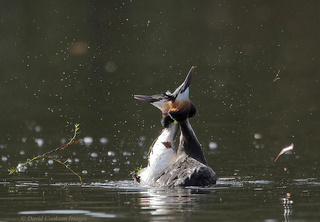
Great-crested Grebe. David Cookson

Another excellent image of the Great-crested Grebes in courtship display....great stuff DC and much appreciated.

Wednesday, 16 March 2011

The Turnstone....

....and the age of amazing tracking technology.

Turnstones. Peter Guy.

There are a couple of things to say about the photograph above, most importantly - and with my apologies - I cannot recall the name of the author, and secondly I reckon it has made an appearance on Birds2blog before but I'm not at all worried about that....I like the picture and it is of one of my most favourite waders.

A study group in Australia have recently recaptured a Turnstone which has made the truly amazing 27,000km round-trip migration for the second time. This bird has also achieved being the first wader to have been tracked on its complete migration in successive years, its incredible journey was made even more incredible in that it included a non-stop week-long flight of 7,600km.

This individual had a light-sensor attached to its leg which recorded where the bird was morning and evening alike. In each year the device was attached in mid-April in Victoria in southeast Australia from where the Turnstone migrated the huge distance to Arctic Siberia to breed. Data retrieved so far indicates that the birds generally start the northward migration with an initial non-stop flight of 7,600km to Taiwan and adjacent regions where they refuel before moving on to the Yellow Sea and northern China, then onwards at least another 5,000km to their breeding grounds in northern Siberia by the first week in June.

It seems the tracking of these Turnstones has turned up some surprise in that the return migration has shown to be made using considerable variation in routes taken by different birds - in itself a puzzle - and one such individual has apparently proved that a Turnstone having survived for 20 years following a particular trans-Pacific route of c.27,000km would have flown well in excess of 500,000km in its life-time.

THE MIND BOGGLES!!

Tuesday, 15 March 2011

Spring....not in the air!


Merlin, Newton Marsh

Merlin Geoff Gradwell 

To get the post off to a good start an excellent image of the Merlin....I know you're reading this Geoff and a special thanks for the brilliant pic of my favourite raptor.

Today couldn't ever possibly have been more of a contrast to yesterday when everyone must have thought spring had arrived. Today was unbelievably depressing and never really got daylight. I drove home from Pilling with lights on my car at just after 4 o'clock, but enough of this gloom....

I started my day at Conder Green - again - to note 2 Spotted Redshank and a Greenshank, with the lone Goldeneye on Conder Pool and a Dunnock singing sweetly with its warbler type song. On the Lune Estuary from Glasson Dock 6 Eider which are by no means a regular occurrence here, 2 Red-breasted Merganser also noted. On Colloway March, being much closer to me today I estimated up to 2,000 Pink-footed Geese here still.

I took note from Jeremy Lane, the Whooper Swans had gone from here, also at Cockersands I noted no Linnet at the winter seed field. Off Plover Scar 7 Eider, as I walked along then headland the movement of two small birds on the shingle below the abbey initially made me jump to attention but soon proved to be 2 Pied Wagtails. The 'swans' seen from here distant and in haze by Bank End Farm yesterday and on two previous visits proved today to be 10 Whooper Swans seen through the gloom but haze free conditions.

On Pilling Marsh a Dark-bellied Brent Goose and a Barnacle Goose were with c.7,000 Pink-footed Geese, and at Fluke Hall a Little Egret and 4 Skylark noted.

And finally....


A nice atmospheric shot of the Wigeon at sunset....Thanks again Geoff. 

Monday, 14 March 2011

Spring in the air.


Meadow Pipit. David Cookson

Spring was definitely in the air today weather-wise but still not taken off  bird-wise, and the odd Sand Martin/Wheatear didn't present themselves to me in the four hours I was 'at it' today. But you should be able to add a few hundred MP's to your records any time soon. 

At Conder Green 2 Spotted Redshanks, neither if which is yet showing any sign of plumage transformation, but watch how rapid it does once it gets underway - white to black - amazing. On Conder Pool another 'fingers crossed' bird - the Little Ringed Plover hasn't arrived yet, though I'm getting too impatient here, 12/14 days maybe. To fill the empty space in my book I noted on the pool, a single Goldeneye, 6 Wigeon, 45 Mute Swans, and 2 Greylag, a Lapwing on here will no doubt make a breeding attempt and won't take kindly to the LRP if/when it shows up here.

The Lune Estuary from Glasson Dock was looking like a summers day with a lack of abundance in bird-life, but I noted estimates of, 220 Curlew and 60 Dunlin, 4 Goldeneye, 4 Goosander and as previously noted no more than mid-fifties of Wigeon. On Colloway Marsh, though distant and hazy for any accuracy I reckon in excess of 1,000 Pink-footed Geese. From Bodie Hill, c.130 Black-tailed Godwit and 12 Goldeneye seen. On Jeremy Lane, at the north end in the beet fodder field 12 Linnet, 3 Skylark, and 2 Reed Bunting, further along the lane, 3 Whooper Swans still, being an adult and two immatures....for how much longer  wonder.

If I'm honest I hoped for my first Wheatear at Cockersands but that didn't materialise and nothing much else did either, but I noted just 8 Linnet at the winter seed field, 13 Tree Sparrows and 5 Reed Bunting at/around Bank Houses and counted 11 Brown Hare on the circuit. From here I could see the 'swans' in the field adjacent to Bank End Farm though distant and hazy but 4 Whooper Swans present there 22 February and 4 March were almost certainly there again today....Come in No 4 times up!

And finally....


In our area the Dipper is a widely distributed species though rather uncommon and a decreasing resident breeder, and yes, this one bears a metal ring. Thanks for the excellent photographs DC/BR, much appreciated.

And here's another Dipper, the video is excellent and the bird shows no fear of  fast moving water.

Sunday, 13 March 2011

Critical!


This video is brilliant if short....

ARKive video - Prince Ruspoli's turaco - overview

An Ethiopian endemic in trouble is the grandly named Prince Ruspoli's Turaco (PRT). The macaw-sized bird with it's scarlet and navy-blue wings, long tail, and green-and-white head was first found amongst the personal effects of the prince after he had been trampled to death by an elephant in 1893. As the unfortunate nobleman had not had the time to label the specimen, it's origins remained a mystery for half a century before the species was seen in the wild by a Cambridge naturalist in southern Ethiopia.

Liben Lark.

The PRT carries with it the unfortunate distinction of being classified as Critically Endangered which is the highest level of threat. It looks set to follow in the footsteps of another bird the Liben Lark which is itself heading towards being the first recorded extinction of mainland Africa's birds, the population of which is thought to number fewer than 100 birds. 

Prince Ruspoli's Turaco. John Richard Darbyshire.

But there is good news, a lifeline has been thrown for these birds thanks to funds collected at last years British Birdwatching Fair at Rutland Water....'Hope springs eternal'....Alexander Pope 1688-1744.

LEARNING SOMETHING NEW EVERY DAY!

Saturday, 12 March 2011

Turtle Trade.


But whats this got to do with birds on Birds2blog....well nothing, but I reckon these are the sort of issues we really need to keep up to date with and from a personal point of view my passion doesn't end with birds but continues through the whole range of wildlife and related matters throughout the world. So if you don't mind the diversion then please read on.... 

Tesco Turtles.

If you don't link to the Wildlife Extra website from my sidebar from time to time I think you should, there's a mountain of info on there and currently includes an interesting story I think will sicken you and will hopefully give you food for thought on whether or not we should all buy our bread and milk elsewhere until the powers that be put a halt on this barbaric practice. Your link is Wildlife Extra 

On a lighter note....

Grey Plover. Geoff Gradwell  

An excellent photograph from GG of the Grey Plover showing its diagnostic black axillaries - contrasting with white underwing-coverts - which are always present and are a unique fieldmark for this bird. It is the best photograph of it's kind I've seen in ages. One thing for sure you're not going to confuse this species with any other 'plover' once you've seen the 'soot' under this birds armpits.

Jackdaws. Brian Rafferty

Another of those pics I can't resist showing, an excellent pose by these two Jackdaws and photographically as good as they come. Thanks to GG and BR. 

I've seen one or two records of Sand Martin and White Wagtail today, in the case of the former - as I write - the nearest one being at Brockholes Quarry LWT.

Friday, 11 March 2011

Early Finish.


Wigeon. Brian Rafferty

Numbers of Wigeon appear to be falling now at all the places I visit, and the Lune Estuary at Glasson Dock doesn't hold a three figure number now according to my last few visits here.

With BT today - no not British Telecom, Brian Townson - we first made our traditional brief Friday visit to Aldcliffe where I noted c.600 Pink-footed Geese and a Little Egret. At Conder Green a Spotted Redshank and Greenshank duly obliged in the creeks along with at least 70 Teal. On Conder Pool a single Goldeneye and 8 Meadow Pipit over. On the canal basin at Glasson Dock I noted another single Goldeneye, 25 Tufted Duck, and a Great-crested Grebe. A cursory glance at the Lune Estuary had it looking like it was the middle of summer regarding bird numbers, and a scan didn't make things much different, though 84 Black-tailed Godwit 'lit up' the place with  a solitary Knot tagging along with them, also to note c.45 Redshank, 22 Cormorant, a drake Goosander, and 2 Goldeneye.

From Bodie Hill another 10 Goldeneye and a Little Egret. On Jeremy Lane the 3 Whooper Swan still, being an adult and two immatures. A detour round Gulf Lane gave a Little Owl having had its 'box' on the tree secured - it had appeared very insecure of late - by whoever tends to the needs of this/these creatures, also 2 Stock Dove. From Backsands Lane 3 Black-tailed Godwit and c.220 Golden Plover. And from Fluke Hall Lane, another Little Egret and Stock Dove.

By now the weather could only best - and as polite as I can be -  described as 'crap' it was raining, it was an early finish and I was home again by 2.10pm

Notes and a an illustration.

Goldeneye. BWP.

1. A Goldeneye on the Lune estuary at Glasson Dock this morning which - at a distance - initially had me fooled until I realised it was the first 1st summer drake Goldeneye I have ever seen. The bird is in bottom left of the illustration above showing the most striking feature about it, being it's black head along with streaked flanks.

2. A Little Ringed Plover has arrived today at Ham Wall RSPB in Somerset.

3. Until I do some reading this is all too confusing for a little birder like me but....the formerly named White-winged Scoter has now become a Stejneger's Scoter and is still present today at Rossbeigh in Co Kerry, Ireland. What I do know is....Leonhard Hess Stejneger (1851-1943) was a Norwegian born American ornithologist who also had a Stonechat named after him....perhaps more on that later.