BIRDING THE LUNE ESTUARY THE TROUGH OF BOWLAND AND BEYOND..........PINK-FOOTED GEESE COCKERSAND PETE WOODRUFF

Thursday, 10 May 2012

Nine days later.


Ring Ouzel. Bowland
Ring Ouzel. Brian Rafferty.


If you want to keep up to speed on the birds at a particular location at this time of the year you really do have to visit on an almost weekly basis as the breeding season comes and goes before you know it. It was for this reason that I decided to get back to Barbondale yesterday nine days after my first visit here on 30 April. I wasn't on my own with this decision, apart from anything else the reports of Ring Ouzel here had created a greater interest in the place than ever and during my stay I saw several other birders, met up with a BTO rep, a cutting edge birder, three Fylders, and Bill and Jean from Lancashire who I often 'bump into' when out and about.


Whinchat. Copy Permitted.

It was excellent that I found at least one male Whinchat had found its way to Barbondale from the large number that have arrived in the UK over the past few days, I actually had two sightings but wasn't convinced the second bird wasn't the one I had seen earlier. The photograph above has a special appeal to me not least of all that it was taken at Cockersands and would have greatly advanced my passion for birds if I'd have found this individual. I'm repeating myself here but....there have been more Whinchats arrived in the UK this year than I have seen before with large numbers recorded including in our own area, an Amber listed and declining species given a welcome boost with these numbers seen reported over the past days.   
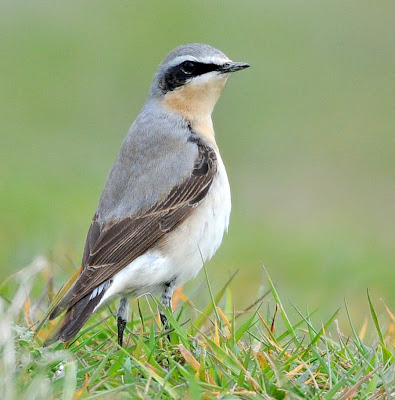
Wheatear. Brian Rafferty.

I usually find good numbers here every year, today I saw at least 17 Wheatear during my seven hour stay during which time I covered some ground and probably walked four miles. Other notables....4 Pied Flycatcher seen as pair, a female, and the singing male seen last time I was here which I'm beginning to suspect may be attached to a female nesting in a tree hole with more observations required.

I found only one male Stonechat today, being the one of a pair seen last week from the path to Bull Pot, a Grey Wagtail was on Barbon Beck as were 5 Dipper over a three mile stretch, a Nuthatch, Great-spotted Woodpecker, at least 5 Redstarts were all male, 5 Reed Bunting, a Buzzard, and a Kestrel. It wasn't until I decided to pay one of my now famous second visits - which often reward me with something I missed on the first - along the path that I had the male Ring Ouzel pointed out to me to be told of claims of three birds here today, along with 2 Cuckoos one of which I had heard for a good part of my visit but never did see.


Many thanks as always to BR for the Ring Ouzel/Wheatear photographs. 


I hope you haven't been trying to get in touch via e-mail recently as I have a new address if you would like to take note....stonechat4@gmail.com        

Tuesday, 8 May 2012

Chris and Lyster.


I had to write up a post this evening if only to bring you up to date on the Cuckoos just in case you haven't done so yourself.


This is Chris who - along with Lyster - has arrived back in Norfolk having flown a massive 10,000 miles since he was tagged back in June last year. Quite amazingly this bird is now within a few miles of the site where he was tagged eleven months ago....mind boggling stuff. Lyster is reported as being on the Broads in Norfolk.

You will remember that Clement - who I personally sponsored - was reported dead several weeks ago and since then a 'no news' situation from Martin has put this bird as also assumed to be dead. There's lots of interesting reading about these five Cuckoos and their epic journey HERE 


And to light up Birds2blog....


Firecrest. Antonio Puigg.

Four impressive images of four impressive birds the first of which is the Firecrest, followed by....

Wryneck. Antonio Puigg.

The Wryneck which - if you live in our neck of the woods - you may have to wait a while to find/see one of these. Many Thanks to AP  for these two excellent images.

Chiffchaff. Marc Heath.


The Chiffchaff....


Ringed Plover. Marc Heath.

And the stunning little wader the Ringed Plover both from RECULVER BIRDER with Many Thanks.

Monday, 7 May 2012

New Post....Old Pics!


I've recently had to do a serious 'sort out' and had to be ruthless in the process, meaning I had to dispose of many images passed on to me by JL over the years, not counted but certainly in excess of 450 prints. However, there were many of these images it was impossible for me to bring myself to 'trash' and I've chosen the following to share on the blog in the hope they might generate some interest. 

In fairness to John Leedal I should point out that these photographs are not of professional quality, for starters he didn't use modern technology, had no computer to edit his work, and I've had to photograph them to gain copies for Birds2blog. By the way....neither of us are from the Victorian era you understand!!

Honey Buzzard.John Leedal. 

JL and I spent many excellent birding hours staked out to see the Honey Buzzards (HB) in the Rusland Valley in Cumbria in the early 2000's, having a good number of sightings over these visits, on one day of good fortune I was able to achieve quite a good recording of a bird calling reminiscent of Golden Plover. 

Although the photograph above is a bit fuzzy it clearly illustrates the kind of views these birds could give you even though it required many hours of emptiness in between. This bird shows its outstretched Cuckoo like head, and the tail - especially when folded in - takes on a 'paddle' like shape, and there are some underpart markings to be seen here too.  

Bee-Eater. John Leedal. 

It was in June 2002 whilst on one of our HB days in Rusland, that I received news of Bee Eaters which had been found just about a half mile away from where we were 'waiting' for the HB's to hopefully show....hows that for good fortune. We had excellent views of up to five birds if my memory serves me well, including one bird feeding an insect to another....amazing stuff. In typical style JL wrote on the back of this photograph he gave me....'A thing of beauty is a joy forever'....Keats

Common Rosefinch. John Leedal.  

This Common Rosefinch was present for us at Giggleswick near Settle in North Yorkshire also in June 2002, obviously a good year for us. I recall this bird immediately giving itself away the instant I opened the car door on arrival at the location to hear it singing its head off....more amazing stuff.

Spotted Flycatcher. John Leedal. 

And finally....Nothing unusual about this photograph of the young Spotted Flycatcher, other than for two exceptions, for starters it was found at Aldcliffe in the sheep pens by the old railway crossing - obviously bred there....hadn't it - and it was found at the end of August 2002 much later than I would have expected to see such a young Spotted Flycatcher.

Saturday, 5 May 2012

The Harrier and the Falcon.


With the breeding season upon us you have to wonder if 2012 will be the end for the Hen Harrier on the upland moors of Bowland, but on the positive side the species had an amazing success in Orkney with the population reaching a 20 year high of 100 breeding females producing the same figure of 100 chicks representing a remarkable recovery for the raptor which is facing just the opposite of this on the grouse moors of the North of England even though areas like this could accommodate 'huge' numbers of breeding pairs of this enigmatic bird with extinction a distinct possibility.

The Hen Harrier in Orkney had a period of decline on the islands, in particular during 1980/90 when populations reached their lowest level since detailed records began in 1953, the direct link being the number of sheep grazing on land favoured by the harrier - the result being land/habitat degradation in turn resulting in shortage of prey - and its lack of breeding success. 

There is a clear illustration here that, given the chance the Hen Harrier will thrive if the habitat is in good condition, the weather is favourable, and illegal persecution can be eradicated which is an issue which appears to never going to be resolved in the North of England in particular the Forest of Bowland, sheep have never been the problem here....but if you know different and think they have I'm all ears.

On the raptor theme there is an interesting record of a pair of Peregrine Falcons breeding on a salt marsh in the south of the country. These birds were found in May last year at a nest in a simple scrape among Sea-purslane at the seaward edge of the saltmarsh just few metres from the high water mark. This nest was within a few metres of at least three other breeding species including Black-headed Gull, Mallard and Oystercatcher. The main concern was that the nest would be washed out with the spring tides, but this was an unfounded concern as the nest survived the tides and at least one young was observed to fledging and followed through to hunting as a young bird in late August.

History records a Peregrine Falcon nest on heathland in the then Hampshire of 1928 and nests have been found in the past in mature moorland heather....fascinating stuff!

As you may have guessed - if you're interested that is - I'm still not birding, and I'm still on the computer in the Lancaster Library as mine remains 'down'....life's a bitch at times, and this is too long a time for my liking. Add to this the computer I'm using in the library doesn't seem to want me to put any images in this post....just about sums it all up for me these days!  

Tuesday, 1 May 2012

Down but not out!


Still down on my birding but definitely not out.

I have been determined to get to Barbondale before April was out for a few weeks now and just managed to do so by getting there yesterday on the last day of the month. It was a fine sunny day but the cold wind took the edge off it.

I found it hard to decide which of two species should top the list of my records but in the end it had to be the three Stonechats I found which were the icing on the cake on an otherwise dull day for results. It's obvious lots of birds haven't yet arrived on territory and were a bit thin here today, however, three Pied Flycatchers were not to be 'sniffed at' seen as a pair and lone singing male which is precisely how I found the three Stonechats to be, though singing male Stonechats are hard to come by and this one was no exception.  

Pied Flycatcher. Male
Pied Flycatcher. Brian Rafferty.

On the four hour visit I found just 21 species most notable of which were two Redstarts both male, heard a single Tree Pipit, 8 Wheatear, a Nuthatch, Reed Bunting, Buzzard, a 'good number' of Willow Warbler, and saw 12 Swallows through. Hopefully things at Barbondale - and elsewhere - will pick up in the coming days. On the way here I saw a Badger as a  road casualty at Kirkby Lonsdale....very sad.

Redstart Male
 Redstart. Brian Rafferty.

I now had the choice of several places to continue my long awaited 'away day' and decided to take a look down the River Wenning and up the River Lune from Hornby. An interesting visit if only to eventually see at least 80 'hirundines' in the air above, at least 30 of which were Swifts together with estimates of 20 House Martin and 30 Swallow. Other birds of note, two Little Ringed Plover were on a flood in the field by the confluence, 3 Common Sandpiper, a pair of Goosander, Skylark, a Great-spotted Woodpecker, and a Raven overhead, Sand Martin numbers appeared to be in significantly low number.

Summer visitors have still to arrive yet and several records seen today of - for example - Whinchats in the country/county appear to indicate this is now happening.

Many thanks to BR for the excellent photographs posted in haste along with everything else on a computer in Lancaster Library as mine is currently down....I'm beginning to think an evil spirit has taken over my life....OH DEAR !!  

Wednesday, 18 April 2012

Crossbills and a 'chat'.


Crossbills. Brian Rafferty. 


Something of a coincidence, BR has had a day in Bowland this week and not only found Crossbills, but also took full advantage of doing so by achieving excellent photographs of the birds. This follows yesterdays post which referred to the 'unusual' bird at Helsington Barrows in February 1997 having been suggested through a photograph as being a possible 'xanthachroistic' male Crossbill by a reliable ornithologist whose knowledge on such matters I respect. I went on to claim never having found the meaning of the word, I should add including it not being in the Oxford Concise English Dictionary. In the comment section GG offered me an explanation which I intend looking into, thanks GG, meanwhile, I remain confused. Thanks to BR for the photographs.


Stonechat. Antonio Puigg.  

This is a photograph of an African Stonechat saxicola torquata which I found on Antonio's website. Having already been in touch with Antonio Puigg he agreed to allow this image on Birds2blog....Many thanks Antonio.


I don't usually allow Birds2blog to become too scientific as I feel much of it is beyond the interest of the average birder, and when I start to try and read about subjects like 'A Molecular Phylogeny of Stonechats', 'Sequence and Taxonomy', together with DNA samples, etc, etc, its time to give up, but by way of a change this is a interesting picture of a species I'm not acquainted with though the differences to the ones I am are subtle. To go deeper into confusion, as I see it there are 14 subspecies of the African Stonechat saxicola torquata and to try to study illustrations of the varying amounts of chestnut on the breast of males of the various subspecies - which is the main distinguishing criteria - may well be generally understandable but some of the subtleties would be beyond me in the field let alone in an illustration....I think I should leave it there, don't you!!  


And finally....


Siskin David Cookson


Spot the difference between DC's Siskin, and....

Serin. Antonio Puigg.

AP's Serin....not a lot! 

Monday, 16 April 2012

Sorting out and looking back.


Six photographs to follow, non of which are competition quality but are essential to the post which relates to sorting out my records/photographs. All the photographs were taken by my old friend and mentor John Leedal, and the poor quality is down to how I have had to deal with them to get them on to Birds2blog. They are chosen at random to illustrate a hint of some quality birding JL and I experienced over many years.


I can't recall how many in total, perhaps they are all in this image which contains 8 Spotted Redshank on the Eric Morecambe complex at Leighton Moss on 10 October 1996. I'm not aware of the best ever count of this species here, but I certainly hadn't seen this number here before and not since. I appreciate you have to take my word that these birds are what I claim them to be as its not all that obvious in the picture....I assure you they are Spotted Redshanks.


Another 'goodie' on the Eric Morecambe pools was this Long-billed Dowitcher on 6 October 1998.


I remember all these bird observations in this post vividly - photographs have an amazing ability to give lasting memory recall - especially this one of the male Crossbill at Helsington Barrows in Cumbria on 28 February 1997. With no time to search my records for accuracy, this bird was one of a good number at this location which JL and I visited about five times during their stay of at least six weeks, to find an unusual male in that it was referred to - from a photograph - as ' a possible xanthachroistic male' in the Annual Birdline North West Report. We were intrigued by this bird which showed particularly yellow feathering around the underparts with a few hints of red, the mantle, back and upper wings were coloured as a female. If JL ever gave me a copy of the photograph of this 'odd' bird it appears to have been lost, if so, most unfortunate.


I clearly recall saying to JL, how unfortunate it was that the best shot he got of this bird had to have the empty can in the frame. This Marsh Sandpiper was at Seaforth in Liverpool on a date I cannot recall, but I'd say probably around 15 years ago in 1997.

    
The Snow Bunting was at Cockersands on 6 November 1999....


....and the Great Grey Shrike was at Marton Mere, Blackpool on 8 March 1998....Halcyon days, and theres more on the way for me too with just a couple more corners to turn yet!


Xanthachroistic....never did get my head round that one....anyone please!!

Thursday, 12 April 2012

Pipits & Cuckoos.


Water Pipit. Copy Permitted.

Water Pipit. Copy Permitted.

The Water Pipits found on Conder Pool on Sunday 1 April are still being seen there today. The Water Pipit in Britain is known to use the same area for feeding over several weeks, it is also known to frequent the same areas each winter. That said Conder Green has never come into the reckoning before and this is a first record here for the species.

The two Water Pipits in the photographs above are the same two I saw on my 'pipit twitch' on Tuesday 3 April and show the difference in plumage detail which I mentioned at the time with the bottom bird in summer/near summer plumage.


As for the Cuckoos, there is some concern over three of the remaining four of the original five satellite tagged last summer in that there has been no transmission from Lyster since 1 April when he was in Ivory Coast, no news from Martin who was last heard from at Lorca in southern Spain, a poor signal was received from Kasper who is in the uplands of Algeria, and Chris is still in Italy where its assumed he will need to fuel up for several days for the last part of his journey from Italy  to Norfolk. It looks like Chris is going to be the first one 'home'....lets hope the other three follow him safely back.


Recovery Slip 1930.


A lot has been learnt about the Cuckoo since this project was launched, little was know about the birds once they left these shores for Africa prior to this project and the only UK-ringed Cuckoo ever found in Africa was 82 years ago in 1930. 

Wednesday, 11 April 2012

The Flycatchers are coming too.


Pied Flycatcher
Pied Flycatcher. Brian Rafferty.

I note with much interest a Pied Flycatcher having been found at Barbondale today, an early record for our area where you would expect to see the species in maybe a weeks time especially if the weather stays anything like it is at the moment, maybe a couple of days earlier  in more favourable conditions, but 11 April is definitely an 'early bird' SEE HERE. 


My intentions are to visit Barbondale before the month is out, probably sometime in the last week of April, by then my hopes are pinned on finding a few more than one Pied Flycatcher. I also have hopes in finding more Stonechats here than was the case last year when - despite five visits - I found not a single bird in keeping with other places. 

BR's photograph of the Pied Flycatcher above is interesting in that, noting plumage detail it obviously isn't a mature bird but a first summer male.

One on a post
Spotted Flycatcher. Brian Rafferty.


I soon hope to be on the trail of the other 'flycatcher' the Spotted Flycatcher, but this bird isn't expected to appear in my records until maybe up to a month later than the Pied Flycatcher in early May. Amongst the many places I can find the Spotted Flycatcher I'll have a keen eye in the Marshaw/Tower Lodge/Trough Bridge area in Bowland to see if 2012 can uphold its record of being the best place to find the highest number of the species in the LDBWS recording area. I'm also reminded of finding my first record of breeding Pied Flycatcher in this area in 2011 including young being fed on 16 June, so this summer looks more exciting than ever for me. 


And talking of Barbondale and Bowland....


Dipper. David Cookson.

....here's another bird - the Dipper - I'll be seeing plenty of at both these locations.

Kestrel. David Cookson.

And yet another one, the Kestrel. Thanks to BR for the excellent photographs of the 'flycatchers', and to DC for the Dipper and the Kestrel. 


On Sunday evening last I watched a Peregrine Falcon on and around the spire of St Peters Cathedral in Lancaster. I made an error made in my last post 'The Cuckoos are coming' when I claimed I hadn't seen a Cuckoo in 2011 until 2 June, in fact I heard one on Birk Bank on 28 April. 

Tuesday, 10 April 2012

The Cuckoos are coming.


I'm quite confident my man in Kent Warren Baker won't mind my using his header pic of the Cuckoo for the introduction to my post for today. I'm also quite confident if he does he'll tell me so and it will be removed. 

I cant wait - this year especially - to hear my first Cuckoo, last year it came very late but was a delight to have heard one on 2 June from Harrisend. By 'especially this year' its going to mean that much more having learnt a lot about the Cuckoo through its migration back to Africa via an intriguing project by the BTO who satellite tagged five Cuckoos last summer the results of which have been an insight into the strategy of this seriously declining species through its migratory journey to Africa....and now they're coming back.

If you haven't been keeping up to date with these amazing birds I can tell you that Chris is now in north-western Italy near the town of Sarzana, Martin is in Lorca southern Spain, Kasper is still in Algeria in the north-west Atlas Mountains, and Lyster -  who appears to be the cause of some concern having made no transmission since 1 April - was last heard of in Ivory Coast, Clement unfortunately is no more having last transmitted on 25 February in Cameroon and - as a result of his satellite tag giving a low body temperature reading - was eventually pronounced dead.


I can recommend some very interesting reading regarding what these five Cuckoos did since leaving these shores last summer, and what they have been up to since including the start of their return migration to the UK....The BTO website is HERE


And finally....


Stonechat.Martin Jump. 

Martin got a photograph of the only female Stonechat on Clougha this year according to my observations on Monday 26 March....


Meadow Pipit. Martin Jump.

....he also got an excellent one of the Meadow Pipit on Clougha too. 

Thanks for the photographs Martin, and for the info prior to my visit regarding the only pair of Stonechats we both found on our respective visits here. Please try to support all us 'little bloggers' HERE