BIRDING ON THE LUNE ESTUARY AND THE FOREST OF BOWLAND...........................................................................................BLACK DARTER PETE WOODRUFF

Sunday, 12 February 2012

The Black Redstart.

  
A few notes about the Black Redstart to fill my birding/blogging gap. 


Too big a gap if you ask me, and I think Birds2blog may well have to be renamed 'The Weekly Post'....I'm rapidly becoming a broken man you understand!

Black Redstart Geoff Gradwell

Today the Black Redstart (BR) is regarded as a scarce but annual passage migrant in our recording area. I can recall three BR in/around our area over the past few weeks, the most recent one being at Cockersands where - void of any accurate details - this area has a good record for the species, one of which I found myself here on 9 November 2009, this bird stayed for a week which is as long as the current one here actually.

Going back in time to the mid-late 1800's, Mitchell regarded the BR as a rare winter visitor, Oakes noted a bird in our recording area at Hornby in October 1940, and recorded a male in song for a month during the summer of 1949 in Liverpool which has been regarded as 'perhaps the first breeding record' for Lancashire and North Merseyside. In fact the first confirmed record of breeding was made in Liverpool in 1977. The first record of BR in Britain was in London 1829.

The BR's distribution is widespread across S Europe, Middle East, and from Caucasus through Iran to E Tibet. It has long been a scarce breeding bird in England, but the number of pairs rose steadily for 50 years from 1940 until 1990 reaching a peak of around 120 pairs. A dedicated survey in 1977 reported just over 100 territory holding males with 60 pairs proven to breed. Large industrial complexes such as power stations - one was at Heysham in April last year -  are known to be popular with the BR as breeding sites, though it goes without saying these sites are prone to high disturbance and in fact several areas have established Black Redstart Action Plans in attempts to improve the nesting environment for the species. 


There is an interesting record of BR in a secluded cloister in Westminster Abbey in 1940, they were first seen by a lady visiting London from Windermere in Cumberland, now Cumbria. Further investigations regarding these two birds found two BR's around the old Abbey Gardens, on one occasion they were observed hawking flies like a pair of Spotted Flycatchers. Even more interesting was the fact that one of the birds was found to have been a juvenile whilst the other was a parent female, proof of breeding was therefore achieved.


The Black Redstart in song....


And finally....well nearly!

Wheatear. Pete Woodruff.

With the days becoming longer its hard to believe its within reason that you could find your first Wheatear of the year in four weeks time, one of the first signs that spring on its way.

Corn Bunting Simon Hawtin

I see an amazing record of 241 Corn Buntings at Rawcliffe Moss on Saturday, a record not beaten here since 2004. The record can be found HERE 

Barn Owl Brian Rafferty  

And definitely finally....

Couldn't close without another one of those 'can't resist this one' photographs showing the Barn Owl with its latest meal. Don't forget to take advantage of the link to BR's website....you won't regret it.


I have no idea why this post has a mainly white background, nor at this point do I have any idea how to get rid of it. What I do know is....I don't like it!

I'D SOONER BE BIRDING!

Sunday, 5 February 2012

The Great Escape....


....with two Mexican and a couple of other birds!

I managed my second days birding in three and a half months last Wednesday having broken free from the shackles of a heavy work load which - in relation to my life as a birder - to be really truthful is becoming quite painful for me but is set to continue I'm afraid, very afraid....but enough of this.

White-fronted Geese. Phil Slade  

My day did have its disappointments and one was that despite a multitude of White-fronted and Bean Geese having made the move to our shores this winter I found not a single bird on Wednesday. But having been up with the lark I first headed off to Conder Green - well where else - to note 2 Black-tailed Godwit, 5 Little Grebe, a drake Goosander, 8 Wigeon, c.30 Shelduck, and a similar number of Common Gull all on Conder Pool. The circuit was - as is usual - worth the effort if only to find 3 Spotted Redshank feeding quietly under the old railway bridge, and up to 80 Teal in the creeks. On the canal basin at Glasson Dock a drake Red-breasted Merganser was unusual on here, a Little Grebe and 5 Pochard were also of note. On the Lune Estuary I noted c.120 Black-tailed Godwit and a drake Goosander. But my ploy of return visits on the same day to the same location paid off once again with a staggering 172 Goldeneye counted at high tide and in fading light compared to the 'few' seen six hours earlier in the day. On Colloway Marsh c.2,000 Pink-footed Geese were too distant to turn into anything otherwise. 

Golden-cheeked Woodpecker.

American Avocet.

I've slipped in a couple of smart Mexican beauties here to brighten up the post. You can always find more than a few exotic birds with a much traveled birder/tour leader who has recently been to Mexico on Ribble to Amazon.....recommended.

At Cockersands I decided to do it light void of lugging the telescope - proper birders don't do this kind of thing - and wandered along the headland as far as Bank End where I found up to 60 'swans' rather distant in an inland field. Not all of these were obvious Mute Swans so I went off back to the car at the lighthouse and drove back to get a better look at them through the optics to find 4 Bewick's Swan two of which were juvenile, and at least 18 Whooper Swans, so a worthwhile effort was well rewarded. On Moss Lane what I initially took all to be Curlew turned out to be something like 350 Black-tailed Godwit and 100 Curlew. 

In a field opposite Sand Villa I saw an estimated 2,500 Pink-footed Geese and uncounted Whooper Swans but on a fast road and a convoy behind me I drove on....proper birders don't do this kind of thing! 

I wanted to get to Cockers Dyke with the return to Glasson Dock planned, but the dyke proved to be another of the days disappointments in that the ever present Iceland Gull of late didn't appear to be there despite about an hour and around seven full scans of the area. But an adult Mediterranean Gull compensated with a Little Egret, and a mixed flock of c.50 Twite/Linnet which I failed to ratio before they departed. 

Raven. Copy Permitted. 

I think this silhouette of the Raven is excellent....photographs with a difference. 

Bringing a smile into birding  life.

Some claim that sound travels faster than the speed of light. I know some people who appear to be both fast and bright....until they speak!

Thursday, 2 February 2012

Going Public!


There's an issue about wildfowling which is going to get out of hand as far as I'm concerned and I have decided to make use of Birds2blog as the platform for me to clear it all up from my own perspective before it does. However - if you are still interested - to fully understand what this is all about. It is essential - if you haven't already done so - that you read my recent post Something of a coincidence followed by THIS 


I think the contribution by this person on the LDBWS website is to be applauded regarding this appalling act on Glasson Marsh, the people - and their kind - referred to should get all the publicity possible and thanks should go to him for highlighting and reporting such behavior.  

I have been asked to provide my opinion as to whether I think this incident on Tuesday 31 January and those involved could be connected with those mentioned in 'Something of a coincidence' the reply to which is....I would err on the side that the two seen on Glasson Marsh on Sunday 15 January as far as I could see were 'real deal' wildfowlers and that I had no other reason to suspect otherwise in the short time I spent at the location on that date, but.....the truth is, how on earth would I know void of any other evidence.

The case is now closed as far as I am concerned and my decision to terminate my WeBS counts stands. It goes without my saying, I can only hope there can be some success in tracking down the perpetrators of this disgusting act towards our wildlife.

Goldeneye. Dave Appleton.

Yesterday I counted a staggering absolute minimum of 172 Goldeneye on the River Lune at Glasson Dock. Unfortunately most were distant and the light was fading at 4.30pm, but I'm firmly convinced these two factors and the birds constantly diving made the count of up to 200 individuals here an impossibility....but - given half a chance - I'll be back to try again sometime soon and provide the evidence that the Lune Estuary at Glasson Dock held up to/in excess of 200 Goldeneye in 2012.

Goldeneye. Dave Appleton.

More on my second 'Great Escape' when I can find the time to draw up my next post.

Many thanks to DA images of the Goldeneyes, much appreciated Dave. 

Sunday, 29 January 2012

The Cuckoos.


During the summer of 2011 five Cuckoos in the UK - Lyster/Clement/Kasper/Martin/Chris - were tagged with tracking devices, I decided to sponsor Clement.  

Clement.

As a result of the tagging there have been a few surprises, the first of which was the fact that Clement left the UK at the early date of 5 June, three of the others left at the end of June which was still an early date for the departure of Cuckoos on their migratory journey south, and the last one left on 22 July.  

Courtesy of BTO.


The Cuckoos presented some more surprises in that they took on a variety of routes with one bird choosing to go due east across the North Sea to the Netherlands, the others can be tracked using the map above and linking the name/colour on the left of the map.

Clement was soon in the news again, leaving France by heading west towards Spain and was followed by the last bird to leave the UK which also headed towards Spain....a brand new migration route. These two Cuckoos decided to minimise the distance of the Sahara crossing - a major source of mortality amongst migrant birds - by moving down the western edge of the desert and into Senegal and the Gambia, in doing so they became the first ever British Cuckoos to be recorded in West Africa.

Clement also showed that at least some Cuckoos migrate across the Sahara by night and day, not just during the cooler temperatures of darkness, in fact on one day he had moved in excess of 200 miles across the desert in the extreme heat of the scorching sun.

By the end of November all five birds had reached as far as the Congo rainforest, including the two that took the much longer western route. All these Cuckoos had been caught in the UK within 70km of each other, yet had been separated by up to 3,600km at times during migration. By the end of December all five birds were in the Congo, the first time they had all been in the same country since leaving the UK.


There are a few things to ponder over these five Cuckoos, whats their next move when the time comes for northwards migration, which route will they/do they take, will they survive the journey, will you see a Cuckoo this summer, how many did you see last year....I saw none but heard three.


Keep up to date with this astonishing story/project and find out for yourself HERE 


Cuckoo ~ Runner-up on Birdguides POTY Competition
Cuckoo.David Cookson. 


Not just a photograph of a juvenile Cuckoo but a simply brilliant one thanks to DC....I wonder if this one is in Congo right now too!

Wednesday, 25 January 2012

Oh no....not another Stonechat post!


If per chance another Stonechat post on Birds2blog - well what do you expect - is likely to bore you I'd suggest moving on. But I did manage to find an excellent image below of a close relation just to break the monotony.

Whinchat
Whinchat. David Cookson

A Summary.

It was interesting to find in the introduction in the LDBWS 2010 Annual report, in relation to some severe winter weather in the winter 2009/10 the Stonechat was the most seriously affected species.


Anyone observing this species as I have for in excess of 12 years - especially in the Clougha/ Birk Bank (C/BB) area, couldn't help but see and record the results of this prolonged period of freezing temperatures being the demise of this smart little chat. Concentrating on this area and others - not alI in the LBWS recording area - I had noted an upturn in the status of the Stonechat from zero here on C/BB in the late 1990's to - for example - an amazing 11 pairs on 21 March 2007. However, by an awful coincidence when I visited here a month later in April the 'Guardians of the Countryside' had decided a 'burn' was a good idea and used it as another tool in their armoury for 'control' under the cover of land management. It goes without saying that the result of this 'good idea' was that the 23 birds I saw in March was reduced to 4 though I'm not suggesting that this event was the sole reason for 4 birds to be left from the 23 found but it sure didn't help and I just wish these people would have taken their torches elsewhere on this occasion.

My observations of the Stonechat on C/BB proved that the upturn in the status of the species which began at the end of the 90's had peaked around 2005/6 and that by the end of the winter of 2009/10 they had virtually disappeared from just about everywhere though I won't labour the issue with statistics here. However, if I was to compare last years Stonechat records on C/BB with those of 2007 when I visited every month of the year, by contrast when I scaled down my surveys in 2011 at 9 locations, I made just 4 to C/BB by which time the Stonechat had been virtually lost making my efforts almost pointless and we were unfortunately almost back to the late 90's with the species. That said, I did find a male up there on 23 July, and a female on 25 August.


Another previous stronghold was on Harrisend, though this area also only produced 4 birds on 24 March from 6 visits in 2011. I concluded that these were migratory birds passing through as I found not a solitary bird up here despite three more visits in June/July/August by which time I had given up on the Stonechat here too. 


It is interesting to note my figures for 2010 agreed with the RSPB findings on the United Utilities Estate on the Bowland Fells where, by comparison to a full survey 66 pairs of Stonechat were found in 2007 representing 50% more than those found in 2010.


Rest assured....I shall renew and pursue the Stonechat relentlessly in 2012 whilst bearing in mind my record of 12 Stonechats on Newby Moor, Clapham on 1 February 2005. 


Well, not being able to leave Birds2blog void of a couple of photographs, how about these....


Black Redstart. Geoff Gradwell 

The smart little Black Redstart which has been present at Knott End for 'a while' now. Thanks for this GG. 


And here's one to put you on your guard if you think you found a Red -crested Pochard. This bird was found at Marton Mere recently and as it turned out....its a hybrid! Thanks for this goes to Cliff Raby  

I'D SOONER BE BIRDING!

Friday, 20 January 2012

Friday the thirteenth....


or....A Bewick's Swan Of Note.


Bewick's Swan - Reculver - 23/12/11
Bewick's Swan. Marc Heath


If you're silly enough to believe in superstitions Friday 13 is bad news. I don't go for such rubbish and last Friday was anything but bad news for me, for starters I got in some birding which produced - amongst a few other nice finds - the excellent bonus of a Bewick's Swan with nine Whooper Swans in a stubble field at Fluke Hall. But these wintering birds bring with them another bonus in that some can be found as marked individuals, and my bird was just one of those. After struggling for several minutes to attempt to read the ring through a hedge, contact with my man at WWT was rapidly followed up the next day by some interesting data from this bird which turned out to be in excess of 22 years old having been ringed as an adult at Martin Mere  WWT in December 1990. As you would be inclined to expect the creature has travelled a few thousand mind boggling miles in its life so far and has been recorded in our own LDBWS recording area just twice in all those years, even more remarkably quite possibly in the very same field on both occasions. With some amazing migratory flights to and from its summer/winter grounds having visited Denmark, Netherlands, and Germany in the process, this bird had been a delight to find and observe. 

Whooper Swans. David Cookson

One of the nine Whooper Swans with the Bewick's Swan was also ringed and had been marked at Caerlaverock, Dumfries in February 2011 having since been first recorded at Fluke Hall last Friday 13 January.

And finally....

Short-eared Owls. Brian Rafferty


You'd be well advised to treat yourself to some spectacular bird behaviour caught equally spectacularly on film HERE

Thanks to Mark/David/Brian for the usual brilliant photography.

I'D SOONER BE BIRDING!

Tuesday, 17 January 2012

Something of a coincidence!


Ferruginous Duck 

You may like to look up the connection to this little tale I'm about to tell, if you would like to you'll find it HERE 

By something of a coincidence -  irony even - on Sunday morning I hear of a Ferruginous Duck found at Mullaghmore Lough in Co Monaghan, Ireland which was later shot dead. This follows on from a Blue-winged Teal that had met the same fate recently also in Ireland. 


So....void of over labouring the issue, here's the irony....

I was employed to 'do my bit' on Sunday at high tide as a counter for the BTO WeBS Survey which I've been involved with for a year or two now and despite the restrictions of my birding of late to such an extent that I got out for the first time only last Friday since 14 October 2011 I chose to try to continue my involvement with this important survey and succeeded in doing so last month. On Sunday when I arrived at my allocated viewpoint overlooking Glasson Marsh I immediately clapped eyes on two 'sportsmen' on the marsh complete with guns and mutts. Now if you did decide to access 'At it again' - or indeed if you know me - you will have already worked out my next move which was to depart the location just 2 seconds after I had applied the handbrake on the motor having not even had the time to switch off the engine.


As you can imagine I've been in touch with the said BTO and told them I just made my last count - or attempted to -  for the WeBS Survey on the principal that I don't subscribe to the shooting fraternity and my conscience won't allow me to try to count birds whilst they are being shot at.....The story ends there, though I could go on. Of course with these two around there was no birds to count anyway....of course!


Smew. Copy Permitted.

Always worth another look, the smart little 'redhead' Smew on the Lune Estuary on Sunday.

Smew. Cliff Raby. 

And definitely always worth another look, the even smarter drake Smew with thanks to CR for the excellent photograph.


Putting a smile into birding....On 11 January a Great Blue Heron was reported at Kirkwall, Orkney apparently present for its sixth day....the bird was later identified as a Grey Heron! 

Sunday, 15 January 2012

Not before time!


I managed an escape day on Friday. I've been looking forward to this for far too long now, and the day was a wall to wall sunshine day with zero wind, a delight to be out let alone out and birding.

Glossy Ibis. Marc Heath 

A Glossy Ibis - the one above was darn sarf in Kent - was found at the north end of Aldcliffe Marsh on Saturday 7 January and remained in the area for six days but hasn't been seen since. The bird made it two of a kind in our area with another one at Leighton Moss. Though this is good news on the Ibis scene its not what I'm about and on Friday I managed a full eight hour stint, almost dawn to dusk but not quite.

As I arrived on the viewing platform at Conder Pool the first bird I saw was a Little Egret, also noting 4 Little Grebe on here with 12 Wigeon and a drake Goosander. An hours trawl had me finding the elusive - it seems - Common Sandpiper, and a Spotted Redshank, both lurking in the hidden corners of the creeks.

On the canal basin at Glasson Dock, a Little Grebe and 2 Goldeneye were of note. On the Lune Estuary 5 Bewick's Swans two of which were juveniles and are rarities in my book. I also noted c.250 Bar-tailed Godwit, up to 800 Golden Plover, and at least 60 Goldeneye with 103 reported yesterday along with a rather interesting record of a pair of Gadwall at Cockersands off Plover Scar, both of these are HERE the latter never in my note book here. On Colloway Marsh a distant raptor was almost certainly Peregrine Falcon.  

Pulling off the road opposite Sand Villa I found 2 Whooper Swans in a field with Mute Swans, and of Pilling Lane Ends another 2 Whooper Swans seen, also a relatively small number of c.2,000 Pink-footed Geese. At Fluke Hall a Bewick's Swan was with 9 Whooper Swans in stubble. Regarding numbers seen together, 13 Meadow Pipit, at least 30 Skylark, 5 Reed Bunting, and 11 Great-crested Grebe offshore all had an element of surprise about them for me.

Stoat. Phillip Tomkinson.

Unlike the one above, a Stoat was good - if brief - in its winter ermine coat along the coastal path. I think this creature is about the twelfth stoat in ermine ever seen by me but I don't seem to be able to put my hands on the records. 

Unfortunately I left my planned visit to Cockersands too late in the day and light was fading but I managed to note on a quiet Plover Scar estimates of 380 Oystercatcher, 25 Knot, and 12 Turnstone, a Cormorant off the scar was tussling with a 'flattie' almost the size of a dinner plate.

And finally, well not quite....

Otters. Phillip Tomkinson.

The Otters at Leighton Moss are showing themselves quite regularly it seems....so if its Otters you're after get on down there!

Thanks to Marc for the Glossy Ibis. And for the Stoat in its summer coat, and the Otters of Mull....thanks to Phillip 

And finally....

Smew. Copy Permitted. 

I had word via a text from a birder I know well that a 'redhead' Smew - not the one in the pic with the Wigeon for size comparison - was on the Lune Estuary with Goldeneye this afternoon. Thanks to the 'birder I know well' much appreciated. I found 3 Spotted Redshank and a Common Sandpiper at Conder Green whilst driving past on the return from a mission.

I'll need to do this birding business all over again and soon....I just can't cope otherwise!

Wednesday, 11 January 2012

Drawing your attention....


....to an excellent illustrated story....A couple of links to more on the 'Icechat' in the previous post....And three excellent photographs.

Surprise, surprise, another post despite my early retirement from birding!

Photograph courtesy of Martin Jump. 


Martin Jump paid a visit to Newton Marsh, a decision he made to be at the right place at the right time to witness and photograph nature in the raw. I have no intention of 'stealing' Martins story and you can read his account, and view his excellent illustrations if the whole event HERE

If it was the first time you heard about the Stonechat in yesterdays post and you remain interested in this remarkable event you can get more on the story HERE and a little more HERE


And the three excellent photographs are....


Grey Wagtail.Geoff Gradwell

The 'wagtail' with the longest tail....an excellent shot of this bird in its natural habitat and its brilliant reflection....nice one GG.

Iceland Gull. Cliff Raby

A nice bird at Marton Mere, Blackpool. Good numbers of the species at various locations at the moment especially up north with double figures in Scotland.  An excellent image of this bird Cliff.

Short-eared Owl. David Cookson

Well you can never tire of 'owl' pics of this calibre, another excellent shot of this stunning bird with its undercarriage down....nice one DC.         

Thanks once more to Martin/Geoff/Cliff/David for the excellent photographs. 

Monday, 9 January 2012

The 'Quickie' Post.


My apologies to all those who have seen what follows before but....

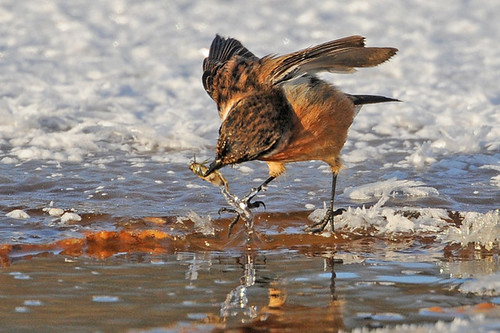
Out of the water
Stonechat. Brian Rafferty.

I had no intention of a post on Birds2blog, maybe one the end of the month....I've sadly still not got the time. However, trawling through the various favourite birding/photography blogs to try and secure my sanity, I discovered that I had missed by one day this amazing photographic record on its second anniversary yesterday 8 January 2010 illustrating an event I reckon nobody could ever have foreseen....that of a 'chat' fishing through an ice-hole in a lake on the return of the 'ice age' during the winter of 2009/10. As can be seen in the photograph the bird was having success in catching Common-back swimmers. At the time I claimed BR's pics to be unique, made sure the event was featured in British Birds magazine, and as I was never challenged the claim still stands.


Stonechat. Marc Heath. 

OK, me being Pete Woodruff, you wouldn't expect to get away with just one photograph of the Stonechat would you....so here's another brilliant one taken recently by 'Reculver Birder'.


Many thanks to Brian Rafferty for his mind boggling pic of the 'Icechat', and to Marc Heath for his smart little bird in Kent.


I'D SOONER BE BIRDING. See you again soon....hopefully!