BIRDING THE LUNE ESTUARY THE TROUGH OF BOWLAND AND BEYOND..........PLOVER SCAR LIGHT COCKERSAND PETE WOODRUFF

Tuesday, 5 July 2016

Stars Of The Green And A Ringed Plover.

Four days later and I was back at Conder Green to find the Avocet pair still in charge of the one surviving young, coming along a treat and growing, but still needs luck for another three weeks to be out of the woods and flying....I'll take a shot at fledged by 25 July.

I saw the two adult Common Tern, but no sign of any young, though I'm confident they are well and were in hiding. According to a text message I received on Friday, one of the young had fledged, had flown and dropped into the pontoon, apparently the adult was frantic as the young bird was unable to get lift off and out of the pontoon, but it was reported flying on Sunday. 


Common Tern. Conder Pool. Pete Woodruff.

This was the Common Terns on 21 June with a young bird on the left. I had the two young down to fledge on or around 9 July, but one of them fledged on 1 July 10 days after I took the picture....amazing!

Eighteen Common Sandpiper were at Conder Green yesterday, ten were in the creeks and eight down the Conder Channel, 2 Wigeon both drakes were on Conder Pool, a Goosander was in the creeks, a Reed Bunting in the hedgerow, and 2 Swift over.

I only covered half the Cockersands plan yesterday. On Plover Scar at high tide, 95 Knot, 6 Ringed Plover and similar Dunlin. A single Eider took off from the sea, I watched this bird fly across to Middleton to land on the sea again just offshore.

On what little wanderings I did at Cockersands, I noted 6 Goldfinch, 3 Whitethroat, saw my first 4 Meadow Brown this year, c.25 Small Tortoiseshell, a Six-spot Burnet, and a Painted Lady....


....Think I'll Go Home! 


The Plover Scar Ringed Plover.

On 19 June a Ringed Plover was reported on Plover Scar, the bird apparently had four eggs in a nest. Yesterday I saw a Ringed Plover sitting on the shingle like it was still on the nest, not long after when I looked again it was stood motionless in the same place looking around. It's difficult to know where this stands in relation to whether or not this bird is still in the breeding programme, and I was reluctant to go on to the scar to investigate and disturb the bird. However when I left the area, looking back I saw two people with an unleashed mutt who had done just that along with the 100 plus other waders I'd been counting earlier....the scar is now birdless.

This is definitely not good for the birds, and certainly not for the breeding Ringed Plover, the mutt sniffed it's way around the entire area of Plover Scar, and to say the least I'm not happy about this 'free range' mutts and people situation.

Sunday, 3 July 2016

Moonbird Part 2.

Moonbird has featured on Birds2blog before, but I was keen to get an update on this bird, but the nearest I got was of a sighting last year in mid-march 2015 at Tierra del Fuego which makes this remarkable creature at least 24 years old and one of the world's most famous bird's.

Moonbird. Jan van de Kam.


There are six Red Knot subspecies, this is B95, a rufa Red Knot, better known as Moonbird. Weighing a mere 4 ounces Moonbird has flown in excess of the distance to the moon and half way back in it's lifetime, during which the world population of Red Knot has declined by 80%, but still Moonbird flies on in his 24 years, just one year behind the longest known Knot of another subspecies of 25 years, begging the question....how does this one bird make it year on year when so many others fail.    

B95's Great Migration Circuit


Moonbird was banded B95 in 1995 at Tierra del Fuego, and the amazing migration circuit takes him from Rio Grande,Tierra del Fuego, Argentina, to his breeding grounds, to return just a few weeks later to Rio Grande in Argentina, an epic journey of an estimated 18,000 each year....mind blowing. The map is best read enlarged 'clik the pik' to do this.

Food for thought....If birds were banned from the southern hemisphere, there wouldn't be enough food to support them in the north. So they've learned to spread out, and by doing so, they've maximised the world population of their species. The Red Knot goes to the Arctic because of the incredible amount of food there for a few short weeks, but they have to be out of there by August before the winter returns.

But there's a dark cloud over all this, the rufa Red knot population at Delaware Bay - one of the three top stopovers of the world - has crashed from 90,000 in the bay's heyday, to a catastrophic low of 13,000 today according to the Delaware Shorebird Project team, and this looming shadow of extinction makes B95's long life all the more improbable.

The Northhumberland Knot.  

On 18 August 1959 a cannon netting excersise in Northumberland caught in excess of 1,000 waders, amongst them was a canutus Red Knot to be ringed, this individual was found more than 3,000 miles away in West Africa just five days later on 23 August.

Quote....To watch the flight of shorebirds that have swept up and down the surf lines of the continents for untold thousands of years, is to have knowledge of things that are as nearly eternal as any earthly life can be....Rachel Carson.

Thanks to BR for the excellent and appropriate new header on Birds2blog.

Friday, 1 July 2016

Another Short And Sweet Session....

....but a little sour at times, not least because the Avocet pair on Conder Pool are now down to one chick left from four. A greater degree of the inevitable here I'm afraid, too many predators, and now a dead sheep to attract corvids and gulls, an easy target even though the parent birds are dedicated and feisty in the protection of their young. 

The Common Tern pair still have two young, and my confidence in the success of this record is by far much stronger than that of the Avocet which would have made it two excellent breeding records for Conder Pool.


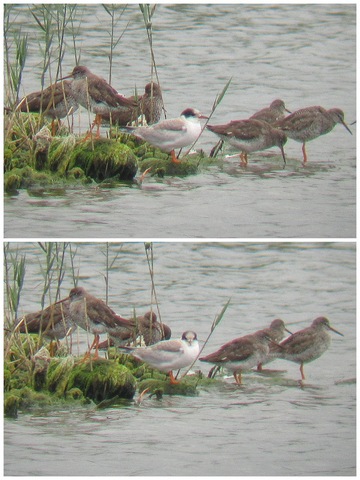
Common Tern Juvenile/Redshank. Conder Pool 2015. Pete Woodruff.

I'm looking forward to seeing this again soon and for the third year on Conder Pool.


Common Sandpiper. Jan Larsson @ Vingspann

Fifteen Common Sandpiper found at Conder Green, seven in the creeks, seven down the Conder channel, and one in a channel on the marsh, they're a week ahead of schedule in double figures this year, it being 6 July last year before eleven were seen. Three Large Skipper and a Speckled Wood, seen in dull and windy conditions they couldn't possibly have been happy about.

A visit to the Lune Estuary at Glasson Dock had a little interest to it, with an impressive count of 14 Little Egret, 4 Grey Heron, a Common Sandpiper intermingling with a small number of Redshank, Lapwing, and a single Dunlin.

Short and Sweet....The End!

Tuesday, 28 June 2016

Stars Of The Green.

The Conder Pool Avocet appear - not too surprisingly - to have lost another chick, they started out with four first reported (LDBWS) 19 June, I saw only three a week ago, and only two yesterday in two visits I made there over 40 minutes.

The Common Tern on the pool have two growing young and I saw them with the parent birds yesterday with fish taken in on one occasion. Interestingly three young Common Tern were reported (FBC) 22 June but not since, in which case they also appear to have lost a chick.


Common Tern. Martin Lofgren @  Wild Bird Gallery 

I also saw an adult Common Tern over the canal basin at Glasson Dock, and minutes later one on the Lune Estuary, seen from the bowling green and which both sightings could have been the same bird from Conder Pool, the only other note on the estuary was 5 Eider.

Also of note during my brief birding spell at Conder Green, more or less returning here on time were 6 Common Sandpiper, and on Conder Pool, c.150 Redshank and a similar 150 Lapwing with 2 Swift over.

The Conder Green Avocets.   

I was quite surprised at some behaviour by the Avocet yesterday when I watched both adults several metres apart both sleeping and with both chicks several more metres away and out of sight of the adults.


Avocet Attack Brian Rafferty

Avocets are well known to be excellent and feisty parent birds, I've observed them taking to flight to attack Carrion Crows almost the length of the pool away at times, and Brian Rafferty's images show the full force of their protective behaviour towards their young against something as big as a Canada Goose.

Many thanks for the consistently excellent images Martin/Brian. 

Saturday, 25 June 2016

Better Late Than Never....Again.

I gave Heysham a couple of hours up to high tide on Wednesday, to check both outfalls prior to the tide coming in, check the harbour, and watch a ferry coming in to dock, to find nothing of note, but being mobbed repeatedly by a Herring Gull as I got towards the south wall, dive bombing whilst calling it's repeated and loud 'kyow' and distinctive 'gag-ag-ag' and intent on making contact with my head but didn't quite actually do so....a pretty unpleasant experience.


Mediterranean Gull. Stuart Piner.

I eventually found 2 Mediterranean Gull, an adult and 1st summer on Red Nab, and an Atlantic Grey Seal seen between the outfalls. Noted coming back through the nature park, a Chiffchaff, Linnet and Common Blue butterfly.


Stonechat. Paul A Walk On The Wild Side Foster

So....not over-rewarded by my visit to Heysham, I was off up to the fringe of Bowland and over the top of Birk Bank with a decent little variety of birds to be found, not least of which were 9 Stonechat seen as two pairs, and a family of five birds too distant to sex/age but certainly no adult male seen with them, so five juvenile or maybe a female and four. Of particular note were 16 Willow Warbler seen/heard, of which up to ten were in the car park at Rigg Lane and included young being fed, and where a Garden Warbler was singing again as it was 24 May when I was there.

I noted a large number of Carrion Crow in the air over Birk Bank, with a single Raven, at least 7 Swift over, and a hovering Kestrel was the only raptor seen. I found young of Great Tit, Coal Tit, and Long-tailed Tit, and flushed a pair of Red Grouse with two young from the undergrowth, but that wasn't as spectacular as the pair with ten young flushed on 24 May on Clougha.

Other birds in an enjoyable three hours up here, 4 Meadow Pipit, 3 Wren, 2 Blackcap, 2 Curlew on a wall probably had young, a Mistle Thrush and a single Siskin flying distant away from me towards Gibson Wood and out of view. Though it was cloudy, 3 Four-spotted Chaser were over the bog with more ovipositing seen.

Definitely a better day up the hill than down it, and there had to be another Stonechat pic....didn't there!!   

Thanks to Stuart and Paul for their excellent images, and to Noushka for the Black Tern header, a brilliant bird in a brilliant image. 

Wednesday, 22 June 2016

Conder Pool's Got Talent.

Difficult to pick a winner yesterday on Britain's Conder Pool's Got Talent, it was a four way split, so I'll put it to the public vote.

The Avocet pair were on guard duties in charge of three young, the bad news being one chick lost already having started off as four. The Common Tern had two young out of the nest and being fed decent sized fish. Next on the scene was the first returning Common Sandpiper, soon followed by the surprise of the day, an adult Little Ringed Plover....Next please!

Also noted on Conder Pool, c.80 Lapwing and 65 Redshank, 3 Wigeon, being two nice drake and a female, a Great-crested Grebe, and a Swift over.  

At high tide Cockersands, on Plover Scar, up to 110 Knot including two 'reddish' birds, 5 Dunlin, 3 Ringed Plover, and two people who took an instant dislike to me - oh dear - when I asked them, if they intended to go out on to the scar again in the coming few weeks, to please be aware of a breeding bird on a nest with four eggs in it, the breeding bird being a Ringed Plover.....The 'please' appeared to fall on stoney ground. 

At Bank End to note, c.1,500 Oystercatcher, 8 Eider, small number of Sand Martin and House Martin around, with a Swift over. 

Butterflies seen between Cockersands and Bank End, at least 55 Small Tortoiseshell, 2 Painted Lady, and a 'blue' which escaped ID, and at Conder Green, 5 Large Skipper and a Speckled Wood. 

The Picture Gallery.  


Adult Common Tern with chick. Conder Pool 21 June. Pete Woodruff. 


Avocet chicks. Conder Pool 21 June. Pete Woodruff. 

Common Sandpiper. Conder Pool 21 June. Pete Woodruff. 

Tuesday, 21 June 2016

Derailed....Again!

Depending on a phone call I might recieve in the next hour, I may or may not get off birding later today. Otherwise I've been derailed once again, meaning no birding and hard to keep Birds2blog afloat....not at all good for my mental state.

Avocet Simon Hawtin

But I was pretty chuffed when I got an e-mail with this brilliant image attached of the equally brilliant Conder Pool Avocet and four chicks on Sunday morning. Your'e too kind Simon, thanks.

Incidentally, a record I'd forgotten was of 2 Avocet on Conder Pool 3 June 2014....well blow me over!


Common Sandpiper Noushka Dufort 

I've been checking my records and noted some dates for Conder Green on a couple of species we're about to find there hopefully in the coming days. Last year the Common Sandpiper had returned to Conder Green three days ago on 18 June, Iv'e yet to see or hear of any back there this year yet. 

Thanks to Noushka for the Common Sandpiper, a superb photograph of this bird showing underwing to excellent effect.

 Spotted Redshank Antonio Puigg  

Last year the Spotted Redshank didn't return until the late date of 7 September, in 2014 it was back 10 days from now on 1 July....all very interesting and has me looking forward to the good times.

Thanks to Antonio for the excellent juvenile Spotted Redshank.

Sunday, 19 June 2016

This, That, And The Other.

With a little time on my hands on Friday I shot off to Conder Green, keen to get my eyes on any offspring's out of the nest on Conder Pool.

The pair of Avocet were still in situ, as were the Common Tern, with one sitting, and the other on guard duty with not a youngster in sight. Also noted, 12 Redshank, a Great-crested Grebe, and the local Kestrel overhead.

A wander around took me on a short stretch of the canal tow-path again, west of Thurnham Mill, where I found at least 20 Large Skipper, 7 Small Tortoiseshell, and 5 Speckled Wood, with a Whitethroat, a male Reed Bunting, and a Common Tern patrolling the canal was presumably a Conder Pool bird....But still no sighting for me of Tuesday's reported juvenile Common Tern on Conder Pool.

The Cockersands Cuckoo.

I was grateful for a text on Wednesday afternoon telling me of a Cuckoo showing well by the entrance track to Tomlinson's Farm at Cockersands. This is obviously a bird starting it's journey south to join another Cuckoo which was tagged in Wales in 2015 which has also left it's breeding grounds earlier than it did last year and is now west of Winchester in Hampshire....I wonder where the Cockersands Cuckoo is now.

The Bowland Grey Wagtail. 


I had an interesting conversation with Martin Jump when he telephoned me on Friday evening to tell me he had seen at least 20 Grey Wagtail on the Marshaw Wyre between Tower Lodge and Trough Bridge. This brings Martins figure added to mine made on two recent visits to Bowland to a combined total of 42 Grey Wagtail from five locations on three birding days.

The Conder Pool Avocet.


Avocet Brian Rafferty  

Three Avocet chicks were out of the nest on Saturday morning Here....Seen as Conder Pool's equally excellent and best record to date with the Common Terns.

Thanks to Martin for the brilliant header image of the Starlings, and to Brian for his excellent Avocet and chick.

Friday, 17 June 2016

Aye Aye Skipper!

Having seen the report of a young Common Tern on Conder Pool on Tuesday, I decided to go take a look for myself on Wednesday afternoon. 

 Large Skipper Male/Female. Pete Woodruff.


But first I took to the canal tow-path at Thurnham Mill and walked to go under the A588 road bridge, at the far side of which I eventually counted 14 Large Skipper all basking on the vegetation with outstretched wings, at which point it started to rain. Lucky for me I was able to take shelter under the bridge where I had to sit out a violent storm which lasted almost an hour with some serious heavy rain, thunder and lightening. 


Large Skipper Male. Pete Woodruff.

After the storm it was no surprise only one of the fourteen Large Skipper could be found, and equally no surprise it was no longer basking with outstretched wings, but gave me a good opportunity to study the underwing markings of a male. 

The storm having passed through, and having escaped the confines of the bridge, I went to look over Conder Pool and saw both adult Common Tern one chasing the other in flight around the island, I've no idea what this was about, but there was no sign of any young. The Avocet were both present and were seeing off an Oystercatcher which had gone too close to the nest, also a pair of Teal were of note on the pool, as was a drake Gadwall, 2 Wigeon, a Great-crested Grebe, and c.40 Lapwing. 

So no evidence for me of any young Common Tern, not seen there yesterday, and I've seen no other mention of the bird to date, but hope to see reports of a result from the Avocet in the next couple of days.

Wednesday, 15 June 2016

Keeping In Touch.

Eight days since I was last on the Lune Estuary....time I got my hand back in there yesterday. 

The day eventually turned decent, and with the sun breaking through, a circuit around Conder Green, a visit to Glasson Dock to look over the river, and a circuit around Cockersands was all quite enjoyable. 

The Avocet and Common Tern on Conder Pool are quietly going about their business of attempting to have a successful breeding programme, though the presence of the semi resident Lesser Black-backed Gull pair, and the sheep now able to trample on and around the islands with the water level considerably fallen, doesn't bode well. 

Also noted on the pool, several Oystercatcher included a pair on the near island which now have two well grown young, 2 Wigeon, a Great-crested Grebe, a Little Egret, male Reed Bunting, 2 Linnet, a Swift over, and the hovering Kestrel seen again.

The Lune Estuary from the bowling green at Glasson Dock is beginning to look a little livelier with c.150 Lapwing back here, 5 Teal, 16 Eider, a Shelduck with 14 young in tow, and uncounted but probably 6 Little Egret seen.

Cockersands at low tide was void of any visible waders, 2 Sedge Warbler and a Whitethroat were the warbler representatives, with 8 Tree Sparrow, 3 Goldfinch, a Great Tit and a Chaffinch around Bank Houses horse paddock.


Large Skipper. Pete Woodruff. 


I was much more impressed with the butterflies than the birds at Cockersands, with at least 50 Large White, 13 Small Tortoiseshell, 6 Large Skipper, and 4 Painted Lady seen.

News from Conder Pool.

According to a report on the Fylde Bird Club website, a young Common Tern seen yesterday, with an adult bird seen to bring in a small fish. Hopefully, Avocet chick/s should be seen here by this weekend.

Tuesday's Negative.


I took this photograph through my telescope from the bowling green at Glasson Dock, these people were distant across at Conder Green with a least 12 hounds. 

There are two issues here....In the first, I picked up one of these minders through my telescope with one of the dogs off the leash at the end of a Mute Swan attack, so unfortunately I saw little of the attack and can't truthfully say whether or not the bird was injured in any way, but the dog was within inches of the bird when the minder called it off, as far as I could see the bird couldn't take off from the water. 

In the second issue, this activity needs to be controlled in areas like this, as can be seen in the pic above they are at the edge of the marsh and onto the mud and in my view shouldn't be there, they can and often do disturb the birds, and in this case today seriously so with the possibility of injury to a Mute Swan.

But the good news, is that I'm aware of a move afoot at last to at least address this problem.